


 Shkruar nga Pamfleti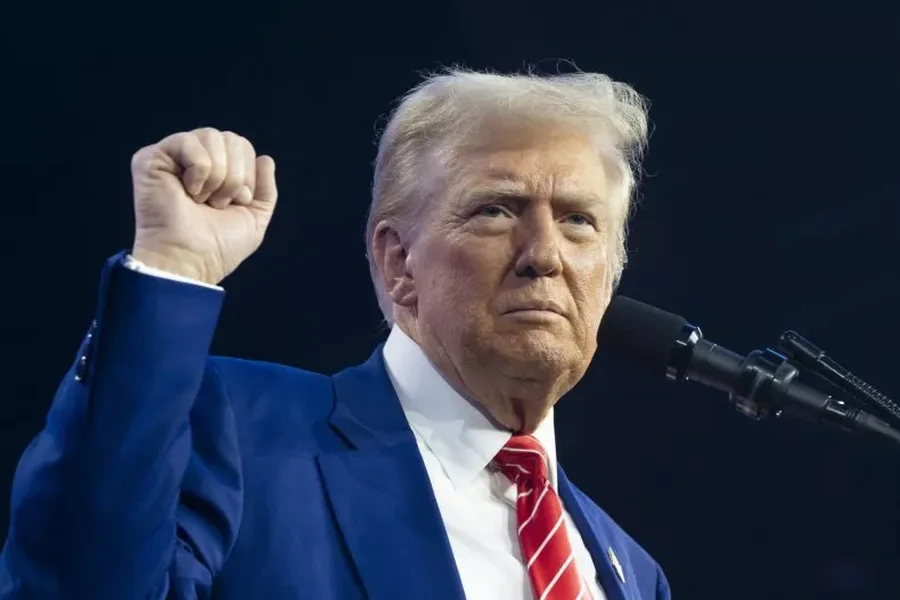
Trump wants to build what was previously technically impossible: missile defense in space. He fears an aggressive Russian-Asian nuclear alliance.
“Ronald Reagan wanted to do this many, many years ago, but he lacked the technology. But now we have it, you can use it to drop a needle from the sky," says Donald Trump. Newsweek magazine quotes the incoming president about his plans to erect a missile defense umbrella over the US; similar to the "Iron Dome" over Israel. Trump is reviving an idea from the 1980s that then-Republican President Ronald Reagan failed with.
Republican politicians apparently connect the need for the realization of this ambitious project with the increased activities of North Korean leader Kim Jong-un in the wake of the war in Ukraine. Analysts suspect he may be paid to provide soldiers and high-tech weapons for nuclear weapons expansion. According to Newsweek, the US is now shifting from a more reactive strategy to increasing prevention; Trump apparently wants to undo Kim's threatening gestures from the start — including the militarization of space.
Fears of Russia, North Korea, China: Trump makes another attempt at 'Strategic Defense Initiative'
This begins where Reagan ignored the former Eastern Bloc with his "Strategic Defense Initiative." The 40th president of the United States wanted to erect a missile defense umbrella in space over the US, which became known as "Star Wars" - an ambitious project that Reagan initiated in 1983 to protect the American nation .
However, after only a few years, it became clear that such a protective shield was neither affordable nor technically feasible. Now Donald Trump is making another attempt at this very goal and is clearly continuing his idea of the American ego.
“Once you start putting systems into space, you never stop. Then the Russians launch systems into space, then China launches systems into space, then China and Russia improve their ability to destroy our space-based assets; so we must have better means of destroying their space weapons," says William Alberque in Newsweek
"First we will defend the homeland," quotes Robert Soofer, the first page from the United States National Defense Strategy (NDS) 2022. Soofer served in the previous Trump administration as deputy secretary of defense, where he was responsible for nuclear defense and rockets.
Soofer insists that the US is inadequately protected in the long term against a long-range missile attack by Russia, China or North Korea. According to him, the risk is "real and growing".
Soofer offers "a possible plan for President-elect Donald Trump to put together the US version of Israel's Iron Dome system."
However, the idea seems half-baked, because the US area in front of Israel is simply too large to guarantee full protection.
Soofer believes it is naive to base US power solely on the threat of retaliation in the hope that North Korea, China or Russia will be swayed by it. He probably comes to this conclusion with other nuclear powers in mind.
"Russia is normalizing a dangerous nuclear discourse," writes Heather Williams. He refers to a CSIS study from early 2024, according to which Russian politicians referred to the use of nuclear weapons in more than 200 cases related to the war in Ukraine.
As the conflict in Ukraine escalates, the threats have become even more serious. Vladimir Putin recently revised his nuclear doctrine - the partnership of a Russian adversary with a nuclear power is enough to justify a nuclear first strike.
Soofer sees the determination needed - on two fronts.
The professor at Georgetown University sees the US threatened on the one hand by an attack by a single enemy, but on the other hand by "a joint or near-consecutive nuclear first strike by China and Russia," as he cites Newsweek.
"As China expands its nuclear forces, defense strategists must ask themselves whether U.S. nuclear forces are sufficient to deter two great powers, perhaps simultaneously, under any circumstances," Soofer said.
His idea calls for an initial investment of $3 billion and up to $5 billion a year for the missile defense agency to buy space-based interceptor missiles and "directed energy weapons," ie, laser cannons.
Given China's diplomatic reluctance and North Korea's estimated limited capabilities, as well as Russia's overestimated capabilities, Soofer also believes the US is initially well positioned.
According to this, the US currently has 44 Ground Based Interceptors (GBIs) spread across the territory.
The Pentagon wants to augment the 44 GBIs with 20 Next Generation Interceptors (NGIs) by 2028.
A GBI is an interceptor missile that is launched from a silo and engages the incoming threat in the atmosphere.
Complementary THAAD (Terminal High Altitude Area Defense) missiles are fired from mobile launchers and operate at lower altitudes. ( Newsweek - Pamphlet from Pamphlet.net)







Lini një Përgjigje