


 Shkruar nga Pamfleti
With this move, Erdogan is playing a dangerous but calculated game.
The arrests ordered on Friday by the Istanbul Prosecutor's Office against 37 senior Israeli officials are just the beginning of Turkey's prosecution of those Ankara accuses of "systematic acts of genocide and crimes against humanity" in Gaza.
At the top of the list is Prime Minister Benjamin Netanyahu, followed by Defense Minister Israel Katz, National Security Minister Itamar Ben-Gvir, Army Chief of Staff Eyal Zamir, and Israeli Navy Commander David Saar Salama.
The names of the other 32 people have not been made public.
According to the official statement, the investigation includes dozens of cases where civilians, including women and children, were hit, as well as the destruction of hospitals, civilian infrastructure and the obstruction of humanitarian aid. A senior Turkish official said that the orders were prepared under direct instruction from President Recep Tayyip Erdoğan and that the process had lasted several weeks.
According to him, the main obstacle was the timing of the publication of the orders, as Turkey was in sensitive discussions with the United States and intermediary countries about the composition of the multinational force expected to be deployed in the Gaza Strip.
"It appears that the president concluded that, given Israel's strong opposition to the presence of Turkish troops in Gaza and the US administration's inclination to support the Israeli position, there was no longer any reason to wait," the senior official said.
A two-pronged strategy: punishment and international affirmation
However, Ankara's move is not separate from Erdogan's broader ambition. He does not see it as a contradiction that, while demanding punishment for Israeli officials, he is also trying to secure Turkey's participation in the peacekeeping force that will oversee the reconstruction of Gaza.
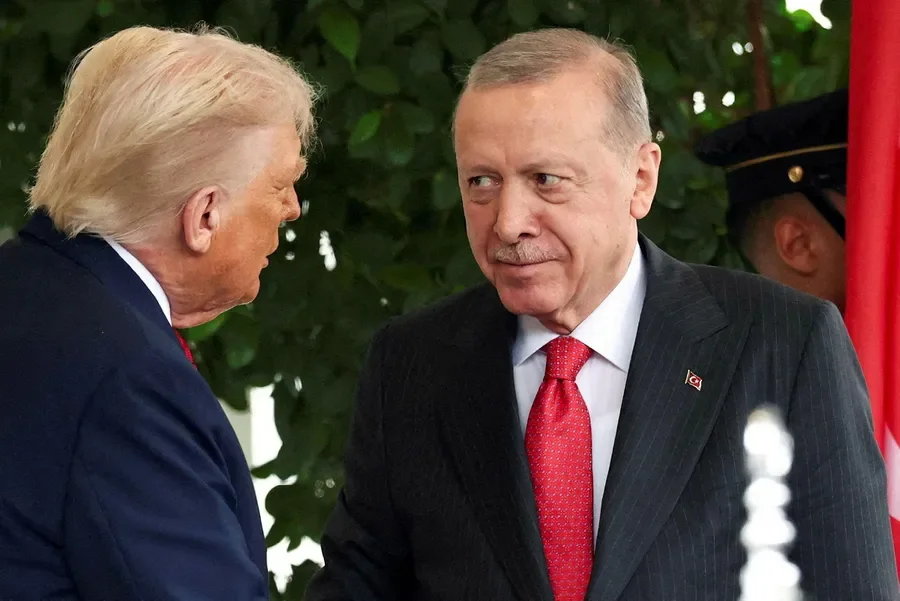
The Turkish president is aiming to strengthen Ankara's position as a pillar of American policy in the Middle East, leveraging close ties with the administration of Donald Trump, who has described Erdogan as a "strategic partner for the peace and prosperity of the region."
This is Turkey's most obvious attempt to return to the center of the Palestinian issue.
For years, Ankara has been excluded from any negotiation process between the US, Israel and the Palestinian Authority.
Even in periods of good relations, such as Erdogan's close friendship with former Israeli Prime Minister Ehud Olmert, Israel has never seen Turkey as a reliable mediator.
Clashes with Egypt and the race for billions
As Turkey tries to gain a role in Gaza's reconstruction, Egypt is viewing this involvement with distrust.
Cairo claims to be the "natural candidate" to lead the reconstruction process, under a structure called the "Peace Board", which will be led by Donald Trump himself.
This process provides significant revenue for Egypt, including employment of Egyptian companies, trade in construction materials, and collection of customs duties on services to be purchased in Gaza.
In this context, a strong Turkish presence is seen as direct economic and political competition.
Add to this the historical rivalries between the two countries:
• Clashes in Libya, where Turkey and Qatar support the internationally recognized government, while Egypt and the United Arab Emirates support separatist General Khalifa Haftar.
• The Turkey-Libya maritime agreement, which once threatened Egyptian gas exports to Europe.
• And, finally, the different position towards Syria: while Erdogan has embraced the new Syrian leader Ahmad al-Sharaa, Al-Sisi continues to maintain his distance.
Egypt’s fear is that, with Trump’s support, Turkey could take effective control of security on Egypt’s border with Gaza, which Cairo considers unacceptable. Not coincidentally, the Egyptian Foreign Minister did not attend the conference organized by Turkey last week on the future of Gaza, although Ankara justified his absence with “previous commitments.”
The decision is in the hands of the White House.
Ultimately, the White House will have the final say on the composition of the multinational force, its command, and the nature of the mandate.
The draft resolution submitted by the Trump administration to the Security Council does not clarify whether the forces will operate under a UN mandate or within the framework of a separate international agreement.
Turkey has warned that its participation will depend on the final wording of the document.
However, Western diplomats acknowledge that Erdogan is likely to exert great influence on how the resolution is implemented, even if it does not fully align with Israel's wishes.
Erdogan's new accounts
With this move, Erdogan is playing a dangerous but calculated game:
• On the one hand, he positions himself as a defender of the Palestinians and a moral leader of the Muslim world;
• On the other hand, it is trying to secure the support of the White House and Trump for a concrete role in the reconstruction of Gaza.
If it manages to maintain this delicate balance, Turkey could return to the center of Middle Eastern diplomacy, after more than two decades of exclusion.
If not, Ankara risks being left out of the table once again where the future of Gaza will be decided, and with it, the role that Erdogan is desperately seeking for himself and for Turkey. / Adapted from The Haaretz



Lini një Përgjigje