


 Shkruar nga Pamfleti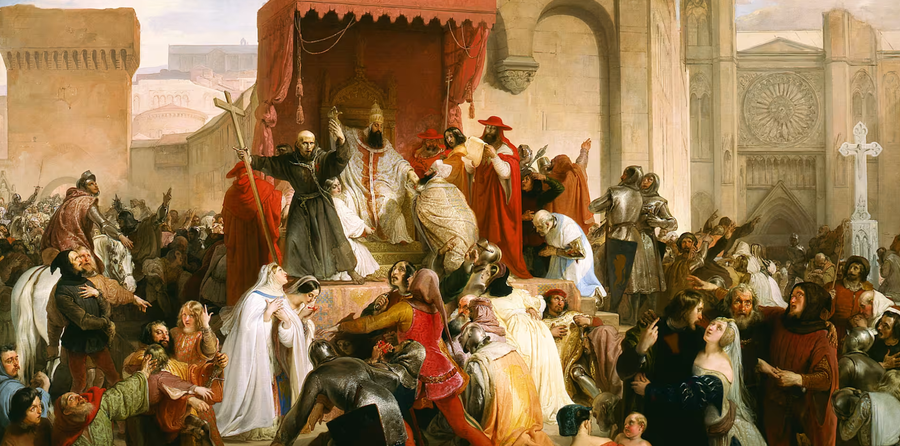
November 27, 1095 - Pope Urban II orders the beginning of the First Crusade
Pope Urban II delivers perhaps the most influential speech of the Middle Ages, inciting the Crusades. He calls on all Christians in Europe to fight against the Muslims to reclaim the Holy Land, saying “Deus vult!”, God wills it.
Born Odo of Lager, Urban was a protégé of the great reformer Pope Gregory VII. Like Gregory, he made internal reform of the Church his main focus, opposing simony (the selling of church offices) and other clerical abuses widespread during the Middle Ages.
Urban proved himself to be a capable and powerful cleric, and when he was elected pope in 1088, he used his masterful leadership to weaken support for his rivals, especially Clement III. By the late 11th century, the Holy Land—the area now commonly known as the Middle East—had become a point of conflict for European Christians.
Since the 6th century, Christians had often made pilgrimages to the birthplace of their religion, but when the Turks took control of Jerusalem, Christians were forbidden from entering the Holy City. When the Turks threatened to conquer the Byzantine Empire and Constantinople, the Byzantine Emperor Alexius I made a special appeal to Urban for help.
This was not the first appeal of this kind, but it came at an important time for Urban.
Seeking to strengthen the power of the papacy, he seized the opportunity to unite Christian Europe under himself while fighting to reclaim the Holy Land from the Turks. At the Council of Clermont, in France, which gathered several hundred clergy and nobles, Urban delivered a rousing speech, calling on the rich and poor to stop their internal strife and join the fight to help fellow Christians in the East and to retake Jerusalem.
Urban denigrated the Muslims, exaggerating the stories of their anti-Christian actions, and promised pardon and forgiveness of sins to all who would die in the service of Christ. His appeal resonated widely, mobilizing the clergy to gather support throughout Europe for a crusade against the Muslims.
Between 60,000 and 100,000 people responded to Urban's call to march on Jerusalem. But not all of those who responded did so out of piety: European nobles were tempted by the prospect of increasing their property and wealth through conquest.
They were responsible for the deaths of many innocents, both on the way to the Holy Land and once there, by appropriating the wealth and property of those they easily considered opponents of their cause.
Adding to the casualties was the lack of experience and discipline of the Christian peasants against the trained and professional Muslim armies. For these reasons, the Christians were initially defeated, and only through sheer force of numbers did they ultimately triumph.
Pope Urban died in 1099, two weeks after the fall of Jerusalem, but before news of the Christian victory reached Europe. His was the first of seven major military campaigns waged over the next two centuries, known as the Crusades, the bloody aftermath of which is still felt today. Urban was canonized by the Catholic Church in 1881.
Other important events:
November 27, 1895 - Alfred Nobel, the Swedish inventor and industrialist, signed his will, leaving most of his fortune to the establishment of the Nobel Prizes. In this document, he ordered that prizes be awarded annually for outstanding contributions in medicine, physics, chemistry, literature, and peace.
November 27, 1901 - The U.S. Army War College is established in Washington.
November 27, 1940 - Bruce Lee, famous actor and martial arts master, was born in San Francisco.
November 27, 1942 - The French Navy scuttled its fleet at Toulon to prevent the ships from falling into the hands of Nazi Germany after the fall of the collaborationist Vichy government.
November 27, 1971 - The Soviet space probe Mars 2 becomes the first man-made object to reach Mars. But it crashes hard into the surface of the red planet, failing to return to Earth.
November 27, 2001 - A hydrogen bomb is accidentally dropped from a US Air Force bomber shortly after takeoff from a base in North Dakota. Fortunately, the bomb does not explode.
November 27, 2001 - US special forces launch their first major ground operation in Afghanistan. It was a response to the September 11 terrorist attacks and aimed at destroying the Taliban regime.
November 27, 2006 - The Canadian Parliament passes a resolution recognizing French-speaking Quebecers as a nation within a united Canada./ Prepared by Pamphlet



Lini një Përgjigje