


 Shkruar nga Pamfleti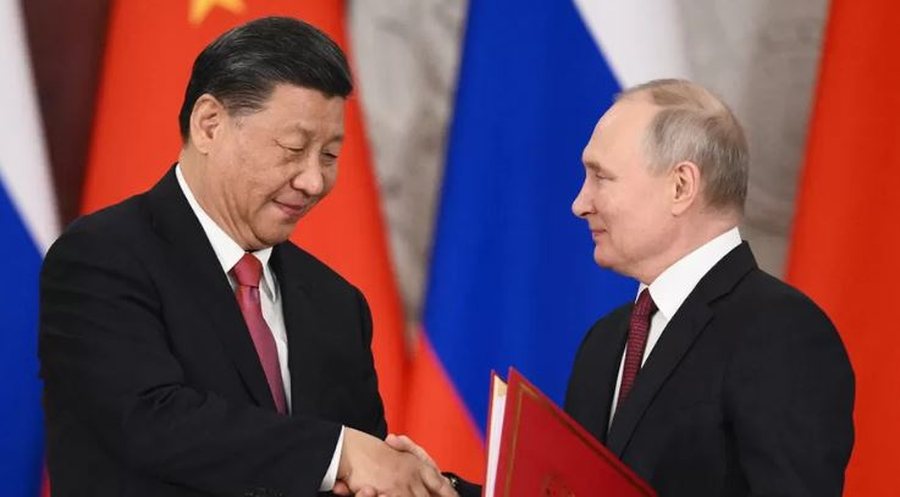
The International Republican Institute, based in Washington, has been fighting against malicious foreign influences in the Western Balkans for several years.
Experts from the Balkans who work with the American organization say that while Russia has engaged in fomenting crises in the Balkans, China has succeeded in expanding economic cooperation with a complete lack of transparency and undermining, among other things, the rule of law.
Colleague Artan Haraqija talked to two of the Balkan experts who were recently in Washington and announced that the Russian and Chinese influence in the region has some similarities but also differences.
Accusations that Serbia is a satellite country of Vladimir Putin's Russia have been heard frequently. There were also international newspaper headlines such as that of "Foreign Policy" from 2019 that "There is a country in Europe where Putin is a rock star".
But especially since the start of the Russian aggression in Ukraine, Belgrade, which over the years has followed a dualist policy between the West and Russia, has given priority to another ally, China.
For several years, the European Parliament has raised the alarm bell about "the growing influence of China in Serbia and the entire Western Balkans".
The Washington-based International Republican Institute has been engaged for several years against malign influences in the region.
Stefan Vladisavljev, from the Belgrade Foundation for Good Politics and Dan Ilazi, from the Kosovo Organization for Security Studies are two of the Western Balkans analysts who have engaged with the International Republican Institute Working Group.
"Russia's intention in Serbia is to cooperate with some local actors behind the scenes or those involved in politics, to damage the process of democratization and European integration. What China is currently doing is implementing that type of capital that damages Serbia's economic, political or social structure and democratic governance," says Mr. Vladisavljev.
Although Serbia and China lack the historical and religious ties that Belgrade has with Moscow, Serbian dependence on Beijing, according to Mr. Vladosavljev, has already reached the value of billions of Euros. Only during the last visit to Beijing by the Serbian President, Aleksandar Vucic on October 17, Mr. Vladosavljev says that agreements worth 4 billion dollars were reached. One of the many problems with this, according to him, is the lack of transparency, since a number of agreements that Belgrade has signed over the years with Chinese companies have not been published or discussed at all before signing.
Now, quite a few Serbian cities where Chinese companies have been located for several years are facing the consequences of these contracts. The damages are numerous, from environmental and health issues of the surrounding residents to the treatment of the workers engaged in the projects.
"The main problem is that official Belgrade is not even admitting that there are some aspects of cooperation with China that are not in Serbia's favor. The only opposition at the moment is being made by civil society and the local government of the cities that are most affected since Chinese companies are present there," says Mr. Vladisavljev.
"I think that what we have achieved in the People's Republic of China has historical character and meaning", says Serbian President Aleksandar Vucic in one of the videos published on his YouTube channel about his visit to China on October 17.
The Chinese President, Xi Jinping, during the meeting in Beijing with the Serbian leader, said "President Vučić has been friendly with China for a long time and Serbia has become a 'steadfast friend' of China".
While Serbia's negotiations with Brussels for EU membership have stalled, the International Republican Institute in one of its assessments says that the government in Serbia is offering a distorted picture of Chinese investments and loans, attributing to this almost all the economic development it has had. Serbia in recent years.
According to the American organization and Balkan experts, the numerous Chinese projects, especially in infrastructure, have made it impossible for the opposition parties to criticize this cooperation due to the risk of being accused by the government of being against Serbia's economic development.
Kosovo, on the other hand, has no direct influence from China, while according to Mr. Ilazi, even the efforts that have been made through neighboring countries such as Albania and North Macedonia, have not been successful, especially appreciating the work of the security bodies. But, says Mr. Ilazi, the idea that these efforts do not exist is completely wrong.
"The reason for this is that when it comes to Kosovo, there is a meeting point between the European extreme right and China and Russia. They share a goal, which is the weakening of the European integration process, the weakening of the American and NATO influence in the region and, in general, the weakening of the public's trust in the region towards European values, towards the process of integration or membership in the EU", says Mr. Ilazi.
" The Serbs deserve a great deal of gratitude, these people who today protect our identity, in reality the Serbs protect all of Europe, our common civilization ", this was the message of a European deputy, representative of the French extreme right, Nicholas Bay while visiting Kosovo in 2022, in visits and meetings with members of the Serbian community.
This video on his YouTube channel, as well as other representatives of the extreme right from non-political organizations, try to create the idea that what is happening in Kosovo is a religious war between Albanians, mainly Muslims of Kosovo, and Christian Serbs.
"These are precisely positions that are in line with Russia's goal and that Russia has constantly encouraged in relation to Kosovo", says Dan Ilazi from the Kosovar Center for Security Studies.
The authorities in Kosovo have often accused Belgrade that, especially in the north of Kosovo, Serbia with the help of Russia is trying to create a new war zone in Europe. The incident in Banjska, in the north of Kosovo, at the end of September is one of the examples that, according to Pristina, confirms this. For Serbian analyst Stefan Vladoslavljev, all of this remains speculation while this matter is not properly investigated, but he believes that in the north of Kosovo there are groups with ties to Russia.
"What has been seen and confirmed in the past is that some paramilitary groups and some actors linked to Russia have been present in the north of Kosovo and that they have had contact with people who were linked to the attack in Banjska. Russia, generally in the whole region it has been playing a damaging role for much longer than the recent incidents and it is undoubtedly an actor that does not want a clear solution in the normalization process. Moscow obviously benefits the most if things get worse from this moment.
" "a very effective way to prevent these narratives against Kosovo that are instigated especially by Russia is for Kosovo to have a stable solution to the disputes it has with Serbia. The solution to the disputes with Serbia gives a significant blow to Russian efforts as well", Dan Ilazi assesses . from the Kosovo Center for Security Studies./ VOA





Lini një Përgjigje