


 Shkruar nga Pierre Haski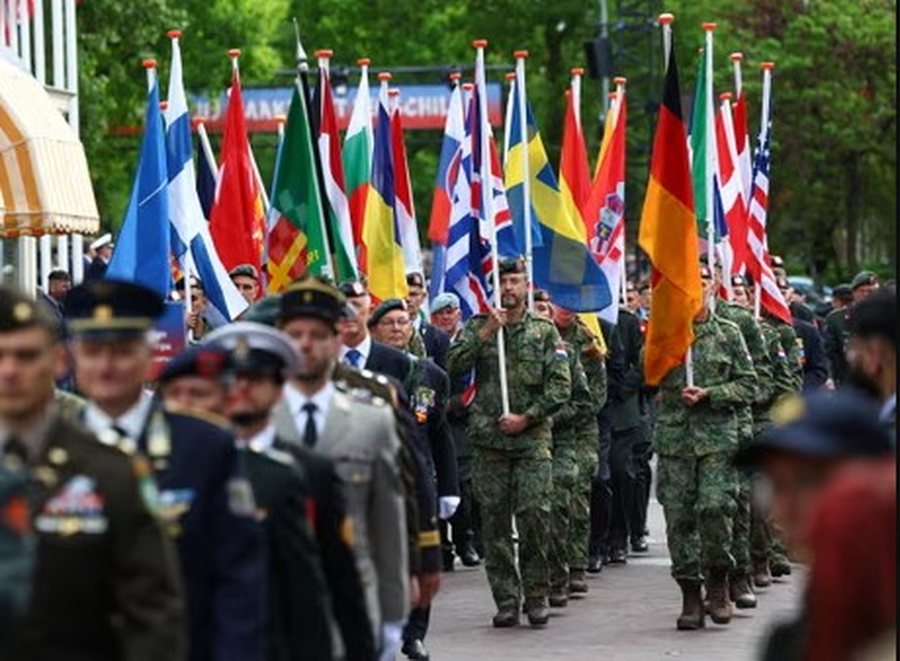
In reality, we are living in a phase of complete reformatting of the world.
If there is one anniversary that should unite rather than divide, it must surely be that of the end of World War II. In 1945, the Soviet Union, the United States, and their European allies emerged victorious from the battle against Nazi Germany.
A few months earlier, Franklin Roosevelt, Winston Churchill and Joseph Stalin had immortalized their alliance in a photo taken in Yalta, in Crimea, which was then part of Soviet territory. The aftermath is well known to all: the Cold War, the fall of the Berlin Wall, the melting of the ice between the two opposing blocs, and finally the return of the “ice age” between East and West.
In these conditions, even the celebration of the victory over Nazism has become divisive. Eighty years after that event, on May 8 in Europe, and on May 9 in Moscow - due to the time difference - the commemoration of the victory has the taste of gunpowder: the war has returned to the continent, paradoxically pitting the allies of 1945 against each other.
What complicates the situation is the fact that the United States, the leader of the "free world" - as it was once called during the Cold War - finds itself with Donald Trump at the helm, who is seriously questioning the international order built in 1945 by moving closer to a controversial alliance with Russia.
In Moscow, the diplomatic theater becomes more symbolic. Three years after the invasion of Ukraine, Vladimir Putin wants to show the West that their attempt to isolate him has failed. His Chinese friend Xi Jinping, the leader of the world's second-largest economy, has been in Russia since Wednesday.
Chinese soldiers will march alongside Russian troops in Red Square. Other foreign leaders have decided to attend Moscow, including the prime minister of a European country, Slovakia's Robert Fico, who has stepped out of line to applaud the Russian military parade as Ukraine continues to be bombed.
The same goes for Aleksandar Vučić, the president of Serbia, a candidate country for membership in the European Union, who nevertheless puts Slavic nationalism before any other consideration.
But Putin's big victory is represented by the participation of Brazilian President Ignacio Da Silva Lula, who by going to Moscow thinks he is advocating a kind of non-engagement, but in reality is openly approving Russia's violation of the United Nations Charter.
This stance of Lula is also linked to an anachronistic anti-imperialism. In reality, we are living in a phase of complete reformatting of the world. Institutions born after 1945, such as the United Nations, are in crisis, while power relations are once again dominating the international scene, as they did in the 19th century.
Today there are not just two blocs, as in the Cold War, but we have a fragmented world that still does not know how this story will end. With his chaotic aggression, US President Donald Trump has accelerated the decomposition of the world order.
The May 9 Club in Moscow is benefiting from the deterrent effect of Trumpism. Of course, among the biggest beneficiaries of the situation are President Xi Jinping and Russian President Vladimir Putin. Two years ago, they announced that the world was experiencing changes not seen for a long time, and that China and Russia were the two main forces behind this change.
Meanwhile, the current president of the United States is behaving in a way that has revived their ambitions. On May 9, Europeans will prefer another holiday, that of “Europe Day”, to commemorate the 75th anniversary of the Schuman Declaration, the birth certificate of the European project. Each one honors its own symbols. This too is called the Cold War./ Adapted from “Pamphlet” by “France Inter”


Lini një Përgjigje