


 Shkruar nga Pamfleti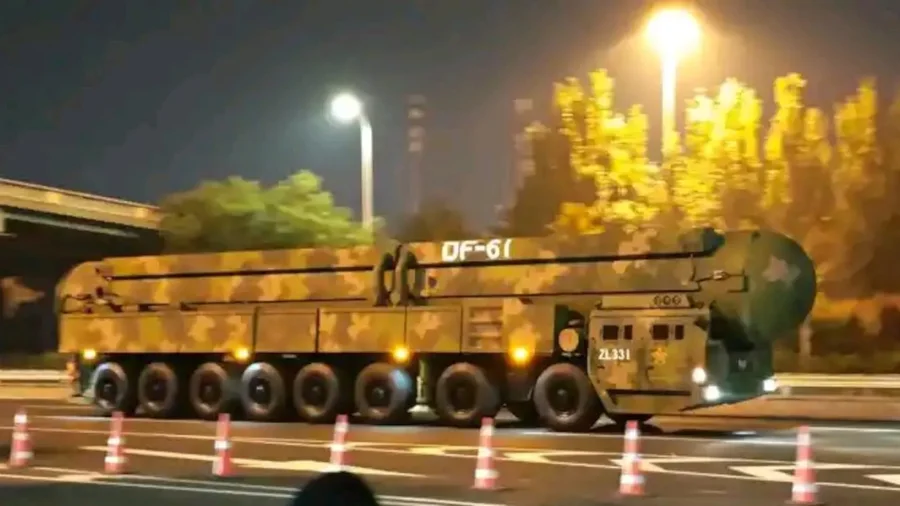
Images of China's new DF-61 intercontinental ballistic missile have been released, bolstering Beijing's nuclear arsenal.
China has raised international alarm after the first images of the DF-61, a new intercontinental ballistic missile (ICBM), emerged, which experts say signals a major step in strengthening Beijing's nuclear arsenal.
Images published online show 16-wheeled vehicles equipped with containers marked with the initials DF-61, which immediately sparked speculation that this is the successor to the DF-41, currently China's most powerful missile.
Features of DF-61
According to CSIS (Center for Strategic and International Studies), the DF-61 has a length of about 20 meters, a range of between 12,000 and 15,000 kilometers and is capable of carrying up to 10 MIRV (Multiple Independently targetable Reentry Vehicles) nuclear warheads, capable of hitting different targets at the same time.
The missile was first displayed in a military parade in 2019, although its development is thought to have begun before 2000. In 2020, US General Anthony Cotton warned Congress that Beijing was developing a “new generation of mobile ICBMs,” more powerful than existing ones.
Security expert Rick Fisher told the Washington Times that the missile "is designed to outperform the DF-41" and that such a weapon "would change the global strategic balance."
China's "nuclear triad"
The DF-61 is part of what Chinese state media has called a “three-in-one strategic nuclear force,” which combines land-based, submarine-launched, and air-launched missiles. In recent military parades, the DF-61 has also been displayed:
-JL-1 and JL-3 missiles launched from submarines,
-DF-31 land-based ballistic missile,
-as well as the DF-17 and YJ-21 hypersonic missiles.
This grouping demonstrates Beijing's ambition to openly challenge the US, ensuring that in any case of conflict, the country has the capability to strike nuclear weapons from land, sea, and air.
Investments in modern weapons
China has also displayed anti-ship missiles, including the YJ-19, YJ-17 and YJ-20, tested against US aircraft carrier models, as well as advanced cruise missiles Changjian-20A, YJ-18C and Changjian-1000, which Beijing says have "all-weather combat capabilities."
Defense experts point out that Beijing is investing massively in modern warfare technologies - from drones and underwater robots, to hypersonic systems, making the nuclear race with the US and Russia more tense than ever before. /Adapted from "Il Giornale"








Lini një Përgjigje