


 Shkruar nga Pamfleti
Israel's triumph in the Six-Day War of 1967 was met with "three NO's" at an Arab summit in Khartoum: No peace with Israel; There is no recognition, there is no negotiation!
The war in Gaza appears to be having the opposite effect, US officials say. Saudi Arabia, the most important Arab state, is saying yes to peace, negotiations and recognition of the Jewish state - if Israel agrees to a "clear and credible path" to the creation of a Palestinian state in the West Bank and Gaza Strip.
There may be two more YES on offer: YES to Arab security guarantees to Israel, beyond diplomatic relations; and YES for Arab states' help in reforming the Palestinian Authority, so that it is fit to run Gaza.
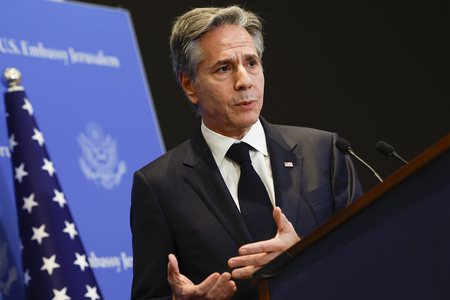
That's the message sent to Israel this week by Antony Blinken as he traveled to the Arabian Peninsula again, his fifth regional tour since the October 7 attack by Hamas. But judging by the contemptuous reaction of Israeli Prime Minister Binyamin Netanyahu, Israel is now an opponent of peace.
The outlook in the Middle East looks dire
Iran's allies in Lebanon are constantly exchanging fire with Israel; and those in Syria, Iraq and Yemen have attacked US forces, provoking rounds of retaliation, before and during Blinken's trip to the region.
More than 27,000 Palestinians are reported dead in Gaza. Most of the population of the territory is displaced and faces disease and hunger. Israel is accused of genocide in the International Court of Justice. In the eyes of many, America's reputation has also been tarnished by President Joe Biden's support for Israel.
However, Blinken is seeking to turn the horror of Gaza into a chance for peace. US officials seemed delighted by their talks with Saudi Arabia's Crown Prince and de facto ruler, Mohammed bin Salman.
Blinken brought hopeful news
On February 6, the emir of Qatar told him that Hamas had responded to a hostage deal drawn up by Israel, America, Egypt and Qatar. The response was considered "positive" by Qatar and promising by Blinken (although there were rejections at first). However, Netanyahu dismissed it as an "illusion".
The problem is whether the fighting will continue after the ceasefire, as Israel wants. Hamas insists on a permanent ceasefire and Israel's withdrawal from Gaza.
The most likely compromise is a phased implementation. America's hope is that even a temporary pause will change the mindset of both sides, allowing them to consider "TOMORROW."
This puts the spotlight back on Netanyahu, who has declared his intention to fight for "absolute victory" and his opposition to a Palestinian state.
"Tomorrow is the day after Hamas. All of Hamas," he said. Arab leaders want America to put more pressure on it.
America wants Israel to agree to "a practical, time-bound and irreversible path to a Palestinian state" as part of a deal between America, Israel, Palestine and Saudi Arabia. America would offer a defense treaty with Saudi Arabia and civilian nuclear technology.
Blinken said Arab states were offering unspecified "security guarantees" to Israel. These are unlikely to include a formal treaty of mutual protection; The Gulf states do not have large armies, nor do they want to be at the forefront of an American-Israeli confrontation with Iran.
But informed sources suggest that options could include more cooperation, in terms of information sharing, a joint air defense zone and joint military exercises.
Some of this is already happening, but the aim would be to make it more visible and institutionalized.
Blinken said that the Arab states were willing "to make concessions to Israel that they were never prepared to make in the past"; America would agree to do the same.
Moreover, Arab states seem willing to help reform the Palestinian Authority.
Some Arab sources suggest that Jordan could help train Palestinian security forces and the United Arab Emirates could help improve the administration of the Palestinians.
Arab states have made it clear they will not send peacekeepers to Gaza even when the Israelis leave; nor will they pay to rebuild Gaza unless there is an Israeli commitment to Palestinian statehood.
However, they seem to understand that they must take more responsibility for solving the Palestinian issue, or risk Iran and other radicals using it to their advantage.
In private, Netanyahu is said to be more flexible than he lets on publicly. Could you feel compelled to say yes to the Saudis? And if he refuses, would those who replace him be more willing to do so? For now, neither Blinken nor anyone else is sure./ Taken from The Economist






Lini një Përgjigje