


 Shkruar nga Pamfleti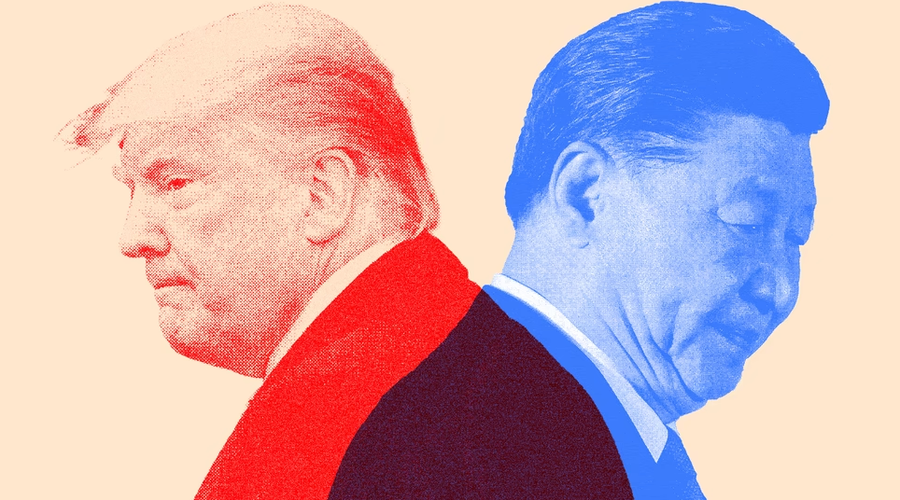
The tariff wall erected by Donald Trump paradoxically contributes to making it easier for China to bypass the United States. But Beijing's new claims, if they materialize, should be viewed with caution...
Conflicting messages from the White House have emerged since April 2, when Donald Trump launched an unprecedented trade war.
The confused escalation initiated by the US president can only reinforce China's belief that it must reduce its dependence on the United States as much as possible. Even if the fever eventually subsides, it has created an entirely new situation, conducive to a long-seemingly impossible decoupling of the world's two largest economies.
Everyone in China, from top executives to small business owners, can only appreciate the risk that exposure to the US market now poses. Since new tariffs imposed on the Asian giant began to take effect, Chinese exporters have been scrambling to find new markets that can take over from American consumers.
Chinese President Xi Jinping's tour of Vietnam, Malaysia and Cambodia shows that Beijing is seeking to strengthen its trade ties with more reliable partners. The European Union and major developing countries are also concerned. Brazil is a case in point, having already surpassed the United States as China's largest supplier of agricultural products.
The tariff wall erected by Washington forces any target country to look elsewhere.
Therefore, Donald Trump is paradoxically contributing to facilitating the advent of a world that aims to bypass the United States. This great realignment is not just about trade.
Washington's withdrawal from international organizations, its now-declared contempt for the established international order, for historic alliances and American commitments, such as support for Ukraine in the face of Russia, also fit into this perspective.
Beijing can only be content to abandon the American soft power it has targeted. This is evidenced by the sudden closure of Radio Free Asia, which played a central role in informing the Uyghur community. By suggesting that it is ready to relinquish, out of weariness or fatigue, its decades-long central role in world affairs, the United States is creating a vacuum into which China may be tempted to step.
Since the beginning of Donald Trump's second term, Beijing, which had already denounced the blind support given by the United States to Israel, despite the bloody destruction of Gaza, has presented itself as the moral high ground.
But the new Chinese claims, if they materialize, should be viewed with caution, even in the face of the global crisis created by Donald Trump.
Because Beijing's trade policy, which aims to sell at all costs the excess production that sluggish domestic demand cannot absorb, continues to threaten jobs in Europe, as in many other countries.
And Xi Jinping's disastrous human rights record remains more than ever an obstacle for many democracies, including European ones. Compromises with Beijing will undoubtedly be necessary to curb American disorder, but China remains too weak to lecture the world. / Adapted from Pamphlet by Le Monde /



Lini një Përgjigje