


 Shkruar nga Pamfleti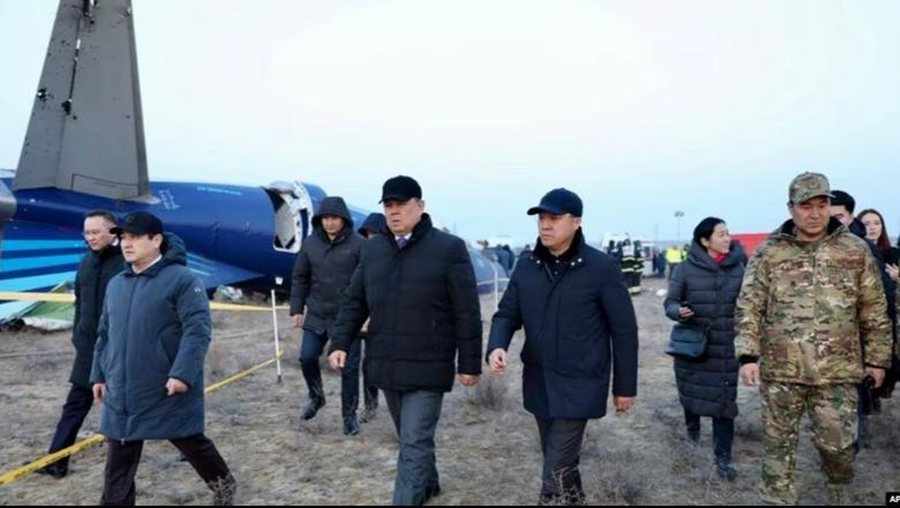
When a passenger plane with 67 people on board crashed off the coast of Kazakhstan on the morning of December 25, Russian media and authorities were quick to highlight the possible causes: thick fog, a bird strike and an exploding oxygen tank. in the cabin.
However, mounting evidence suggests that the Azerbaijan Airlines plane, which was en route from Baku to Grozny, the capital of the Russian region of Chechnya, may have been hit by an anti-aircraft missile that was defending itself against an alleged Ukrainian attack by drone in Chechnya before crossing the Caspian Sea and crashing near Aktau in Kazakhstan, killing 38 passengers and crew the crew.
The evidence, much of which has not been confirmed by authorities in Azerbaijan, Kazakhstan or Russia, includes footage of the plane's interior before it crashed, photographs showing holes in the plane's tail after the crash, comments from a survivor, and testimony left by it is understood that a drone strike was suspected at the time the plane attempted to land in Grozny.
If a surface-to-air missile is confirmed to be the cause of the crash, it would be the second time a Russian missile has downed a passenger plane since Moscow's war in Ukraine with the annexation of the Crimean Peninsula and the conflict in Donbas began a decade ago before.
A Russian missile brought into territory controlled by Moscow-backed forces in Donetsk shot down Malaysia Airlines flight MH17 on July 17, 2014, killing all 298 passengers and crew.
After the crash, Russia unleashed a barrage of false claims and outlandish theories about the cause.
"Exposed to GPS jamming"
The plane took off from Baku before dawn with 62 passengers and five crew members. The short flight northwest to Grozny appeared to be uneventful for half an hour, but then the plane "encountered major obstacles in [Global Positioning System] GPS signals," according to Flightradar24, a site that tracks air traffic around the world. .
The site said that from that moment until about 20 minutes before impact with the ground, Flightradar24 occasionally failed to receive data from the plane and on other occasions received data but details on its location were inaccurate or missing.
"The aircraft was exposed to GPS jamming and spoofing near Grozny," Flightradar24 said.
While these measures themselves are unlikely to have caused the crash, they are a sign that efforts were made on the ground to defend against a drone strike.
A Chechen opposition Telegram channel and Baza, a Russian media outlet linked to the security services, reported a drone strike in Grozny around the time the plane was in the area.
The base also reported that Grozny airport stopped accepting aircraft due to the alleged attack.
Open source researchers confirmed drone strike in Chechnya via geolocation.
An Instagram account run by Chechen Security Council secretary Khamzat Kadyrov – who is the nephew of autocratic regional leader Ramzan Kadyrov – posted a post saying a drone strike had been successfully repelled.
The post also contained a video of what the account claimed was a drone being hit and bursting into flames. This post was later deleted.
State media Grozny-Infrom, referring to the same Instagram post, reported that Khamzat Kadyrov wrote that "all [drones] were shot down."
"Something blew up"
According to a transcript of radio exchanges between the plane's crew and emergency services in Grozny, which was released on December 25 by the Telegram channel VChK-OGPU, which has been declared a "foreign agent" by Russia, the crew reported that had lost control over the plane due to a "bird attack".
The reporting of the VChK-OGPU and the authenticity of the transcript could not be verified. Even the channel itself casts doubt on the possibility of the birds hitting the plane, as it said on December 26 that visible damage to the tail of the plane after its crash "indicates that a missile launched by an air defense system likely exploded near the plane."
A surviving passenger told Russian state channel RT that the plane made three attempts to land in Grozny and that on the third attempt “something exploded…. I wouldn't say it was inside the plane” and that a piece of shrapnel flew between his legs and pierced his life jacket.
The pilots diverted the plane from Grozny, while the transcript showed that they asked the weather control tower in Mineralnie Vodi and Makaçkala, two cities relatively close.
But the plane eventually headed east and crossed the Caspian before crashing near Aktau at 11:28 a.m. local time, about an hour after first reports that a drone strike in Grozny had been repelled.
A video of the plane falling and then crashing into the ground shows it was intact and not engulfed in flames until it crashed. Post-crash photographs and footage of the plane's tail section show multiple holes, tears and scratches that observers say look like shrapnel damage.
The edges of the holes are curled inward, suggesting that the explosion occurred outside the plane, not inside the cabin.
Military analyst Yan Matveyev told Current Time that the explosion of a Russian Pantsir S-1 missile at a distance from the fuselage may have caused the damage.
In addition, footage from inside the plane before the crash shows significant damage.
According to The Wall Street Journal, UK-based aviation security firm Osprey Flight Solutions said in an alert to airlines that the plane "may have been brought down by a Russian military air defense system".
"Video of the downed aircraft and the circumstances surrounding the aerospace security environment in southwestern Russia indicate that it is possible that the aircraft was hit by some form of anti-aircraft fire," Osprey chief of intelligence Matt Borie was quoted as saying by the Journal.
The plane "was shot down by a Russian air defense system," wrote Andriy Kovalenko, head of the Counter-Disinformation Center at the National Security and Defense Council of Ukraine, in a post on X on December 25.
He did not provide evidence beyond footage, media reports and information from existing open sources.
Ukraine has carried out numerous drone attacks on military targets in Russia since Russian President Vladimir Putin launched a full-scale invasion in February 2022. Drone attacks in Chechnya and other parts of the North Caucasus have increased in recent months.
Authorities in Kazakhstan, Russia and Azerbaijan have said they will not comment on the cause of the plane crash until the investigation is complete, and Putin's spokesman, Dmitry Peskov, urged others not to air "hypotheses."
In Chechnya, Ramzan Kadyrov did not say more than the expression of condolences./ REL




Lini një Përgjigje