


 Shkruar nga Claudiu Pop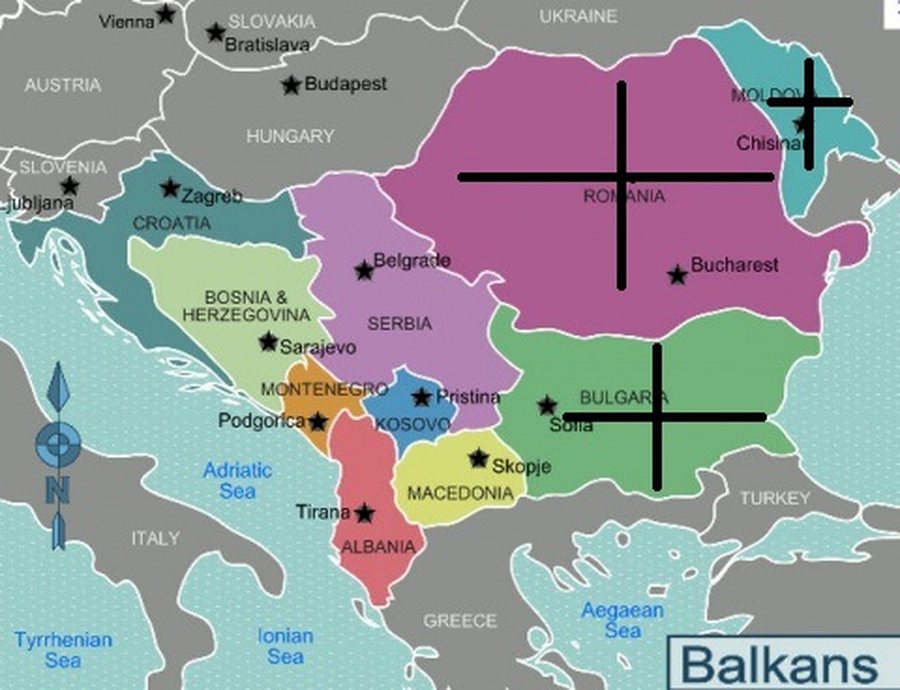
Bulgarian naivety and Romania's outdated army
Like a scientist who can't seem to find a cure for cancer, the Western world has been trying for a long time without much success to find an antidote to Vladimir Putin's tyrannical regime and its negative influence on Europe.
This geopolitical "stability" prompted Andrei Pleșu, founder of the Romanian cultural magazine "Dilema Veche", to republish an article entitled "Weaknesses of the West", a decade after its first publication. Among the many "imperfections" of the West, Plesu mentions the large set of rules, their objectivity but also their naivety to go so far as to admire leaders like Putin.
And in the end, the "diplomatic" relations between the Russian Federation and the rest of the world resemble the effort of a distinguished lady dancing a tango with a hungry tiger. "This is how things end badly" - concludes Pleșu's analysis. Expressing her opinion in the same issue of "Dilema Veche" magazine, anthropologist Anca Manolescu is in the same line with him.
But she is more specific when it comes to showing what Europe is not doing well, starting with a quote from Lithuanian Foreign Minister Gabrielius Landsbergis. "The bell has rung for a long time, but we haven't gotten out of bed yet," warned Landsbergis (of the center-right Union of the Fatherland party) during an interview with the correspondent Ines Trams of German television ZDF.
Therefore, Manolescu thinks that Europe should "act faster, more widely and more decisively". It is enough to look briefly at the situation in Southeast Europe to see that the West has much more work to do in its fight against Russia's malicious efforts.
Putin continues to greatly influence Moldova
First, pro-Russian regions in Moldova are problematic. Shortly after the liberal government in Chisinau faced rumors of a Russian invasion of Transnistria, authorities saw Evghenia Guțul, the pro-Russian leader of the autonomous Moldovan Gagauzia region, meet with Vladimir Putin in Sochi.
After returning home, Guțul claimed to have reached an agreement with the Russian company Gazprom to buy cheap gas for Gagauzia. In response, Moldovan investigative newspaper Ziarul de Gardă quoted Moldova's pro-European Prime Minister Dorin Recean, who described the leaders of Gagauzia as a "criminal group" making "false promises" and who should be brought "to justice".
On the bright side, more and more Moldovan churches are leaving the Metropolitanate of Moldova, which is under the Russian Orthodox Church, to join the Metropolitanate of Bessarabia, which is under the Romanian Orthodox Church. The main reason for this is Russia's involvement in the war against Ukraine.
"The Russian Orthodox Church is directly involved in the war in Ukraine, creating its own army of mercenaries, which it trains in the Church with special forces instructors and then sends them to fight in Ukraine," declared the liberal mayor of the Moldavian town. Răuțel.
Bulgaria has played in favor of Putin
Second, Bulgaria's naivety in allowing Russia to build a gas pipeline through its territory gave Putin a way to supply Serbia and Hungary, which have not for a moment stopped trading with Russian gas as happened to most of the European customers of the company "Gazprom".
As the editor Ivaylo Stanche points out, the Bulgarian newspaper "Capital" received several debunked documents that prove that Russia aggressively dictated the construction of the Turkish Stream branch through Bulgaria.
One of the biggest defenders of the pipeline was the conservative Boyko Borisov (head of the center-right Citizens for European Development of Bulgaria, GERB), Prime Minister of Bulgaria between 2017-2021. The TurkStream gas pipeline has been operating in Bulgaria since 2021.
Romania's obsolete army
When we talk about Romania, one of its weaknesses is the poor state of the army. The latest data published by journalist Andrei Udișteanu on the Romanian investigative platform Recorder, shows that at least 130 military trucks used by the country's army are over 40 years old.
One of these old trucks had a breakdown in 2017 which caused the death of 3 soldiers. "Romania is not ready. Neither politically, nor militarily, nor economically. It is not ready to take a leading role in European and transatlantic security policy," Goșu told journalist Carolina Drüten, reporting for the Romanian online publication PressOne./ Adapted Pamphlet from "Voxeurop.eu"




Lini një Përgjigje