


 Shkruar nga Pamfleti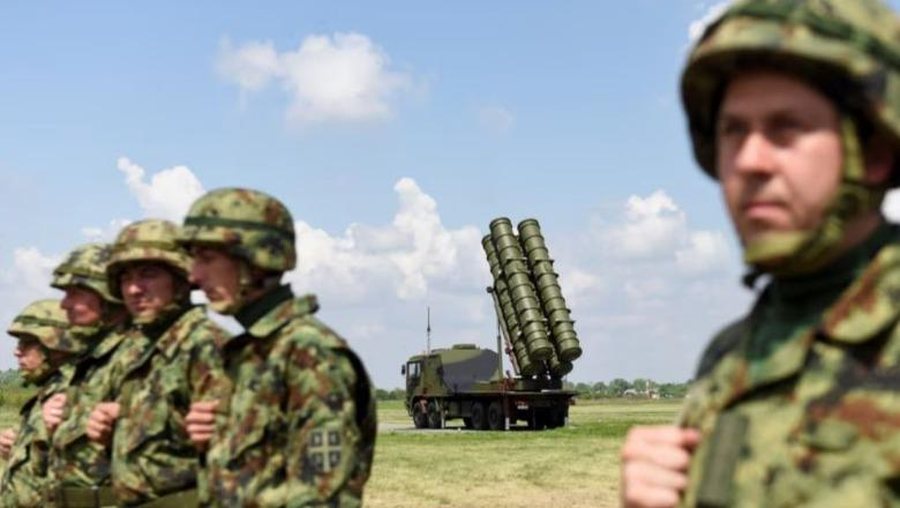
"A deterrent against any potential aggressor from the neighborhood."
This is how Serbian President Aleksandar Vučić justified the need for new weapons purchases that he considered this week while participating in a military parade in Beijing.
He met there with the President of China, Xi Jinping, and said he used his participation in the parade to see "what would be interesting to purchase for the needs of the Serbian Army."
Serbia cooperates extensively with China in the defense sector, and its arms purchases from this country have drawn criticism from the European Union - which Serbia seeks to join - and the United States.
According to the Stockholm International Peace Research Institute (SIPRI), Serbia - although positioned as militarily neutral - has made the largest military expenditures in the Western Balkans region over the past five years, purchasing armaments from both the West and the East.
In 2024 alone, Serbia allocated $2.2 billion to the military - about five times more than Albania, a NATO member and the second-largest country in the region for military spending.
This amount constitutes 2.6% of Serbia's Gross Domestic Product.
Who is "threatening" Serbia?
As a justification for arming Serbia, Vučić often uses "threats from the neighborhood."
"Everyone is arming themselves to the teeth. They are arming themselves in the region as well, and it is our duty not to be left behind. All I can tell you is that we are not being left behind" - was a statement by Vučić in January 2024.
He often says that Serbia "does not want to attack" anyone and that it is a "factor of peace and stability" in the Western Balkans, but at the same time, he treats neighboring countries as if they represent a "threat" to Serbia's security.
“We will not touch anyone, we will only defend our territory and integrity and nothing else,” Vučić said in a statement to Serbian media in Beijing.
During the same speech, he referred to the announcement of military cooperation between Croatia, Kosovo and Albania, which signed a joint declaration in Tirana on March 18.
With this declaration, the three countries pledged cooperation and emphasized the importance of joint responses to security challenges, hybrid threats, and other risks.
Commenting on it, Vučić said that it is about the formation of a military alliance directed "against Serbia".
The Croatian government told Radio Free Europe at the time that the three-state declaration does not aspire to the creation of any military alliance.
Serbia is surrounded by NATO member countries.
Of the Western Balkan countries, it is the only one that does not have aspirations for membership in the North Atlantic Alliance.
While Albania, Montenegro, and North Macedonia are members of NATO, Bosnia and Herzegovina and Kosovo aim to join.
Serbia also borders Croatia, Hungary, Romania, and Bulgaria - all members of NATO and the European Union.
Comparison with Croatia
In his statements, Serbian President Aleksandar Vučić has also paid special attention to the military capabilities of neighboring Croatia.
Relations between the two countries have been tense in recent years - with frequent accusations between officials from Belgrade and Zagreb.
“Serbia is looking at what the Croatian army has,” Vučić said on June 23, after attending a session of the expanded collegium of the Chiefs of the General Staff of the Serbian Armed Forces.
He also mentioned Croatia after Serbia agreed with France, in 2024, to buy French Rafale fighter jets.
"When they bought 12 Rafales, it was good news for the region, and now that Serbia is buying them, it is a tragedy. And our media is also participating in this," Vučić said in August 2024.
According to SIPRI data, Serbia, that year, allocated about $700 million more than Croatia to the military.
She had shared more in the previous four years.
Where does Serbia get its weapons?
Data on how much and what Serbia imports and exports are kept secret and cannot be viewed in the database of the Statistical Office of the Republic, as they are subject to the implementation of data confidentiality rules.
Serbia relied heavily on Russian weapons until the Russian invasion of Ukraine.
However, it stopped these purchases after the full-scale invasion began in February 2022.
Although it declaratively supports the territorial integrity and sovereignty of Ukraine, official Belgrade did not join the sanctions against Russia, despite calls from Brussels and Washington.
The last equipment to arrive in Serbia from Russia, two years after the start of the Russian invasion of Ukraine, was the Repelent anti-drone system.
They were part of a previously contracted and paid purchase, but could not be delivered precisely because of the war in Ukraine.
Due to new geopolitical circumstances and the war in Ukraine, Serbia turned to China, from where it purchased combat drones and the FK-3 anti-aircraft missile system.
In April, Serbia signed a new defense cooperation agreement with neighboring Hungary - a member of the EU and NATO - which Vučić hopes could serve as a step towards creating a military alliance./REL



Lini një Përgjigje