


 Shkruar nga Mario Draghi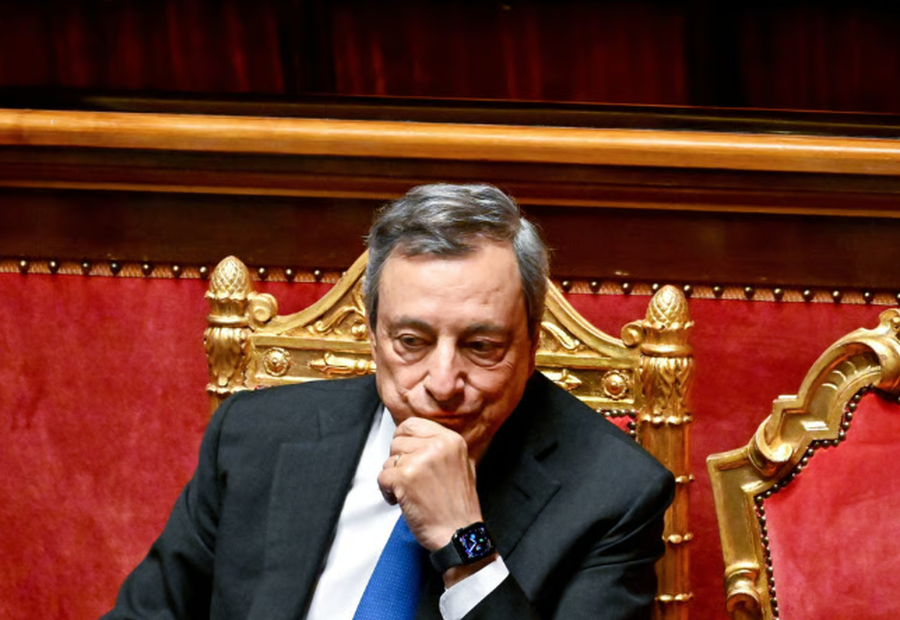
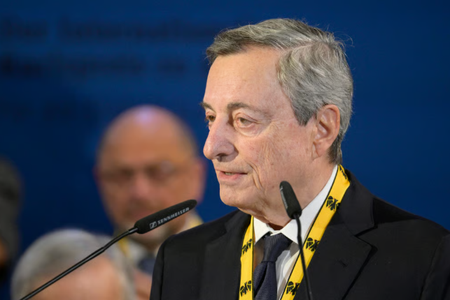
In a speech delivered today during the prestigious Charlemagne Prize acceptance ceremony in Aachen, Germany, former Italian Prime Minister and former ECB President Mario Draghi analyzed the bloc's structural weaknesses and proposed a new vision for integration. He calls for a "pragmatic federalism" as the only means to guarantee Europe's sovereignty and development in a world that is changing radically.
I do not claim that what awaits Europe is easy. The pressure on our continent is great and is increasing month by month. However, this is not just a moment of danger; it is a moment of discovery.
The forces that test us today are accomplishing something that decades of peace could not. They are forcing us to recognize again what we have in common and what we are willing to build together.
Since 2020, we have experienced a series of external shocks that have narrowed our room for manoeuvre. We are still facing the highest trade tariffs of a century, while the war in the Middle East has brought back high inflation and anxiety to our families.
Our investment needs have become gigantic. What was once estimated at 800 billion euros in strategic spending, with new defense commitments, has now reached an average of 1,200 billion euros per year.
The world that once helped Europe flourish no longer exists. It has become harsher and more divided. We can no longer assume that the guardians of the post-war order across the Atlantic will continue to defend it with the same dedication.
For the first time since 1949, we must face the possibility that the United States will no longer guarantee our security on the terms we have taken for granted. Nor does China offer an alternative.
It is accumulating industrial surpluses that threaten to deplete our manufacturing base, while directly supporting our adversary, Russia. For the first time, we are truly alone.
Our European system was wisely built to prevent the concentration of power after the horrors of the last century. This model brought peace, the single market and the euro. But it was based on two assumptions that have now fallen apart: the assumption that the world would always be open to free trade and that someone else would solve our security problems.
Today, we find ourselves with an unfinished single market, fragmented capital markets, and isolated energy systems. We have three major weaknesses that need to be addressed immediately.
First, exposure to external demand. Our companies have been forced to seek growth abroad because Europe did not offer enough space domestically. This makes us extremely sensitive to political decisions in Washington or Beijing.
Second, strategic dependence. We depend on America for 60 percent of our gas imports and remain dependent on Chinese supply chains for our green transition. If we had integrated our capital and energy markets, European savings would fund innovation at home and energy bills would have been halved.
Third, technological lag. The productivity gap with the US is widening. Artificial Intelligence is not just another tool; it is a transformation that requires investments five times higher than what we are making today.
Whoever wins the AI race wins the economic future permanently. So how should we respond? Some suggest doing nothing, but that would be a lack of decision-making.
Others want the return of the protectionist state, but national industrial policy within the single market would be costly and fragmentary. Subsidies given by one country harm the growth of another. I believe that the solution is true integration.
We need to coordinate state aid at the EU level to create “European champions” capable of competing globally. The more we reform, the less we will need new debt.
Our relationship with the US must also change. An alliance where Europe depends on America for defense is an alliance where security is used as a lever for pressure on trade and energy. Our defense autonomy does not weaken NATO; on the contrary, it makes Europe a more valuable and stronger ally.
We spend billions on American weapons and lose another 60 billion every year due to the lack of cooperation between us. It is time for our defense to be as European as our values.
We must give operational substance to mutual defense. If a member state is attacked, the response must be unquestionable. It is not necessary for every country to contribute tanks; someone can provide cyber defense, someone logistics, and someone financial support.
What is important is the obligation to the other. Today, our citizens are asking for more Europe, but not an abstract Europe. They want concrete improvements that can affect them. Our problem is that action at the level of 27 countries is often blocked by committees that dilute the initial ambition to the point of impotence.
We need to break this cycle. Countries that want and feel the need to move forward should be free to do so. This is pragmatic federalism. It is an experimental approach, where cooperation deepens in concrete areas such as energy, technology and defense.
Our model is the euro: those who were willing started it, built strong institutions and today leaving it is unthinkable. Dear leaders, today we find ourselves at a point where the decisions we have to make can no longer be within the old framework. Europeans want the EU to protect their freedom, development and solidarity.
Our task is to respond to this belief with courage. Let us show them, then, that Europe still has the strength to transform this crisis into an indestructible union./ Adapted from "Pamphlet", from "Il Foglio"


Lini një Përgjigje