


 Shkruar nga Pamfleti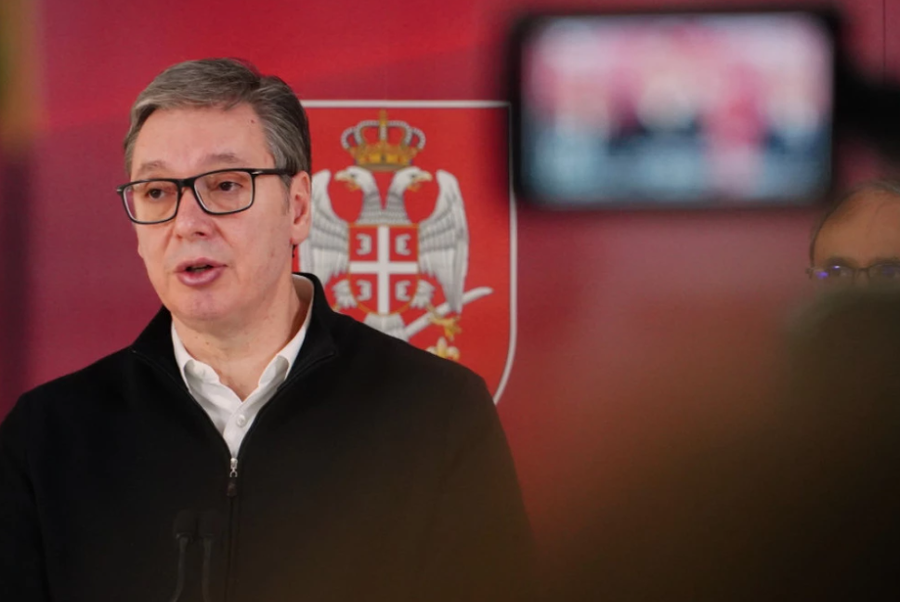
Vučić is feeding the false myth of encirclement, transforming Serbia into a paranoid fortress that relies on foreign armaments and imperialist nostalgia. This discourse of self-victimization is the mask of an expansionist policy, which aims to destabilize the region through fear and military pressure. Meanwhile, the apathy of the West makes this game even more dangerous, giving Serbia space to manipulate the fragile balances of the Balkans...
The latest statements by Serbian President Aleksandar Vučić, following the report on the operational status of the armed forces for 2025, mark a dark turn in the security discourse in the Western Balkans.
With rhetoric laden with paranoia, he has emphasized the formation of what he calls a “regional military alliance against Serbia,” openly targeting the growing cooperation between Tirana, Zagreb, and Pristina.
This fabricated narrative serves as a justification for an unprecedented process of militarization that is turning Serbia into an isolated garrison. Vučić, in the tone of a false prophet, said that Belgrade is acting “responsibly” to prevent aggression from its neighbors, while the country’s defense capabilities have increased dramatically, especially in the air force and air defense.
This militarization is supported by a record budget, reaching 2.65 percent of Gross Domestic Product, with over half of the funds going to armaments and war technology.
Serbia is feeding on Russian, Chinese, and recently French systems, while the return of 75-day compulsory military service aims to create a large human reserve, ready to be used as cannon fodder in Vučić's dangerous game.
If Serbia truly wanted good neighborliness, there is no logical reason for it to feel threatened by its neighbors. Tirana, Zagreb, and Pristina have openly declared that strengthening their defenses is a response to the Russian threat and the need to secure NATO's eastern flank.
But the fact that Vučić feels threatened by this protection is a complete expose of his position: Serbia implicitly admits that its interests are closely linked to Moscow.
Vučić, like a puppet of Putin, turns the “self-encirclement syndrome” into a means of keeping the region under tension, while the West continues to display dangerous apathy.
The relative silence of NATO and the US towards the ideology of the "Serbian World" and the risk of destabilizing Bosnia and Herzegovina is being interpreted in the region as a harmful tolerance.
Vučić, with his increasingly harsh tones, warns of a political and spiritual union with the Bosnian Serbs, while Washington and Brussels are still content with routine statements, leaving room for Serbia to exploit their passivity to change the "de facto" balance of power.
This accelerated militarization and the rhetoric of "siege" have also severely hit the dialogue process between Pristina and Belgrade, shifting the focus from diplomatic normalization towards a fragile military balance.
Serbia is using rapid armament and warnings about the unification of Serbs as a means of pressure, sending the message that it is ready to defend its interests even outside the frameworks mediated by Brussels.
This approach makes dialogue almost dysfunctional. Every step Kosovo takes to strengthen its sovereignty is portrayed by Belgrade as part of an “aggressive pact,” creating an endless cycle of accusations that keeps the region in a frozen state of conflict.
In this context, NATO and US apathy is creating a dangerous asymmetry, where dialogue is no longer seen as a means to peace, but as a space where Serbia buys time to increase its military superiority.
Feeling under pressure from this militarization and uncertain from the lukewarm international reaction, Pristina is forced to seek closer alliances with Tirana and Zagreb, which reinforces Vučić's narrative of "anti-Serbian" alliances.
The Balkans are turning into a chessboard, where troop movements and missile purchases weigh more than agreements signed on paper. A single incident could spark a new crisis, while Western diplomacy, overwhelmed by not coping with quite a few crises, seems unprepared to manage it./ Adapted from "Pamphlet", by "Tanjug"



Nuk e di pse perdorni superlativa per qener kriminele banale duke i cilesuar presidenti X e Y kur keta kafshe nuk meritojne as titullin zotni, pse? Presidentin le ta mbaje kush popull qen bir qeni e ka zgjedhur e jo te tjeret qe nuk e vleresojne as me nje mut ne oturak. C'eshte kjo gjeme nderkombetare me tituj te larte per halera qe i krijojne njerezimit dhimbje e gjakderdhje!?