


 Shkruar nga Pamfleti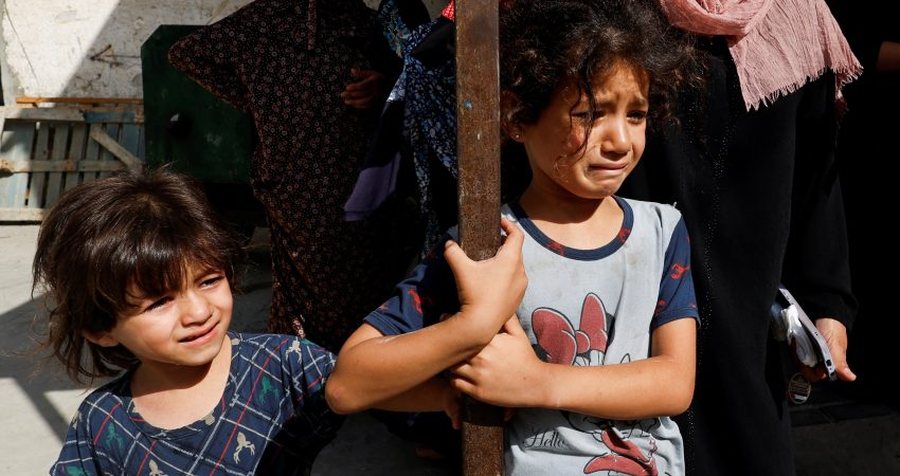
According to data reported from the war between Israel and Hamas, children account for a very high percentage of casualties in Gaza.
The Palestinian Ministry of Health, in its reports, states that approximately 2,900 children were killed in the enclave between October 7 and 24. This accounts for about 40% of the total death toll of more than 7,000
Although there is some concern that the number may be inflated — the health ministry is run by Hamas and President Joe Biden has said he has "no idea if the Palestinians are telling the truth about how many people have been killed," the ministry's estimates have been widely correct.
In earlier conflicts, in Ukraine, a conflict between two much larger powers, children accounted for less than 550 of the roughly 9,800 civilian casualties over a much longer period.
The high number of child deaths in Gaza reflects, among other things, its particularly youthful demographics. About half of the population of the Palestinian territories is younger than 20 years old, a much higher percentage than the average of other upper-middle-income countries such as Iraq, Namibia and Thailand.
The basis of a youthful society is a high fertility rate, the number of children a woman will have during her lifetime. The rate in the Palestinian territories, including Gaza (total population 2 million) and the West Bank (3 million) was 3.4 in 2021, according to the UN Population Division. From 2017 to 2019, the Palestinian Central Bureau of Statistics put it at 3.8.
Detailed data on Gaza and the West Bank is hard to come by. But according to the Population Division, Gaza's birthrate was 3.9 during that period. These rates are much higher than those of neighboring Israel, Jordan or Egypt and comparable to those of Ghana or Congo, both much poorer countries.
Such a high fertility rate is usually associated with short life expectancy, poverty and low levels of female education. The Palestinian territories do not have these characteristics. The average income per person in the territories is $4,600 per year, higher than in Egypt and Jordan. (The figure for Gaza is thought to be significantly lower.) More girls than boys are enrolled in secondary education. The Palestinian Territories are unusual in combining the fertility of poor countries with upper middle income social characteristics.
It seems likely that the long conflict with Israel and the influence of Hamas (which rules Gaza but not the West Bank) is partly responsible.
Yasser Arafat, the former president of the Palestinian Authority, once said that his people were waging "a cradle war": population growth was a way of affirming Palestinian identity and assertiveness.
Hamas's pro-natal rhetoric has been particularly vociferous. After taking control of Gaza in 2007, it tried to maintain the generation's high birth rate; which was 5.8 from 1999 to 2003, one of the highest anywhere
Since then, fertility has fallen, as it has almost everywhere else. In 2015 Gaza had about two-thirds of the population of the West Bank, the historic center of Palestine. At current rates, it will be poised to give Gaza a bigger voice in the debate over any future Palestinian state./ The Economist








Lini një Përgjigje