


 Shkruar nga Pamfleti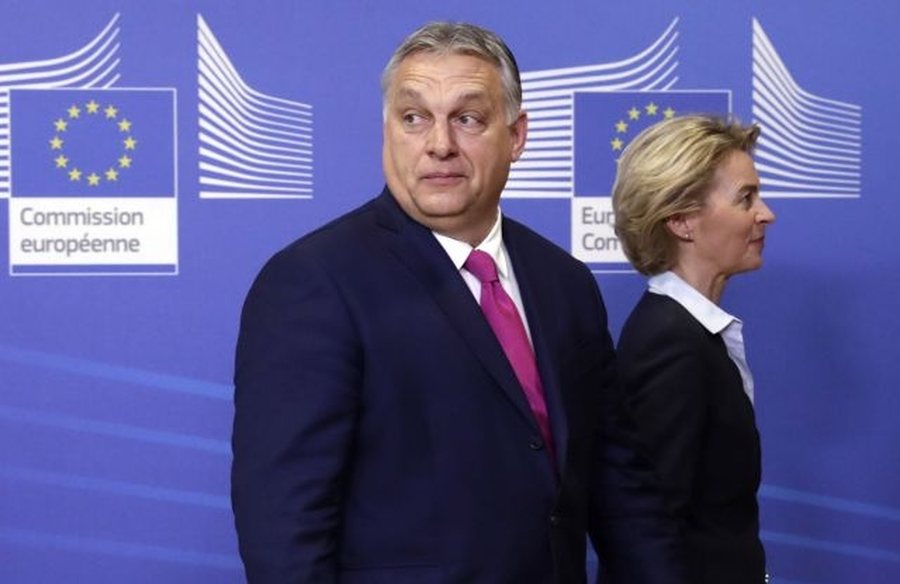
Officials in Brussels are said to have drawn up a secret plan to sabotage Hungary's economy if Viktor Orbán decides this week to again block a 50 billion euro aid package for Ukraine.
In a document drawn up by EU officials and seen by the Financial Times, Brussels has outlined a strategy to explicitly target Hungary's economic weaknesses, jeopardize its currency and trigger a collapse in investor confidence in an attempt to damage "jobs and economic growth" if Budapest refuses to lift its veto on aid to Kiev.
Viktor Orban, Hungary's prime minister, has vowed to block the use of the EU budget to provide 50 billion euros in financial aid to Ukraine at an emergency summit of leaders on Thursday.
If he does not back down, other EU leaders must publicly vow to permanently block all EU funding to Budapest in a bid to spook markets, prompting a rise in the country's currency and a cost overrun. of its borrowing, Brussels declared.
"This is Europe telling Viktor Orban "enough is enough". You may have a pistol, but we have the bazooka," said Mujtaba Rahman, director for Europe at Eurasia Group.
"Without this financing, financial markets and European and international companies may be less interested in investing in Hungary," the document said.
Such a penalty could quickly cause a further increase in the cost of financing the public deficit and a decline in the currency. Janos Boka, Hungary's EU minister, told the FT that Budapest was unaware of the financial threat, but that his country "does not give in to pressure".
"Hungary does not make a link between support for Ukraine and access to EU funds, and refuses other parties to do so," he said.
"Hungary has and will continue to participate constructively in the negotiations."
But in a sign of mounting pressure on Budapest to reach a compromise, Boka said Budapest sent a new proposal to Brussels on Saturday, specifying it was now open to using the EU budget for the Ukraine package.
The document, detailed by an official at the Council of the EU, the Brussels-based body that represents member states, outlines Hungary's economic weaknesses including a "very high public deficit", "very high inflation", a weak currency and the level of high EU debt service payments as a share of gross domestic product.
Brussels has previously used its financial leverage against member states, such as with Poland and Hungary over rule of law concerns and Greece during the eurozone crisis, but a strategy to explicitly seek to undermine a member state's economy would to mark a new big step for the block.
Three EU diplomats told the FT that many countries supported the plan. "The situation has become tougher," said one. "What kind of union do we have if we allow this kind of behavior?"
"The stakes are high. It's blackmail," said another.
Boka told the FT that Budapest wanted to "explore the possibility of a more constructive and European solution" and has proposed that it could support the €50 billion plan if it was given an annual veto on the payments.
Other EU countries have already rejected the suggestion as they fear Orban would seek to block it every year and extract further concessions. But one of the diplomats added that there was no way Orban could have a veto over the funding.
Boka said that the political pressure on Hungary is constant and strong, but that it did not affect his government's negotiations.
"We had to take a step and we believe that the other side will be equally flexible", he added.
While 26 member states have a plan B to send money to Kiev outside the EU budget, this would require ratification by national parliaments, causing delays and uncertainty.
Several capitals have considered whether to invoke Article 7 of the Treaty on European Union, which would allow Brussels to strip Budapest of voting rights or, one diplomat said, block the disbursement of money.
But others have opposed the notion as it requires unanimous support and many countries are reluctant to impose such a serious sanction.
Boka said it was important that the unity of the EU was "preserved", as this is why we are willing to make compromises as long as they do not affect our vital interests.
He added, however, that if the compromise effort fails, Hungary's original proposal for a separate Ukraine fund outside the EU budget would be Budapest's preference.



Lini një Përgjigje