


 Shkruar nga Pamfleti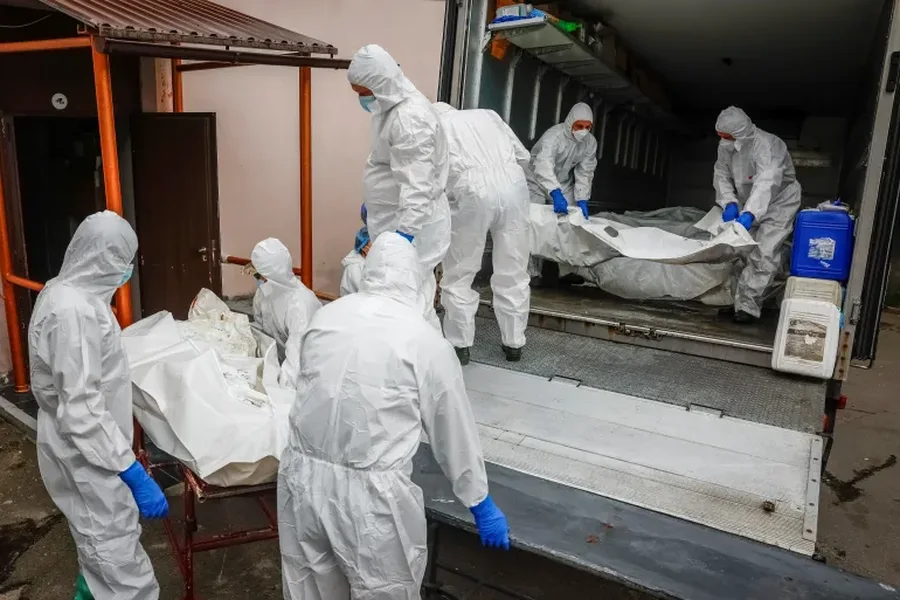
As a grim figure is reached, the extensive propaganda campaign and state payments are keeping grieving relatives under surveillance...
Over the past few years, Nikolai has seen the ups and downs of the funeral trade in his hometown of Ufa, a Russian city in the steppes west of the Ural Mountains.
The coronavirus pandemic, which hit Russia with devastating force, brought an unexpected boom to his family business, forcing him to hire additional staff almost overnight to cope with the surge in demand for funerals.
"But after Covid, there was a real decline; people just stopped dying in such large numbers," Nikolai said.
That lull didn't last long. Over the past two and a half years, business has picked up again. Part of the reason: Russia's casualties in its ongoing occupation of Ukraine.
Few regions in Russia have sent as many men to fight and die in Ukraine as the republic of Bashkortostan, whose capital, Ufa, draws recruits from poorer surrounding areas in search of money.
"Sometimes, I check the name of the person we're burying and realize it's someone I know, someone I went to school with or met before," said Nikolai, who asked that his last name not be revealed for fear of government retaliation.
Since the start of the war in Ukraine, Russia's military casualties have remained a closely guarded state secret. But if you look a little closer, the signs of devastation are unmistakable: from the booming funeral industry to the growing number of veterans returning home without arms or legs.
In total, between January and April 2025, funeral service providers in the country earned nearly 40 billion rubles (£380 million), a 12.7% increase year-on-year, according to Rosstat, Russia's federal state statistics service.
This month, the number of dead and wounded in Russia during the war reached a historic milestone.
According to the British Ministry of Defense, more than a million Russian troops have been killed or wounded since the start of the full-scale invasion of Ukraine on February 24, 2022.
The estimate is consistent with a recent study by the US-based Center for Strategic and International Studies (CSIS), which estimates Russian military deaths at up to 250,000 and total casualties, including wounded, at over 950,000. Ukraine has also suffered very high losses, between 60,000 and 100,000 personnel killed and total casualties reaching approximately 400,000.
While exact figures for casualties during the war are difficult to verify, independent Russian media outlet Mediazona has identified the names of more than 111,000 Russian military personnel killed, using official records, social media obituaries and images of tombstones. The outlet believes the true death toll is significantly higher.
These are shocking figures by any measure of comparison in modern Russian history.
In just over three years, Russian casualties are estimated to be 5 times higher than the total death toll from all Soviet and Russian wars between the end of World War II and the start of the full-scale invasion in 2022.
The war in Ukraine has proven far more deadly for the Kremlin than other recent conflicts: Russia's losses are roughly 15 times greater than those suffered during the Soviet Union's 10-year war in Afghanistan and 10 times higher than in Russia's 13-year war in Chechnya.
And it's not just the dead who are returning to their coffins, but soldiers with amputated limbs and serious injuries are also returning home, spurring a significant increase in the production of prosthetic limbs.
“We doubled the number of our clients a year after the conflict began, and since then there has been a steady growth of 10% every year,” said Igor Vinogradov, the director of a medium-sized prosthetics and orthopedics firm in northern Russia.
"So far, most are war veterans," Vinogradov said, adding that his company relies on prosthetic arms and legs imported from Germany, as well as some domestic technology.
Data from Russia's labor ministry shows that the state subsidized the provision of 152,500 prosthetic limbs to people with disabilities in 2024. This marks a 53% increase compared to the previous year, when 99,200 artificial arms and legs were distributed - a significant increase from 64,800 in 2022.
"The market has exploded," said a prosthesis manufacturer in Moscow, who asked not to be identified.
Russia's losses in Ukraine are likely to further accelerate the country's deepening demographic crisis. The invasion has caused tens of thousands of young Russians to emigrate to the West and claimed the lives of many others who could have formed the backbone of the workforce for decades to come.
The death toll adds to the damage from the Covid-19 pandemic, which caused more than a million excess deaths and left lasting scars on Russia's population.
Alexander Raksha, an independent demographer and former analyst at Rostat, estimates that the average life expectancy for men has fallen from 68 to 66 since the start of the full-scale occupation. He said the government has made it harder to track the long-term demographic consequences of the ongoing fighting.
"Russia stopped publishing all mortality and life expectancy data for its male population from 2024 onwards," Raksha said.
Russian anti-war activists, both at home and abroad, initially believed that the growing number of returning troops would spark public protests.
But Russia's extensive propaganda campaign has portrayed the fallen as heroes, with Vladimir Putin repeatedly touting the idea that death on the front lines is more meaningful than enduring a bleak existence in the country's impoverished cities.
Responding to a grieving mother during a televised meeting in late 2022, he said: “Some people die in road accidents, others from alcohol, when they die, it is unclear how. But your son lived, do you understand? He fulfilled his purpose.”
Instead of widespread public discontent, it now seems to be the opposite: many Russians who have lost relatives are calling on the Kremlin to move forward, convinced that the losses must be justified.
Among them is Dmitry Shkrebets, whose son, Yegor, was one of more than three dozen sailors killed when Ukraine hit Russia's flagship Black Sea warship, the Moskva, in 2022.
Shkrebets now runs a blog in which he regularly calls on Russia to increase its attacks on Ukraine.
"Any compromise with Ukraine would be a betrayal of the country. A betrayal of the blood that our sons have shed," Shkrebets said.
“We must see this through to the end,” he said, adding that he hoped Russia would soon launch an offensive in the Ukrainian cities of Odessa and Nikolayev. To maintain support among grieving families, the Kremlin has also resorted to offering generous payments to relatives of the dead and wounded. The government allocated at least 1.2 trillion rubles (about $15.3 billion) in compensation for the families of the dead and wounded in 2024 alone.
For now, Moscow appears to be able to replenish its manpower for the war, allowing it to slowly advance and conquer more territory in Ukraine, despite the human cost.
Military recruitment continues to increase in many regions, with signing bonuses for contracts to join the war reaching record levels of up to 2 million rubles (about $25,000).
Janis Kluge, a researcher on the Russian economy at the German Institute for International and Security Affairs, estimates that Russia recruited 89,601 men between January and March 2025, based on federal spending on draft bonuses.
"This represents a 22% increase compared to the same period last year," Kluge said.
Nikolai, the funeral home director, said he is closely following the peace talks between Russia and Ukraine to determine his next step in the business.
“Of course, I hope this ends soon and the deaths stop,” he said, noting with disappointment that talks appear to have stalled. “It just feels wrong to make money off the deaths of young boys,” he said. /Adapted from The Guardian Pamphlet/





Lini një Përgjigje