


 Shkruar nga Ylli Pata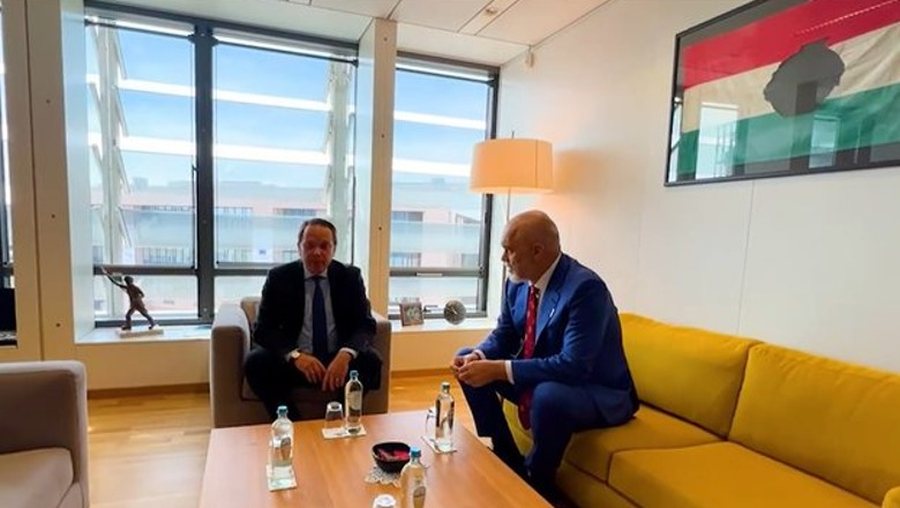
The flag without a star has accompanied the anti-communist revolts in Albania several times, since those of the infamous prisons of Qafë Bari, Spaçi, Burrel, etc.
In the meeting that Edi Rama held in Brussels with the EU Enlargement Commissioner, Oliver Várhelyi, an artifact that the European official kept in front of his office caught the eye.
Placed in the frame, was a torn Hungarian national flag in its center. That artefact has no connection, of course, with the well-known lawyer from Budapest who today represents his country in the government of the European Union. Várhelyi is 51 years old, while that flag placed at the top of the country has a history of almost 70 years.
Namely in 1954, when the first anti-communist revolution took place in the part of the Communist Empire. The Hungarians, of course not all, but a large part of them, came out in protests, many grabbed their weapons and fought against the Soviets, and their symbol was the flag torn in the middle, after the star had been removed. Years later, more than 35 years later, it became the symbol of all the countries of Eastern Europe, which tore the center of the flag, as a political identity.
Exactly the same thing happened in Albania as in Hungary exactly 70 years ago. There have been some groups, some young people, who, knowingly or not, came out secretly against the Soviet Empire, with which Enver Hoxha's Albania allied itself after the Second World War.
Three young people from Shkodra, who studied near the Artistic High School in Tirana; namely Nikolin Pavaci, 19 years old, Karlo Çefa, 18 years old and Ndrekë Bazhdari, not yet 17 years old; they were the first to create a form of covenant called the "Castriote Brezni" and devoted themselves to the work, understandably in secret, to sensitize public opinion. Tracts were distributed in Shkodër and Tirana, until they were arrested and sentenced to prison.
The flag without a star has accompanied the anti-communist revolts in Albania several times, since those of the infamous prisons of Qafë Bari, Spaçi, Burrel, etc. Today we have enough of the witnesses of those events, but they are becoming rarer every day because the years go by. We also have public figures such as lawyer Ngjela or Fatos Lubonja, who are living evidence of the human suffering of state violence.
However, post-communist Albania never adopted the symbol that the EU commissioner displayed in his office, which is actually the political logo of his FIDEZ, which is successfully led by a politician who does not who can like Viktor Orban.
FIDEZ is the first Hungarian coalition of anti-communist parties to win elections after the overthrow of the one-party system in 1989. Eight years after the first victory, FIDEZ dissolved as a normal dialectic, giving way to the victory of the Hungarian Socialists, who were in in a way co-shareholders in the country's democratic changes.
But then FIDEZ came back, changing its profile quite a bit. Today this political alliance is no longer a right-wing pro-Western and liberal grouping. But an ultra-conservative alliance, anti-liberal and not at all pro-Western. Viktor Orban is the Western leader who has the most friendship with Vladimir Putin, Xi Jinping, or Recep Tayyip Erdogan.
However, the basic symbol of FIDEZ is that torn flag that Oliver Várhelyi has in the offices of political Europe. The basis of the right-wing parties of Eastern Europe is the representation of resistance, ideology, effort and anti-dictatorship philosophy.
Of course, not all of them were dissidents like Vaclav Haveli of the former Czechoslovakia, who is one of the greatest anti-communist leaders in Europe, or an indomitable fighter like the Pole Leh Walesa. But all the leaders who have undertaken to represent that part of politics have done so with the utmost respect.
What about us? It is not a question that the historical leader of the anti-communists was a friend of Enver Hoxha, with whom he has an impressive collection of photos, or that his avatar resembles the Albanian communist dictator like two drops of water.
But because that "thing" that was born on December 11 or 12, 1990 (the date is more flexible), has never represented the Albanian flag without the star above the eagle.
Even the three young anti-communists who 70 years ago stood in solidarity with the Hungarian revolution, were tamed by the Democratic Party.
Gjashtë vjet pas rrëzimit të komunizmit, treshja e famshme Nikolin Pavaci, Karlo Cefa, dhe Ndrekë Bazhdari u bënë bashkë me një lëvizje të re politike në Shkodër që rrëzuan Sali Berishën dhe PD-në. E bija e Ndrekë Bazhdarit, Keti, një industrialiste e njohur në Shkodër, kandidoi për socialistët në vitin 2015 si kryetare e bashkisë në Shkodër. E ishte ajo betejë e Ketit që solli më pas ndryshimin që ndodhi sot me Benet Becin.
E kur sot bërtasin në PD, në mjediset e opozitës, apo edhe në panelet e darkës për modelin e të djathtës shqiptare, askush nuk thotë që për modelin që tregoi sot një djathtist hungarez në takimin me Edi Ramën. E megjithatë askush nuk skandalizohet me albumin e pasur të fotove me Enver Hoxhën të Sali Berishës.
"That was the time", it is said. Perhaps, those who tore the star 70 years ago like the Hungarians, why were they tamed by the party? Look at how they behave with Gjergji Hani, the candidate for president of the Democratic Party. who is the only politician of that level who was in prison during the communist dictatorship. They mock Gjergji and justify the Doctor who is close to Enver Hoxha...


Lini një Përgjigje