


 Shkruar nga Ben Blushi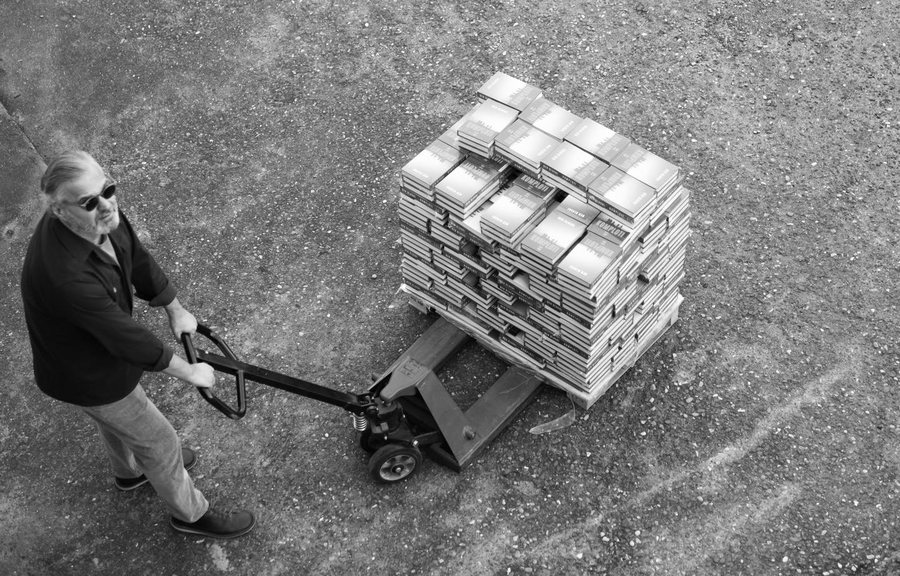
Many years ago, as my father waited for his books to be printed, I thought I would never experience that pleasure. At that time, when the books came from the printing press, it seemed to us that another child had come home...
My latest novel came off the press this morning. It was plasticized, packaged, wrapped in enough transparent bags to hold three copies. Books come out of the presses neat and fresh, just like any other commodity that comes out of a factory where it is cleaned, polished, weighed, packaged and decorated before it goes on the market.
The difference between books and other goods is that the goods hide the author, whom the book carries throughout its life. Thus goods are more protected and books are more attacked. Books have therefore suffered greatly from competition with consumer goods. When the world produced less, it read more. Today, with millions of pairs of shoes, forks, plates, spoons, washing machines, dryers, brushes, pencils, buttons, lampshades, telephones and clothes, people read less. Merchandise has a property that books do not: they take over the mind more quickly.
Many years ago, as my father waited for his books to be printed, I thought I would never experience that pleasure. At that time, when the books came from the printing press, it seemed to us that another child had come home. The arrival of a new book had the magic of illuminating the darkness of everyday life, and in the poverty of the few things we consumed, the house was enriched with another commodity, which moreover bore our surname.
I remember approaching those publications and smelling them. The books smelled of lead mixed with glue and surprisingly a little gasoline. I have never understood why books from the communist era smelled like gasoline. Perhaps because the linotype machines were cleaned and lubricated with gasoline and grease. Maybe. Someone who hates communism more than I do would probably say that books were doused in gasoline to make them burn faster. He may be right. A good friend who used to work as a linotypist in the old printing house of Tirana has died and I can no longer ask him about the strange smell of the books of that time. He died of lung cancer because of the lead type with which he had typed millions of pages.
Now, every time I publish a book, I get the same thrill, but not the same smell. The pages of books no longer smell of gasoline and those who type them do not smell of lead like the linotypers of old.
However, following my book-sniffing habit, I ended up this morning at the printing press where my tenth book came out. There I met the men and women who print the books. They work in digital printing presses and besides not smelling like lead, they are also funnier. I also laughed a little with them, took some pictures, among which one was pushing a pallet loaded with the heavy circulation of the new novel, and together with Roland Tashon who photographed us, I ran away taking some copies with me.
None of those who work in that modern printing house asked me about the book. By printing books, they probably think of other goods. And since they didn't ask me, I'm not telling you what this latest novel is about.
There are full days. Now I want to fill myself with the smell of my new book.







Lini një Përgjigje