


 Shkruar nga Pamfleti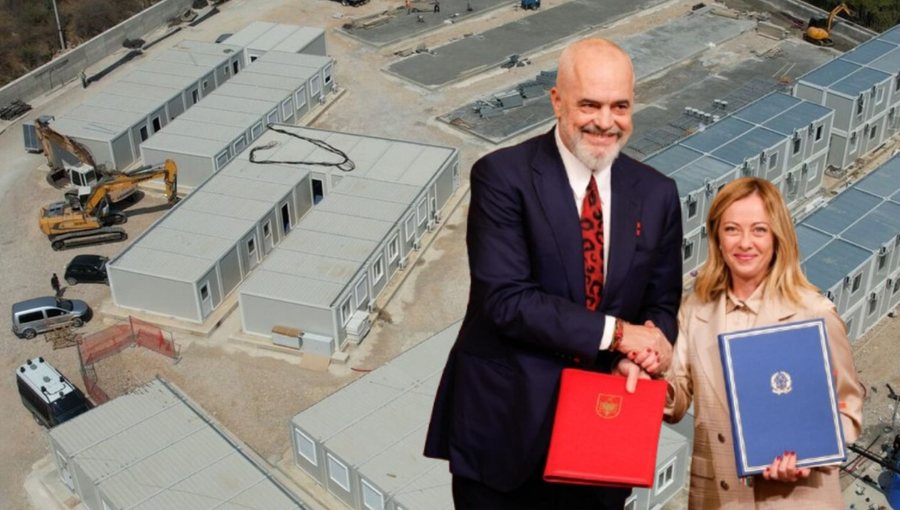
The center for immigrants promised with much fanfare is not functioning, but continues to gobble up public funds. No transparency, no results, only silence and secret contracts...
If the project cannot serve as a functional model for Europe, then it must be kept alive at all costs, whether by spending millions or by violating rights.
This is the philosophy that seems to guide the implementation of the Italy-Albania agreement on migrant processing centers. A year after its launch on the ground and almost two years after its signature by the Meloni government, the balance is scandalous: a project that has not achieved its objectives and is devouring the Italian budget to give life to a political facade.
According to the initial project, the center in Gjadra, an isolated area in northern Albania, would have a total capacity of around a thousand places, divided into three units: a reception facility for asylum seekers with 880 places, a CPR (repatriation center) with 144 places, and a mini-prison with 20 places for people who committed criminal offenses while in detention. In reality, the complex was never fully built and began operating on an emergency basis on October 16, 2024, with less than 50 beds. By March 2025, the capacity had reached around 400 places, but only a small number of migrants passed through there: around 20 people in 2024 and 43 in January 2025.
After several court decisions in Italy ordered the return of asylum seekers, the Italian government decided on 28 March 2025 to transform Gjadri into a full-fledged CPR, the same category as those operating on Italian territory. Gjadri thus became the 11th CPR in the Italian system, but it is located outside the borders of the European Union and is not subject to the same monitoring standards.
From October 2024 to July 2025, according to data obtained by the organization Altreconomia through transparency requests, a total of 111 people were detained in Gjadra. But the total cost for this period is 133 million euros, or about 1.2 million euros for each person detained. These figures make the Meloni government's claim that this center is an effective solution for managing immigration untenable. Meanwhile, the number of migrants arriving in Italy continues to be high: over 140 thousand in 2023, over 54 thousand in 2024 and over 55 thousand for the first half of 2025 alone.
Transparency is almost non-existent. The Italian Interior Ministry says it has no detailed data on the center’s operations, while organizations dealing with migrant rights are forced to use information requests to obtain partial data. In 2024, the center in Gjadra operated for only five days, but the 133 million euro contract awarded to the company Medihospes provided for payments even for periods of inactivity. For those five days alone, the company received 570,000 euros from the prefecture of Rome, according to a joint investigation by Action Aid and the University of Bari.
This amount includes not only operating fees, but also the costs of construction and "militarization" of the structures, which amount to over 74 million euros - all provided through closed procedures, without competition and without transparency. In these conditions, suspicions have increased that the center in Albania was not created for effectiveness, but to avoid auditing and institutional control of public spending.
Sources from within Medihospe indicate that initially, Italian employees were offered a salary of over 3 thousand euros per month, more than double the salary in Albania. To reduce costs, the company created a branch in Tirana and hired about 100 Albanian workers with contracts under local law. Italian prison officers, 15 in total, remain stationed in Gjadra even though the prison is not functional, with a daily salary of 130 euros and the right to return once a month to Italy. This brings an additional cost to the state of about 4 thousand euros per month for each officer. Meanwhile, the Italian police forces, about 60 people, are accommodated in a hotel with a swimming pool. For these five days of operation in 2024 alone, 528 thousand euros were spent on accommodation and food.
This entire structure, according to a former employee who testified for the newspaper “Domani”, is completely isolated from public oversight. Journalists, human rights organizations and even MPs are not allowed to enter. The Italian Interior Ministry has limited the powers of inspectors and has done everything to keep this operation shrouded in secrecy. Employees have been forced to sign confidentiality clauses, while the criteria for selecting migrants to be transferred to Albania have not been made public. It is no longer the Italian Navy that deals with the transport, but “the vehicle available on occasion”, while no institution provides detailed information on the procedures. This creates a “Chinese box” system, where no one takes responsibility and no one controls.
The only justification that seems to be left for the Italian government is to avoid responsibility before the Court of Auditors, since the funds spent are inexplicable in the face of minimal results. But according to the organization Action Aid, it is completely illogical to transfer immigrants from Italy to Albania when within Italian territory, in 2024, there were 263 empty places in the existing reception centers. And then, these people should still be returned to Italy to be repatriated.
In essence, Gjadri's project is a bureaucratic machine that wastes public funds and violates the rights of immigrants and, moreover, is being used as a false model for a European future, within the framework of the New Pact on Migration that is expected to enter into force in June 2026. In an attempt to keep this failed experiment alive, the Italian executive is destroying both the foundations of the rule of law and its own fiscal coffers. / Adapted from "Pamphlet" by "Ristretti"






Giorgia Meloni është politikane e vlerësuar në Itali por nuk kupton asgjë nga mardhëniet mes Italisë dhe Shqipërisë. Ngatërrimi me Shqipërinë është vdekjeprurës për çdo karrierë politike në Itali.... Këtë e dëshmon historia. Mëndjemadhja romane do t'a pësojë keq nga kruarja me fikun e detit