


 Shkruar nga Pamfleti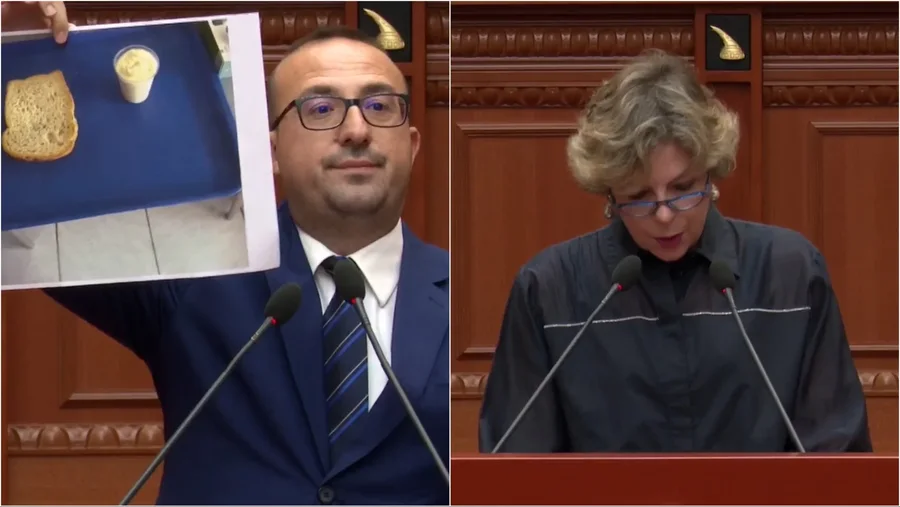
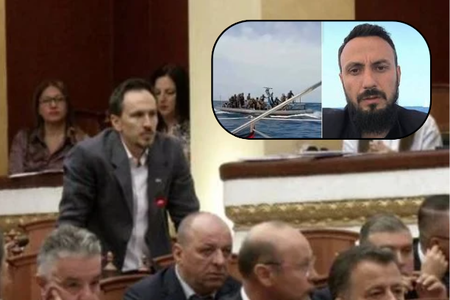
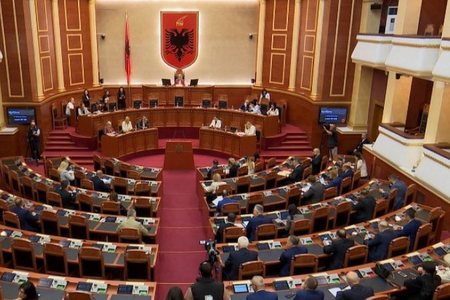
In this Thursday's plenary session, an interpellation took place between Democratic MP Sajmir Korreshi and the Minister of Health and Social Welfare, Evis Sala, regarding the conditions and problems at the Lushnja Hospital.
From the Parliament podium, Korreshi published photos of the breakfast that, according to him, is served to patients at the hospital, raising concerns about the lack of basic supplies and the conditions of the hospital facilities.
"The first question for you is, have you had breakfast? And I'm showing you the breakfast that the patients of the hospital in Lushnje eat. There is not a cook in the kitchen, but a nurse, you said it yourself."
The premises of the Lushnje hospital were verified, where they say that conditions were poor in both the kitchen and the laundry 3 years ago by three people from these audits.
Now I'll tell you, first of all, why did you move the building and leave it in a 'shelter' for 8 months and not issue a construction permit. Who is responsible for patients receiving service in miserable conditions? Second, how are you with geography? Is it so hard for you to understand that there are other cities besides Tirana. Why don't you come with me hand in hand to see the conditions? The question that patients ask me is, does the minister work or stay on the plane? On the plane, at most, she will check the ambulance.
What is missing in the Lushnja hospital today? Alcohol, cotton, vicuna. Just so you know, it's become a joke there, the doctor says 'Where's the cotton with alcohol?', there's no alcohol, the nurse brings the cotton with water and the doctor says 'Why did you leave the alcohol open because it's gone bad?'.
"In 2024, you dismissed such and such a person from the position of deputy director, in 2025 they will become director. Now you removed him because he did not buy vicunas, now you are bringing him back. I and the citizens of Lushnja demand answers, Madam Minister," said Korreshi.
On the other hand, Minister Evis Sala stated that the problems of the Lushnja Hospital are old and related to the depreciation of buildings built before the 1990s. She announced that the hospital is included in the national investment program for reconstruction.
"I want to thank MP Korreshi, because his interpellation serves as a useful reminder of how important it is to speak with facts, and not with political narratives, about the Lushnja Hospital and the real investments that are being made."
Citizens need the truth, not fabricated political alarm. Because there are MPs who, as soon as they see a construction scaffolding, declare a national disaster. Unlike the folklore of alarm, we choose work and investment.
Healthcare cannot be used as a stage for fear propaganda or to blacken every investment that is made, just for a few political credits of the moment.
Allow me to inform citizens about the truth about the investment in Lushnja Hospital.
The Lushnje Municipal Hospital covers over 63 thousand inhabitants and operates in buildings built before the 1990s, which for decades have had considerable infrastructural and technical depreciation. This is not a problem created today. It is a long-standing legacy, which for years did not receive the necessary investments.
Precisely for this reason, Lushnja Hospital has been included in the national program of investments in hospital infrastructure, financed by the state budget and the Albanian Development Fund.
The investment began in 2026 and works officially began on March 4. The planned fund for this year is around 82 million lek, while another 236 million lek are planned for 2027.
The intervention is being carried out in building no. 3 of the hospital, where emergency, imaging, surgery, resuscitation and pathology operated. In parallel, interventions are also being carried out in the facilities related to maternity and support services, with the aim of improving conditions for mothers, newborns and patients in general.
This is not a facade investment. It is not a painting of walls for propaganda photos. It is a complete infrastructural reconstruction, which includes the rehabilitation of hospital facilities, the reconstruction of technical networks, the improvement of hygienic and sanitary conditions, the increase of technical safety and the modernization of diagnostic and treatment conditions.
Of course, an intervention of this level brings temporary operational difficulties. But the question is: what should we do? Not invest at all? Let the buildings deteriorate? Or close services to citizens?
We have chosen the most difficult, but most responsible path: to invest while guaranteeing continuity of service.
For this reason, a temporary reorganization plan has been approved and is being implemented, and emergency services, imaging, surgery and other departments continue their activities in other functional areas of the hospital.
There is a big difference between constructive criticism and an attempt to distort reality. We welcome criticism that helps to improve the system. But we cannot accept the rhetoric that tends to present public hospitals as abandoned structures, while work is done there every day, investments are made every day, and thousands of citizens are treated there.
"It's easy to be an opposition with jokes. It's more difficult to build hospitals, finance equipment, and keep the system running during reconstruction, as we are doing today," the minister replied.


Lini një Përgjigje