


 Shkruar nga Pamfleti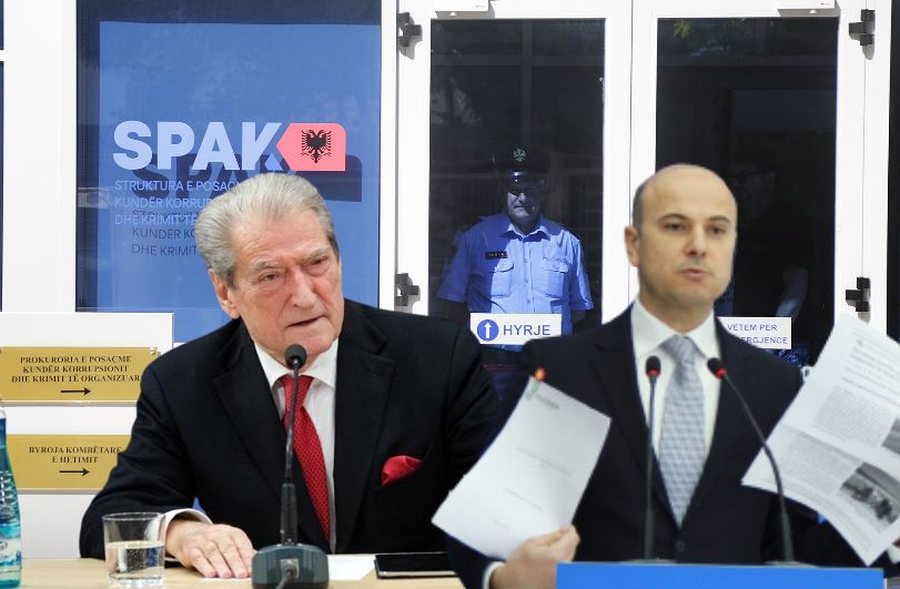
New details emerge from the GJKKO Appeal decision for the leader of the Democratic Party, Sali Berisha.
The Court of Appeal recalls, according to Anila Hoxha, that SPAK has requested to question 137 witnesses and 5 defendants in the proceedings.
As the journalist quotes part of this decision that turned Berisha into a 'compulsory appearance', the judge also speaks of the threat to witnesses that may come from the influence of the suspect. Specifically, the Special Appeal, referring to the first instance that lifted the house arrest, says "The Special Court of First Instance for Corruption and Organized Crime, in revoking the security measure against the applicant, in addition to the lack of risk of flight, has also justified the lack of risk of damage to evidence because the case has already passed to a preliminary hearing and this risk has been eliminated since the evidence has been taken. Regarding this special condition for the imposition of a security measure against the applicant, the court of first instance continued its analysis that the detention (house arrest in this case) against the applicant should be imposed for a limited period, referring to Article 245, point 1, letter “d”, of the Code of Criminal Procedure, and that the prosecution should have used the institution of securing evidence to obtain, during the investigation phase, evidence that was at risk of being damaged by the defendant. Finally, it emphasized that, by analyzing the personality of the defendant and his behavior, the criminal offense attributed to him and the types of evidence requested and obtained by the prosecution, as well as the scope of the investigations in time, it is not found that such a risk exists. This conclusion of the court of first instance, in most of its arguments, is erroneous.
According to our accusatory criminal procedural system, evidence is formed during the court debate, so all the data collected by the prosecution during the preliminary investigation phase acquire their value in the trial. It is true that the information on the facts and circumstances on which the prosecutor will base the accusation is fixed during the investigation, but they acquire the value of evidence during the trial phase. In this regard, the conclusion of the preliminary investigation phase does not diminish the risk of damaging the evidence. This becomes more sensitive when we are faced with living evidence, which is such that it is not only formed exclusively during the judicial examination but has an unstable nature in relation to the facts and circumstances that present themselves to the judicial process. This evidence, with the passage of a long time from the moment of occurrence of the fact or circumstance, or under the influence of internal and external factors, tends to lose the ability to reproduce the data as it was perceived. Unlike them, frozen evidence does not change over time and under the pressure of various factors. However, here too it must be taken into account that the manner in which such evidence was obtained may be found to be in violation of the law and as such the evidence may be declared unusable, which would lead to the need to obtain it again.
In this context, the court considers that, while it can be accepted that the risk of evidence being seized is reduced by the administration of frozen evidence by the proceeding body during the preliminary investigation phase, this cannot be said for live evidence. Witnesses and co-defendants, or even experts if the need arises for their questioning, will have to reproduce what they perceived before the court and answer the questions of the latter and the parties. An exception is made only in the case where the defendant requests a summary trial and the court accepts it, taking into account the statement given during the preliminary investigation phase, which is not proven to have occurred in the case under trial. In this regard, live evidence is always threatened by the influence that the defendant may exercise over it.
In the case under review, it results that the prosecution requested that one hundred and thirty-seven witnesses and five defendants in this proceeding (referring to the request for trial) be questioned, being considered as live evidence. For this reason, the court of first instance could have argued that the risk of obtaining evidence was mitigated due to the administration of frozen evidence (documentary evidence) by the proceeding body and, taking this factor into consideration in relation to other factors, as will be justified below, to assess the possibility of replacing the security measure but not to decide on its revocation.”
However, the Court of Appeal does not agree with SPAK either, adds Anila Hoxha when the prosecutor argues that the court has shown itself to be practical in the references it has to open sources "regarding the personality of the defendant. Open sources, especially when they are official, can serve any individual, organization or state institution to refer to the facts mentioned in them and, for this reason, these facts are considered as universally or officially known, which do not need to be proven (Article 13, paragraph 1, of the Code of Civil Procedure). Against this argument, the Constitutional Court in its decision no. 81, dated 09.11.2024, relating to the individual constitutional complaint of the applicant, referred to universally or officially known facts when it found that the applicant is a politician, former president and former prime minister, currently a member of Parliament and leader of the main opposition party, to which this appeal court also referred and will refer below.
At the conclusion of the analysis related to the risk of evidence poisoning, as one of the special conditions for the imposition of a security measure against the applicant, the Court of Appeal once again emphasizes that the arguments provided by the investigating judge and confirmed at all levels of the judicial power, related to this condition set out in Article 228, point 3, letter “a”, of the Code of Criminal Procedure, cannot be re-evaluated without ascertaining the presence of new evidentiary elements. In this regard, the analysis of the res judicata, made for the second special condition for the imposition of a security measure, the risk of absconding, also applies to the risk of evidence poisoning. ” adds the Court of Special Appeal.






Lini një Përgjigje