


 Shkruar nga Giuseppe Gagliano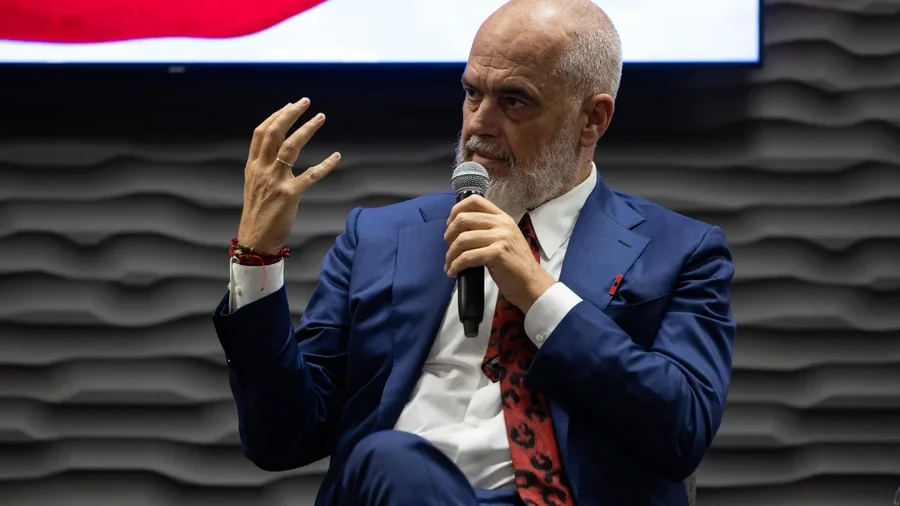
In a recent investigative article, the Italian media outlet "Inside Over" has closely analyzed the dramatic developments in Tirana, describing the anti-government protests as a turning point in Albanian politics. Titled "La protesta che rompe l'equilibrio", the analysis emphasizes that the throwing of a Molotov cocktail at the office of Prime Minister Edi Rama is not simply an isolated act, but a sign of the deepening of a dangerous institutional crisis.
The recent protest in Tirana, where a Molotov cocktail was thrown at Prime Minister Edi Rama's office at the height of an anti-corruption demonstration, is more than a violent act, it is a clear sign that the political crisis in the country has entered a dangerous phase. Thousands of citizens on the streets, arrested, injured, and a protester who accidentally set himself on fire, all of this shows that Albania is facing a tension that is exceeding the limits of political and institutional security.
At the epicenter of this crisis is the Deputy Prime Minister and Minister of Infrastructure, Belinda Balluku, against whom SPAK has filed charges of interference in large public tenders. The problem lies not only in the criminal investigation, but in the parliamentary immunity that has so far hindered any action of justice. The socialist majority has refused to vote to lift the immunity, passing the matter for interpretation to the Constitutional Court, a move that on paper appears to be respect for the law, but in practice is perceived as a political shield to protect power.
Balluku has denied the charges and has expressed her readiness to cooperate with justice. But the damage is already deep: when one of the key government figures is implicated in investigations that affect the country's largest public investments, the crisis does not remain only in the hands of prosecutors, it becomes institutional and structural.
Opposition in the streets and the blow to legitimacy
The protests are led by Sali Berisha, a political figure with a controversial past but still capable of mobilizing crowds. His message is clear: this government has lost all legitimacy. Its rhetoric portrays a state captured by a network of power that plunders public assets and distorts democracy.
In this climate, the Molotov cocktail is seen not simply as an act of vandalism, but as a symbol of the extreme delegitimization of the system. The danger is tangible: when political conflict leaves parliament and spills into the streets, the dividing line between protest and destabilization becomes blurred. And a country with still fragile institutions like Albania cannot afford this kind of ambiguity.
SPAK and the clash with the executive branch
Prime Minister Rama's statements have ignited another front of conflict: he has accused SPAK of abusing preventive arrests and of actions that contradict European standards of justice. But this is slippery ground: justice reform and the independence of SPAK have been the main condition of the European integration process. Questioning SPAK's methods is a blow not only to an institution, but to the very symbolism of the new justice system.
Here the crisis takes on a deeper dimension: a judiciary that seeks to maintain its independence and an executive that fears that control is slipping from its hands.
Geopolitical consequences and the slide from the European path
Albania is not isolated. These developments come at a time when Tirana is trying to present itself as a reliable partner for the European Union and NATO in the region. But the image of a destabilized country, embroiled in accusations of deep corruption and an open inter-institutional war, undermines this narrative and opens up space for foreign influences, seeking to take advantage of any cracks in the system.
The dangerous border
Rama speaks of “desperate fellow citizens,” while Berisha of an “illegal government.” But in the middle stands a state that risks falling into a vicious circle of distrust and extreme polarization. The question is no longer just whether Balluku is guilty or not, but whether Albanian institutions will manage to withstand the blow without ultimately collapsing into the logic of permanent conflict.
The Molotov cocktail thrown in Tirana is not an isolated episode. It is a warning. When politics stops producing solutions and starts producing only anger, the dividing line between a fragile democracy and a deep crisis becomes extremely thin and dangerously invisible. / Adapted from "Pamphlet" by "Inside Over"






Lini një Përgjigje