


 Shkruar nga Pamfleti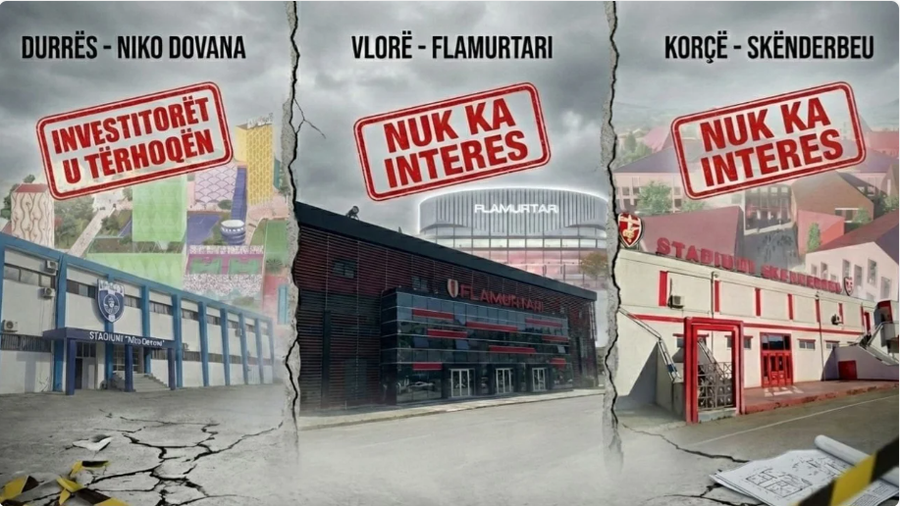
Last year, the Albanian government introduced with great fanfare what was billed as the “Renaissance of Sports Infrastructure.” The floodlights were turned on, world-renowned architects shook hands with officials in Tirana, and 3D renderings promised a futuristic future for the stadiums of Durrës (“Niko Dovana”), Vlorë (“Flamurtari”), and Korça (“Skënderbeu”).
The model seemed simple on paper, copied from the success of Air Albania in the capital: The government provides the land and development permits, while the private sector builds the stadium in exchange for commercial space and residential towers. But as the calendar marked September 30, 2025, the deadline for investors to submit bids, what was left behind was not excavators at work, but a deafening silence.
The "Stars" of Architecture and Paper Projects
The government did not skimp on the selection of the "showcase." The international competition announced the winners as prestigious studios, which brought concepts that aimed to transform not only the green fields, but the entire urban fabric of the respective cities.
Durrës (Niko Dovana Stadium) : The winner was the Belgian studio 51N4E. Their project envisaged removing the stadium's enclosure, turning it into a park open to citizens when there are no matches, surrounded by residential and service towers that would finance the work.
Vlora (“Flamurtari” Stadium) : The winner was the Japanese studio Fujiwaramuro Architects. Their project, quite avant-garde, proposed a structure that rose above the city, integrating the stadium with luxury hotel and commercial areas, aiming for elite tourism.
Korça (Skënderbeu Stadium) : The winner was the Danish studio CEBRA. Their concept was based on the winter nature and culture of the city, proposing a sports complex that also served as a park, with low but sprawling buildings that respected the local architecture.
The government's condition was clear: Public-Private Partnership. The state paid for the "dream" (design), while the billions for the "reality" (construction) had to be found by the private sector.
Deadline failure and investor "escape"
On September 30, 2025, the official deadline ended. The result? No serious and sustainable interest in taking on the financial burden of these colossus.
The most blatant case, and the one that serves as an “alarm bell” for the failure of this economic model outside of Tirana, is that of Durrës. For the “Niko Dovana” stadium, a concrete interest was initially reported. A group of investors joined the initiative, giving hope that Durrës would be the first construction site. But the enthusiasm lasted less than a month.
After doing the real calculations – the cost of steel, concrete, and above all, the return on investment (ROI) – the investor quietly backed down. The economic math simply didn’t add up. Building a modern stadium to UEFA standards requires a colossal amount of money, which the sale of apartments or commercial units in Durrës (despite rising prices) cannot justify with the same speed and certainty as in Tirana.
"Become part of the future" – Or part of failure?
Today, if you visit the official website for announcing government projects, you will encounter a paradoxical reality. Under the inspiring slogan "Be part of the future," the call is still open.
The status “continuing to be available” is a bureaucratic euphemism for saying that there is no offer. The reopening of the issue and the silent postponement of the deadlines shows that the government is in a bind. It has three magnificent architectural projects in its hands that risk remaining only expensive models in the halls of municipalities.
Why doesn't the "Air Albania" model work in the districts?
The cause of the lack of interest is not the lack of capital in the market, but the lack of financial logic in these specific projects:
1. Purchasing Power : A tower in the center of Tirana (at Air Albania) is sold for 3000-4000 Euro/m2 even before the foundations are laid. In Vlora, Durrës or Korça, the absorption of such a large construction volume (required to cover the cost of the stadium) is much slower and at lower prices.
2. High Risk : The investor's withdrawal in Durrës showed that the profit margin is too narrow to justify the risk. Building a public facility (the stadium) is a pure cost (“sunk cost”) that must be recovered from the commercial part. If the commercial part is not sold quickly, the investor goes bankrupt.
3. Lack of State Guarantee: The government requires the private sector to take all the risks. In an uncertain global economic climate, no one wants to spend tens of millions of euros on concrete for stands without a guarantee of quick profit.
The government's strategy to delegate public infrastructure to the private sector seems to have hit a wall. The call being open indefinitely after September 30 is not a sign of flexibility, but of desperation. Without a review of the conditions – whether through subsidizing part of the construction from the state budget, or providing stronger fiscal incentives – the 51N4E, Fujiwaramuro and CEBRA projects will remain digital evidence of an ambition that never touched the ground.
Until then, the "future" that investors are invited to be a part of seems to be a long wait./ Top Channel




Lini një Përgjigje