


 Shkruar nga Pamfleti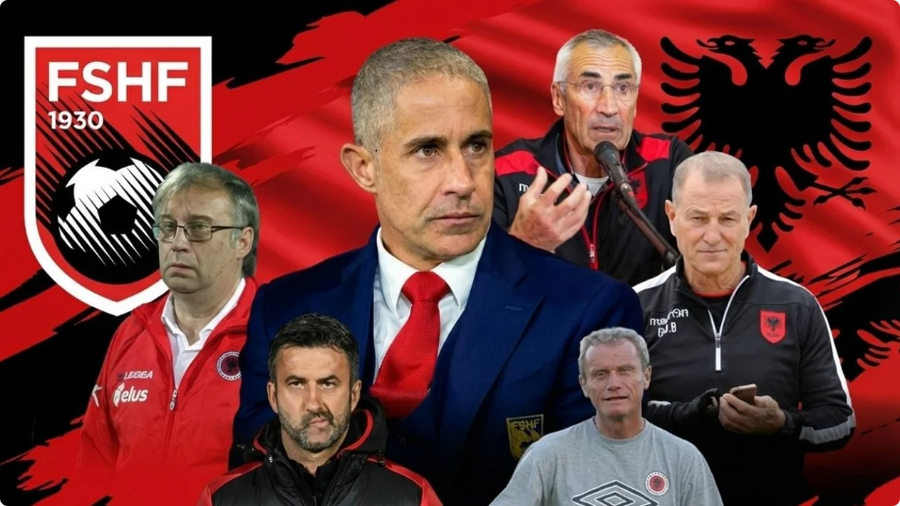
On the day of the partial contract renewal of Sylvinho and his support staff at the helm of the red and black bench in July of this year, it is worth remembering what foreigners brought to our football, the country, and the red and black boys.
If once the success of the Albanian National Team was measured by "dignified losses", today we are talking about records of victories and consecutive qualifications. An analysis of the bench of foreigners in our representative team shows that Albania has not simply had coaches, but architects who have built the new mentality. At the top of this list, with figures that challenge any predecessor, stands the Brazilian Sylvinho.
1-Sylvinho (Brazil) – Efficiency record holder
Since 2023, Sylvinho has brought enthusiasm back to the red and black camp. The statistics speak for themselves: with a win rate of around 47-50%, he is the most effective coach in modern Albanian history (for those with over 10 matches).
Balance : 12 wins, 8 draws, 12 losses (in about 32 matches until January 2026).
Major achievement : Qualifying for Euro 2024 as group winner and sending the team to the 2026 World Cup Play-offs. He injected an attacking style of play that had never been seen before in Tirana.
2-Gianni De Biasi (Italy) – "Father" of the first miracle
There can be no ranking without the man who "broke the curse." De Biasi remains the longest-serving coach and the one who gave Albania its first European passport.
Balance : 19 wins, 10 draws, 22 losses (in 51 matches).
Major achievement : Historic qualification for Euro 2016 and first win in a major tournament (1-0 against Romania). De Biasi built the steely defense that became our trademark.
3-Hans-Peter Briegel (Germany) – The coach of "big wins"
The German Briegel was the first to make the Albanians believe they could defeat the champions. Under his leadership, Albania gained the respect of Europe.
Balance: 10 wins, 4 draws, 17 losses.
Major achievement : The victory over Russia (3-1) and the one over Greece (2-1), who had just been declared European Champions in 2004. He brought German discipline to a group full of talent but without a compass.
4-Edoardo Reja (Italy) – The consolidator of the transition
Edy Reja took a team in crisis and stabilized it, giving it continuity in the Nations League and qualifiers.
Balance : 14 wins, 9 draws, 15 losses.
Major achievement : Reaching Group B of the Nations League. However, his playing style was often criticized as being too defensive, which places him below the Sylvinho-De Biasi duo.
5-Josip Kuže (Croatia) – The coach with a big heart
Kuže remains one of the most beloved figures among the fans. Even without a qualification, he brought a humane football and promising results.
Balance: 8 wins, 7 draws, 9 losses (in 24 matches).
Major achievement: The 1-0 victory over Belarus and building a group that would become De Biasi's foundation later.
The History of the "Foreign Legion": From Pioneers to Spectacular Failures
Albania's history with foreign coaches did not begin today. It dates back to 1946, when Yugoslav Ljubiša Broćić became the first foreigner to sit on our bench, immediately giving us our only title, the Balkan one. Since that year until today, a full 12 foreign coaches (excluding those with only 1-day tenure) have attempted to "tame" the rebellious nature of Albanian football.
In addition to the big names we listed above, there are several others who contributed to the history of our national team:
Otto Barić (Croatia) : A true football gentleman who, although he stayed a short time, taught us how to play as equals with giants (like the 0-0 draw against Bulgaria and important home wins).
Arie Haan (Netherlands) : He arrived as a "total" football legend, but in Albania he left the memory of a team that struggled terribly to score, leaving with a modest record of only 2 wins.
Christian Panucci (Italy) : Perhaps the biggest failure in terms of expectations; came in as De Biasi's successor with a big ego, but left the team at its lowest point in terms of morale and results.
Giuseppe Dossena (Italy) : The first to open the "Italian school" in 2002, but his adventure was a fleeting one that lasted the blink of an eye (only 2 matches).
Miklós Vadas (Hungary) & Nikolai Lyukshinov (BS) : Representatives of the eastern school of the 50s, who laid the first tactical foundations when football in our country was still in the first steps of amateurism.
In total, 12 coaches from 7 different countries (Yugoslavia, Hungary, BS, Italy, Germany, Netherlands, Croatia and Brazil) have tried their luck. Today, after many attempts, it seems that we have found the magic formula with the Brazilian-Italian school of Sylvinho, who is reaping the fruits of a path that began 80 years ago./Top Channel



Lini një Përgjigje