


 Shkruar nga EUobserver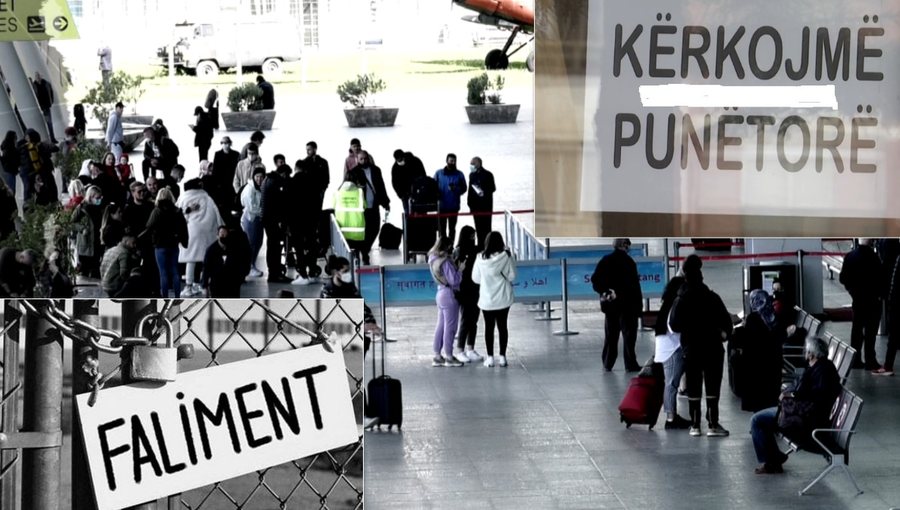
By 2023, it was reported that 3,500 doctors and nurses had left Albania for Germany. This is a nightmare for Albania. An aging population that logically requires more medical care than young people, a large-scale emigration of doctors, and fewer young people studying medicine...
A silent nightmare is happening in the Balkans, with large-scale emigration plus a low birth rate. Serbia and Albania have lost over half a million people since 2014, Bosnia and Herzegovina is expected to lose half its workforce by 2050 (more than during the 1990 wars), and Croatia losing more than a million citizens from 1990.
EU membership brings many benefits, ranging from democratization, rule of law, protection of minorities and freedom of speech. One thing that low-income countries currently or aspiring to join the EU did not anticipate was large-scale migration.
The Balkans have been the epicenter of merciless wars and ethnic cleansing – but there is nothing more dangerous than a steadily declining population, fueled by low birth rates, mass immigration and an increasingly unattractive market for foreign investment.
Reasons for leaving?
The Balkans have always been a source of immigration, and this is nothing new, with many at different times fleeing wars, poverty or simply in search of better opportunities.
In the 1960s and 1970s, Yugoslav leaders even authorized men to migrate to Germany and Austria as 'Gastarbeiter' [foreign workers]. Mass emigration quickly followed the fall of communism in Albania. For relatively small countries lacking natural resources, migration was often seen as the best option to ease the burden of overpopulation.
What has made the current situation a ticking time bomb is a much lower birth rate and the lack of a government policy to address the issue.
The region has never achieved a real market economy. Most politicians have prepared their economy to enrich themselves or their circle of friends, leaving limited and few chances for the people.
While corruption and nepotism have been a dominant factor in the awarding of government jobs, low wages in many private enterprises were an essential element in making them unattractive to local or foreign immigrants.
Due to the small size of these countries, they are not able to attract enough foreign investment or large companies that can offer a well-paid salary. Although all national governments recognize the problem, they have hardly taken any action. Apart from some restrictions on health care workers, other professions are difficult to curb - even for health care it is only a postponement,
To complicate the situation, practically everyone can easily travel from the Balkan countries to richer countries such as Austria, Italy, Germany or the Benelux countries.
Equipped with good enough language skills, finding a job and moving to another country that offers better wages or greater opportunities is easy. On the other hand, the Balkan countries are unable to bring in enough foreign labor to compensate for those who left, unlike for example Poland, which attracted 1.3-1.5 million Ukrainians (before the start of the 2022 war) as workers in different sectors.
The mass emigration of well-educated young people deprives the country of origin of jobs, in addition to the problem of an aging population and sufficient funds to maintain the pension system.
IT, tourism, health
Almost every sector suffers from emigration, but these three in particular: since almost every job is related to technology, many of the companies in the region cannot find IT experts,
The salaries offered by Croatian companies are much lower than what German companies can offer, except for social and health insurance.
Tourism was the second sector to suffer from the mass exodus. Although they are only the busiest for three to four months of the year, but crucial for the economic growth of almost all countries in the region, many supermarkets, hotels, restaurants and bars have difficulty finding the necessary staff,
Until recently, it was not difficult for hotels located near the coast to recruit Albanians from small towns to work for three to four months or to employ teenagers or students during their summer vacations. In the tourism sector, however, they are now moving to better places. The primary destination is Croatia, where the tourist season is longer and the salary is higher.
The third sector is health, while some steps have been taken to curb emigration, but these will most likely only postpone the problem, not solve it.
By 2023, it was reported that 3,500 doctors and nurses had left Albania for Germany. This is a nightmare for Albania. An aging population, which logically requires more medical care than young people, a large-scale emigration of doctors and fewer young people studying medicine, will inevitably increase hospital waiting lists.
While Bulgaria, Romania and Croatia lost population after joining the EU, Moldova, Albania and North Macedonia already lost population before joining the EU.
Can governments address the problem with higher wages, improved health care or better services? Why do young people emigrate? Can the government do anything to stop them?
These are some of the most difficult questions to answer. People migrate for a variety of reasons, and pay is certainly one of them, plus the much higher standard of living in Western Europe.
Most people leave to settle in a non-corrupt society with improved health and well-being, a rule-based society without nepotism or corruption. As young people tend to travel more widely and have the required skills, they often see more opportunities for themselves and their families in a democratic society. Therefore, this migration is very much related to financial and monetary aspects, but also to the hope for a better and safer future.
For regional governments, the way forward is to move from a combination of stabilization and authoritarian policies to a democratically organized society. / Adapted "Pamphlet" from " EUobserver " / Author: Rigels Lenja







Lini një Përgjigje