


 Shkruar nga Francesca Barca dhe Federico Caruso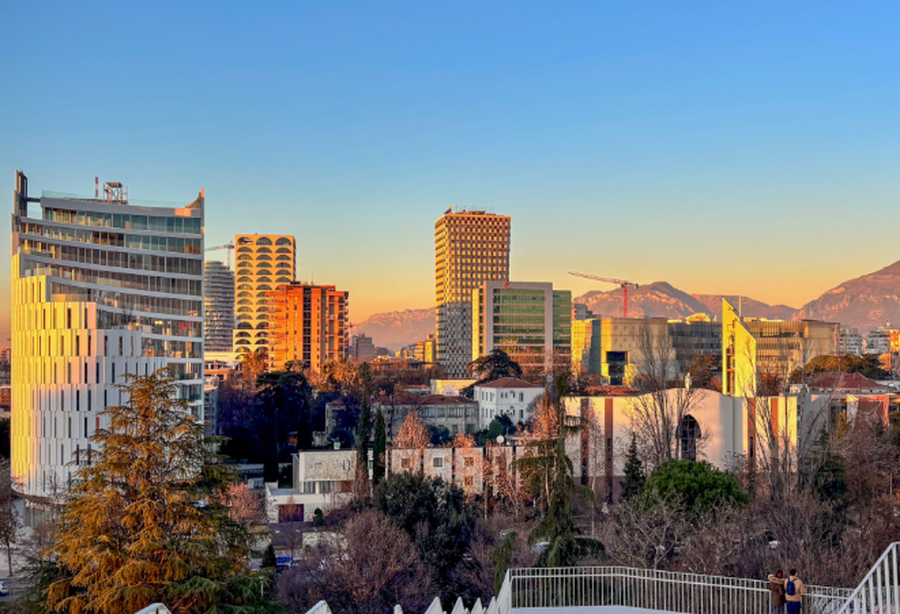
Against all logic, prices have exploded, while most buildings remain empty.
The center of Tirana is densely packed: with people, cars, bicycles, skateboards, and a wide variety of architectural forms.
During rush hour, the traffic is so heavy that it is difficult to grasp the true size of the boulevards. Architectural styles from different historical periods coexist, but it is especially the numerous skyscrapers that stand out, all new, imposing and, to one degree or another, impressive.
These are projects by the so-called "archivists": names like Stefano Boeri (known in Italy for the "Vertical Forest" in Milan), Marco Casamonti, the Dutch studio MVRDV and the Belgian 51N4E. Big names, with an international reputation, who build innovative and, according to them, environmentally friendly projects.
According to Erblin Vukaj, a journalist for the independent newspaper Citizens, these names are being used by Prime Minister Edi Rama to give legitimacy to the latest wave of construction developments. We are in the heart of Blloku, between “Brigada e VIII” and “Vaso Pasha” streets, where together with Vukaj and journalist Elira Kadriu we embark on a walk that reflects this transformation.
In the same area are small villas that likely belonged to party leaders during the socialist regime (1944–1991), buildings built after the fall of the regime, as well as more imposing structures such as Stefano Boeri’s “Cube Block” and two other towers under construction by Marco Casamonti’s studio. On one of the old buildings hangs a banner criticizing the government’s construction policies. A little further on, Vukaj points to a building that is set to be demolished to make way for another tower. The area lacks parks and bike lanes.
Empty tower in a city that is emptying
Behind the imposing architectural facade lies a void. According to INSTAT data, in 2023 one in three apartments in Albania was uninhabited. In 2024, journalist Ola Xama reported that there were over 85,000 empty apartments in the Tirana region, 52,000 of them in the capital. At the current rate of population growth, it would take about 45 years to fill these apartments.
These figures are much higher than in the 2011 census, when 21.6% of apartments were uninhabited. Meanwhile, the country is emptying: between 2011 and 2023, Albania lost nearly 500,000 residents.
However, construction continues unabated. In 2015, permits were issued for residential buildings with a total area of 50 square kilometers; in 2022, this figure increased more than 40 times, to 2,071 square kilometers, and the trend has continued since then.
In theory, an increase in supply coupled with a decrease in demand should lead to a decrease in prices. In practice, prices have increased, while wages have not.
According to the Bank of Albania, in the first half of 2025, housing prices in Tirana increased by 5.1%, while on an annual basis by 32.6%. In 2011, an apartment in the most central areas cost 700–2,500 euros per square meter; today prices range from 2,500 to 4,500 euros per square meter.
The average gross monthly income in Albania is around 82 thousand lek (850 euros). In January 2026 the minimum wage was increased from 40 thousand to 50 thousand lek (518 euros), ranking Albania among the countries with the lowest minimum wage in Europe, after Moldova and Ukraine. In Tirana it is almost impossible to find a two-room apartment for rent for less than 600 euros per month.
From "Tirana 2030" to reality
The wave of construction was driven by urban policy initiated during Edi Rama’s term as mayor (2000–2011) and continued by his successor Erion Veliaj. In 2017, the “Tirana 2030” urban plan, designed by Stefano Boeri Architetti, was approved. The plan envisioned vertical development to free up public spaces and greenery, as well as improving public transport and bicycle lanes.
According to architect and researcher Dorina Pllumbi, the plan paved the way for intense densification. “Previously, buildings could be up to seven stories, a maximum of nine. Today we have projects that exceed 70 stories,” she says. The tallest completed building is the 40-story “Downtown One,” but even taller projects have been approved.
Pllumbi emphasizes that there was a lack of care for historical heritage: old villas collapsed, while the city changes at a rapid pace, making it difficult for residents to recognize their neighborhoods.
Suspicions of money laundering
The Friedrich Ebert Foundation report, entitled “Money Laundering in the Real Estate Sector,” estimates that corruption and tax evasion generated at least 8.168 billion euros in the period 2015–2024, mainly in the construction sector. The report argues that the price increase is not explained by normal market mechanisms, but by factors that distort the relationship between supply, demand and price.
Accusations of money laundering are present in the public debate, but without concrete evidence presented publicly.
Changing the face of the city
Nearly a century ago, in 1925, Tirana was designed with the contribution of Italian architects during the fascist period. Today, according to some analysts, history is repeating itself in a different form. Pllumbi calls this a “soft coloniality of power,” speaking of an internalized sense of inferiority to the West.
Meanwhile, the city faces basic problems such as the lack of water, evident from the deposits on the roofs. For Pllumbi, these are “permanent protests”: if urban planning does not address traffic, services and quality of life, change remains superficial.
Protests have been limited, although student movements in 2018–2019 and mobilization for the National Theater showed civic discontent.
Europe as a horizon
Membership in the European Union is seen by many Albanians as a possible way out. But scholars warn that the country faces serious challenges, including transitional justice and corruption. For some, integration could be an opportunity to strengthen democracy; for others, there is a risk that Albania will remain on the periphery of larger interests.
Urban transformation is changing the appearance of Tirana, but it remains unclear whether it is solving the city's structural problems and for whom this new urban reality is actually being built./ Adapted from "Pamphlet", by "Voxeurop"


Lini një Përgjigje