


 Shkruar nga Pamfleti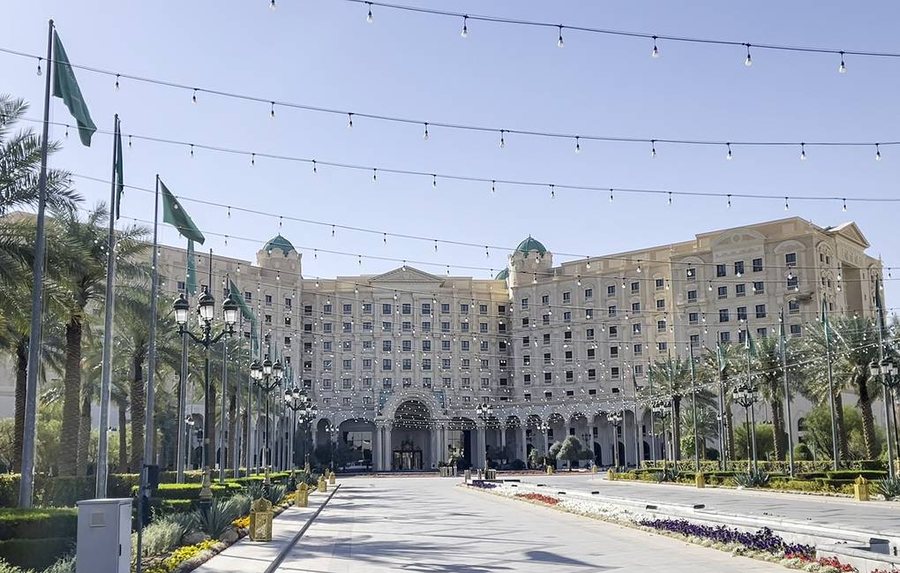
US and Russian officials have begun talks in Saudi Arabia as Donald Trump pushes the idea of brokering a limited ceasefire that Washington hopes will mark the first step towards lasting peace in Ukraine.
Ukraine and Russia have agreed in principle to a month-long halt to strikes on energy infrastructure after Trump spoke with the countries' leaders last week. But uncertainty remains about how and when the partial ceasefire will take effect — and whether its scope will extend beyond energy infrastructure to include other critical sites, such as hospitals, bridges and vital services.
U.S. officials held initial talks with Ukraine on Sunday evening and negotiated separately with Russia on Monday, with most of the meetings taking place at the Ritz-Carlton hotel in Riyadh. Monday's talks were still ongoing after more than eight hours, according to Russian state media.
The United States is expected to transit ships between the two countries to finalize details and negotiate special measures to ensure the safety of maritime transport in the Black Sea.
"The ultimate goal is a 30-day ceasefire, during which we discuss a permanent ceasefire. We're not far from that ," US special envoy Steve Witkoff said on a podcast with far-right commentator Tucker Carlson over the weekend.
Moscow, meanwhile, appears to be exploiting the window before any ceasefire is in place, launching massive drone strikes into Ukraine on Monday. Ukrainian officials said a Russian missile had also damaged a school and a hospital in the northeastern Ukrainian city of Sumy, injuring at least 74 people, including 13 children.
" Moscow talks about peace while carrying out brutal attacks on densely populated residential areas in major Ukrainian cities. Instead of making empty statements about peace, Russia should stop bombing our cities and end its war against civilians ," said the country's foreign minister, Andrii Sybiha.
Ukrainian and American delegations discussed proposals to protect energy facilities and critical infrastructure on Sunday, Ukraine's defense minister said.
Ukrainian President Volodymyr Zelensky said his country's delegation at Sunday's talks was working in a "completely constructive manner," adding: "The conversation is quite useful, the work of the delegations is continuing."
Zelensky earlier said he would provide the U.S. with a list of energy infrastructure that would be off-limits to attacks by the Russian military. The Ukrainian delegation is expected to hold additional discussions with U.S. officials on Monday.
"We are implementing the directive of the Ukrainian president to bring a just peace closer and strengthen security ," Rustem Umerov, the Ukrainian defense minister who is leading the country's delegation, said on Facebook.
Russia is represented in the talks by Sergey Beseda, a secret adviser to the Russian FSB security service, and Grigory Karasin, a former diplomat who negotiated the 2014 Minsk agreements between Russia and Ukraine.
As Russia-U.S. talks began in Riyadh, Trump said he expected Washington and Kiev to sign a revenue-sharing deal for Ukraine's critical minerals soon. Trump also told reporters that the U.S. was talking to Ukraine about the potential for its firms to own Ukrainian power plants.
Ukrainian officials have supported signing a minerals deal, but Zelensky has publicly rejected the idea of American firms owning Ukrainian power plants.
The progress of the talks was marked by a series of controversial pro-Russian statements from Witkoff – intercepted by Trump as his personal envoy to Putin – in which he appeared to legitimize Russia-organized referendums in four regions of Ukraine.
Speaking to Carlson, Witkoff claimed that in the four regions where Moscow held widely condemned referendums on joining Russia, the vast majority of people have indicated that they want to be under Russian rule.
The referendums in the Luhansk, Donetsk, Kherson and Zaporizhzhia provinces were widely condemned in the West as illegal and seen as a thinly veiled attempt to justify Russia's illegal annexation of the regions. Their annexation marked the largest forcible seizure of territory in Europe since World War II.
In the interview with Carlson, Witkoff also claimed that Putin had commissioned a portrait of Trump "from a leading Russian painter" that the envoy had brought with him after a trip to Moscow.
Witkoff went on to say that after the assassination attempt on Trump last July, Putin told him that he visited his local church, met his priest, and prayed for Trump.
" Not because he was the president of the United States or could become the president of the United States, but because he had a friendship with him and he prayed for his friend. I don't consider Putin a bad guy. This is a complicated situation, that war and all the components that led to it ," Witkoff said.
Witkoff’s willingness to echo the Kremlin’s talking points and his praise of Putin is likely to heighten anxiety in Ukraine and across European capitals. In an interview with Time magazine published on Monday but conducted before Witkoff’s comments, Zelensky said that some American officials had begun to take Putin at his word even when it contradicted their own intelligence.
"I believe that Russia has managed to influence some people in the White House team through information. Their signal to the Americans was that the Ukrainians do not want to end the war and something must be done to force them ," he said.
Moscow and Kiev remain far apart on acceptable terms for a peace treaty, with no sign that Putin has given up any of his maximalist goals in the war against Ukraine.
Moscow has imposed several maximalist conditions on any long-term solution – most of which are non-starters for Kiev and its European allies. These include a ban on all foreign military aid and intelligence sharing with Ukraine, limits on the size of its armed forces, and international recognition of four Ukrainian regions illegally annexed by Russia after referendums held in 2022.
The Kremlin has also signaled that it would reject any Western troop presence in Ukraine – something Kiev sees as essential to ensuring lasting security guarantees.
Ukraine remains deeply skeptical of any Russian deal, pointing to past instances where Moscow failed to honor its commitments./ TheGuardian



Lini një Përgjigje