


 Shkruar nga Nathalie Tocci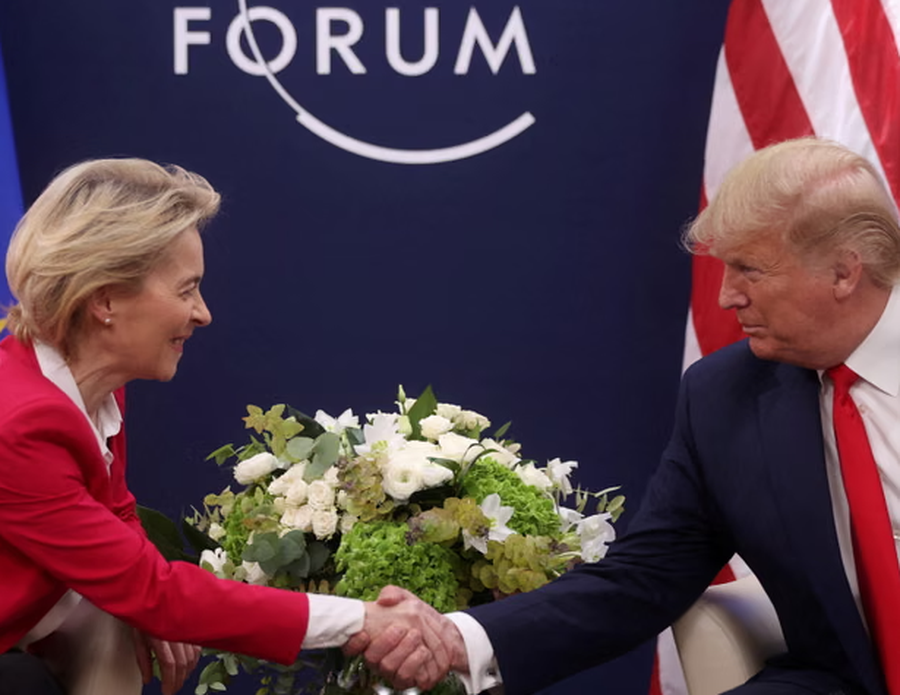
When threatened with US tariffs, Europe was initially optimistic. But the influence of nationalist leaders sympathetic to Trump has caused a rift.
Donald Trump’s trade policy has been labelled by his critics as “Trump always refuses”. But when it comes to his latest trade war with the EU, it is Brussels that risks refusing. The US and the EU have been negotiating for months for a deal. This week Trump made the shocking announcement that the US would hit the EU with punitive tariffs on goods at a devastating rate of 30% from August 1. This was in addition to separate tariffs on steel and aluminium, and even more punitive tariffs on cars.
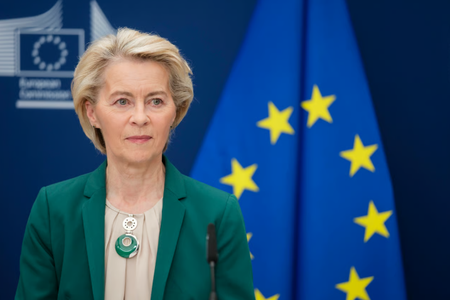
Stunned Brussels negotiators calculated the economic damage and ministers talked of retaliation. Ursula von der Leyen, the president of the European Commission, warned that “all necessary steps will be taken to protect the EU’s interests.” But so far, despite the tough words, the EU is hesitant. The hope of finding a reasonable compromise, which is the preoccupation of German Chancellor Friedrich Merz, makes economic sense. But the political consequences of the EU’s silence and perceived weakness could be huge.
Brussels’ initial strategy in the talks with the US was to aim for a “0% for 0%” tariff deal. It argued that the overall transatlantic trade balance, including services as well as manufactured goods, should be taken into account. For although (as Trump bitterly complains) the EU enjoys a sizeable trade surplus in goods with the US, amounting to around €200 billion a year, it consistently runs a deficit in services, particularly in technology services, amounting to around €150 billion a year.
When the UK reached an early “framework agreement” with the US, accepting a 10% US tariff on its exports but leaving open negotiations for exemptions in a number of specific sectors, it was scornfully regarded in EU circles as a bad deal.
A 10% tariff is, after all, quite high. Keir Starmer shaking hands with this seemed to be sealing the end of the era of free trade. The assumption was that given the EU’s economic size and its dependence on European markets for certain American exports, for example Harley-Davidson motorcycles, Brussels had the leverage to do much better: to persuade Washington into a more trade-friendly deal.
In fact, China, whose economic weight is comparable to that of the EU and much higher than that of the United Kingdom, used its influence to secure a trade truce, which is as much, if not more, in Beijing’s interest than Washington’s. Washington and Beijing are now working towards a summit in the fall.
With Europe, the negotiations have not gone so well. While the Trump administration has recently resumed its attacks, threatening Mexico, Canada and Brazil, the instability has made the EU restless, eager to sign a deal at any cost. In the spring, on Trump’s so-called “liberation day”, the EU had been set on threatening significant retaliation, including the possibility of its “nuclear option”, an anti-coercive trade instrument that would severely limit US access to the EU’s internal market. All of this was put on hold after the White House first took notice, reducing its initial threat of 20% tariffs to a base level of 10%, along with higher sectoral tariffs.
The prevailing view among EU member states then was that, rather than follow Trump into the pit of a bitter trade war, they should negotiate a comprehensive free trade agreement. In the background, European governments also feared that Trump would exploit their dependence on the US for military protection by attacking, particularly against Ukraine, at the NATO summit in The Hague.
The Hague summit took place and ended in June. No deal was reached on trade, but talks continued. Then Trump dropped his latest bombshell, including on agriculture and pharmaceuticals.
But once again, the EU has reacted. A package of potential counter-tariffs designed to hit US exports worth 21 billion euros a year has been delayed. The European Commission is working on an additional list of retaliatory tariffs, including US goods such as aircraft, alcohol and food, initially worth 95 billion euros. But that has been reduced to 72 billion euros and may never come into force. Talks on implementing the anti-tipping instrument are on hold for now. Meanwhile, the US is applying tariffs on around 380 billion euros of annual imports from the EU.
As with all sanctions, retaliatory tariffs would be self-defeating. It makes economic sense to focus on doubling down on removing trade barriers with other countries. In this regard, the European Commission has been active. In addition to free trade agreements with four of the Mercosur group (Argentina, Brazil, Paraguay and Uruguay) and Mexico, which were reached before Trump took office, the EU has accelerated the pace of talks with Australia, New Zealand and India, and has launched negotiations with the United Arab Emirates.
After many years, it has just reached an agreement with Indonesia. It has also proposed the Comprehensive and Progressive Agreement for Trans-Pacific Partnership, which includes 11 Asia-Pacific countries plus the United Kingdom, to deepen relations and explore the possibility of developing a new World Trade Organization, since the original has been blocked by the United States for many years.
But it is one thing to make speeches and even sign trade agreements, and quite another to implement them. To mention the most obvious and painful point, ratification of the free trade agreement with the Mercosur bloc remains blocked. However, there is real momentum behind the EU's trade policy with both countries in the “rest of the West” and the “rest” of the global South.
But none of this changes the reality that giving in to Trump’s trade harassment could backfire politically for Europe. Even though trade is managed by the EU collectively, not by individual governments, political decisions still require approval by a qualified majority of member states. And it’s no secret that European countries are divided between doves and hawks.
The doves are prevailing so far. These include right-wing, nationalist, Trump-friendly countries like Giorgia Meloni’s Italy, countries like Germany that are heavily exposed to US trade, and northern and eastern member states that fear Trump’s wrath over protectionism. Together, they make up a strong majority. So strong that if the US were to continue the bullying, the EU could continue to bend to the breaking point, perhaps even going so far as to relax its digital regulations, which is arguably the real price Trump is asking.
This bowing to Washington would constitute a significant undermining of European integration. And although right-wing EU governments share responsibility for the appeasement agreed so far, they would also benefit politically from a bad deal, blaming the “Brussels bureaucrats” for the damage.
If, for example, the EU ends up agreeing to a US tariff base of 15% or 20%, plus higher sectoral tariffs – in other words, a worse deal than the UK’s – it will be hard to argue that European unity has been a source of strength. Europe’s tendency towards nationalism and the far right is weakening the continent. While doing so, it is strengthening those far-right forces that are damaging Europe’s interests./ “The Guardian”





Lini një Përgjigje