


 Shkruar nga Magdaléna Fajtová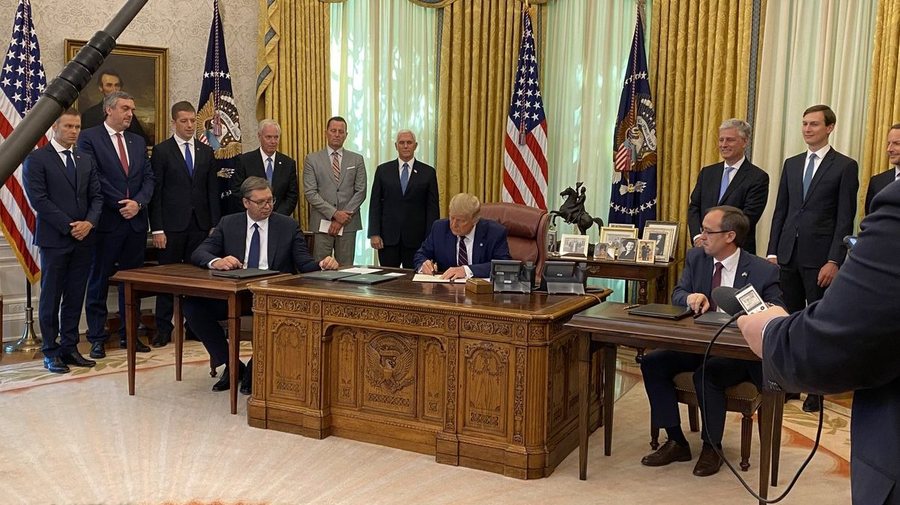
Whether the Trump administration will be friendly to Serbs — not just those living in Serbia, but also those in Bosnia and Herzegovina — will probably depend on where Richard Grenell stands...
Donald Trump will once again become the American president and the most important politician in the world. The result of the presidential elections in the USA will also have an impact on politics in the Balkans. For some leaders in the region, Trump represents a hope for change in the direction of US diplomacy, which may now become more friendly to the Serbs. Whether this will really end like this, perhaps even Trump himself does not know.
The former president probably celebrated the victory with joy. Abroad, no one would have celebrated Trump's victory with more enthusiasm than Milorad Dodik, president of the majority-Serb entity of Bosnia and Herzegovina. On his Instagram profile, he published six posts expressing his overwhelming joy at Trump's victory — including a video in which he wears Trump's famous "Make America Great Again" hat, claiming that he should says "Make Republika Srpska Great Again".
Later, Dodik also released a video from a party where he and Serb member of Bosnia's tripartite presidency, Zeljka Cvijanovic, are sitting at a table of food and drinks, with Dodik and several musicians singing his favorite nationalist song "Srpkinja je mene majka" (I was born to a Serbian mother). At night, the building of the president of Republika Srpska was decorated with a giant light projection of Donald Trump against the background of the flags of the Serbian nation (which look like upside-down Russian flags) and the USA, with a giant inscription in Cyrillic script " Congratulations from Republika Srpska".
Dodik says he expects the Trump administration to lift US sanctions against him as an individual. Washington imposed sanctions on Dodik years ago for violating Bosnia and Herzegovina's constitution, taking steps that weaken the influence of the central government. For several years, he has escalated his threats to expel Republika Srpska from Bosnia and Herzegovina.
Aleksandar Vucic, the president of neighboring Serbia, is probably also celebrating Trump's victory. He was one of the first heads of state to congratulate him. He had already supported him in previous elections, but as is typical of Vucic, he has also maintained good relations with the Biden administration.
Trump family members and allies have recently invested in major projects in the Balkans. Early last year, the Serbian government approved a multi-million dollar contract with Trump's son-in-law, Jared Kushner, to build a luxury hotel on the site of the former Ministry of Defense in Belgrade. The building, located in the center of the city, was bombed during the NATO-led military intervention in 1999.
Since then, the destroyed building has served as a reminder of the event, which is – to this day – why the vast majority of Serbs are against NATO membership. Whether the Trump administration will be friendly to Serbs — not just those living in Serbia, but also those in Bosnia and Herzegovina — will probably depend on Richard Grenell's position in it.
During Trump's first term in office, Grenell served as Trump's special envoy for negotiations between Serbia and Kosovo, almost succeeding in finalizing an agreement between the two countries. The deal finally broke down in 2020 after the special court for Kosovo in The Hague accused the then president of Kosovo, Hashim Thaçi, of crimes against humanity, which he was alleged to have committed during the Kosovo War.
According to German public broadcaster Deutsche Welle, the deal was also supposed to include a "territory swap", swapping Serb-majority villages in northern Kosovo for an Albanian-minority region in southern Serbia. This raises the question of how this kind of problem-solving would have been viewed in the rest of the Balkans, where almost everyone argues with everyone else over territory.
Eventually, Vucic sat down with Trump in the Oval Office, signing an agreement on economic relations with the Prime Minister of Kosovo, Avdullah Hoti. The agreement included the resumption of the first direct Belgrade-Pristina flights since the war in Kosovo, a commitment to create a planned "mini-Schengen area" in the Balkans, a one-year moratorium on Serbian lobbying for the revocation of Kosovo's recognition, and a suspension of Kosovo's efforts to join international organizations.
Four years have passed since then and relations between Serbia and Kosovo have deteriorated significantly following disputes between ethnic Serbs and the Kosovo authorities. Kurti, who has refused to compromise with Belgrade, has returned to his post as prime minister. The only thing left of the deal is a strange video in which Trump announces that the deal will also include moving the embassies of Serbia and Kosovo to Jerusalem. In the video, Vucic looks like he's hearing this for the first time. /Adapted "Pamphlet" from " Respect "


Lini një Përgjigje