


 Shkruar nga Pamfleti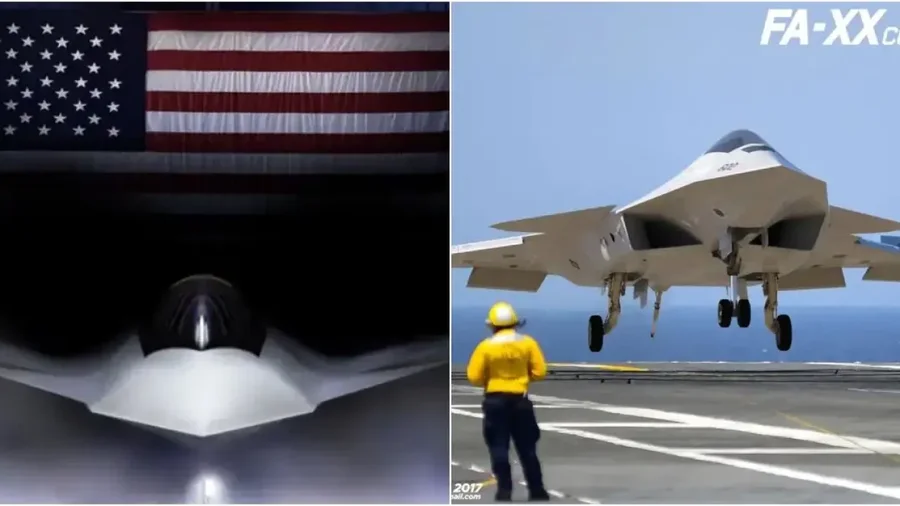
How the US is quietly renewing its air fleet with sixth-generation fighter jets. The race between the Navy and the Air Force, what is happening between the two American military structures?
The US military is entering a defining era of air dominance, marked by a quiet but fierce rivalry between the US Air Force's Boeing F‑47 and the US Navy's sixth-generation F/A‑XX fighter jet.
While both platforms fall under the broader vision of Next Generation Air Dominance (NGAD), their different development paths, timelines, and strategic support reveal a growing inter-service competition that is reshaping priorities in American airpower.
Conceptual images of the US Air Force's F-47 and US Navy's F/A-XX sixth-generation fighter jets highlight the distinct strategic roles and design priorities shaping the future of American air dominance.
The F-47 has advanced in both funding and political momentum. Led by Boeing and integrated into the U.S. Air Force’s highly secretive NGAD framework, the F-47 is designed as a long-range, stealthy air superiority fighter capable of penetrating deep into contested environments. With a projected combat range exceeding 1,000 nautical miles and a cruise speed above Mach 2, the F-47 represents a major leap in survivability and lethality. It will operate as the piloted center of a distributed air combat force supported by autonomous combat drones, all networked through a secure digital battlespace.
This aircraft is tailored to meet the US Air Force's requirement for penetration and air superiority. It will replace or complement the F-22 Raptor, a fifth-generation fighter that, despite its exceptional stealth and maneuverability, lacks the operational range, sensor integration, and adaptability to compete in the highly contested environments of the future.
The F-47 will integrate adaptive-cycle engines from the NGAP program, providing on-demand switching between high-thrust and high-fuel-efficiency modes. It will also feature advanced sensor fusion, infrared-guided countermeasures, artificial intelligence-assisted pilot decision-making, and high-bandwidth data links for controlling cooperative fighter aircraft. These features offer exponential gains over the F-22, F-15EX, and even the F-35A in terms of survivability and mission effectiveness.
In contrast, the U.S. Navy’s F/A-XX, envisioned as a stealthy, carrier-based, multirole fighter, is facing significant delays. Budgetary constraints and capacity constraints within the aerospace industrial base have forced the Pentagon to delay the engineering and production development phase of the F/A-XX. Industry sources reveal that senior defense officials made a deliberate compromise: they accelerated the Air Force platform at the expense of the Navy’s, in order to maintain the critical timeline for achieving operational air dominance by the early 2030s.
It will replace the F/A-18E/F Super Hornet, which lacks the stealth and range for close-quarters combat environments. The F/A-XX will have improved low observability optimized for both air-to-air and deep strike missions, integrated electronic warfare capabilities, and possibly an optional manned/unmanned cockpit configuration.

Unlike the Air Force's F-47, the F/A-XX must meet stringent carrier-suitability standards, including folding wings, a reinforced landing system, and catapult compatibility. Its greater internal fuel capacity and ability to control autonomous wings will make it a transformative force multiplier for carrier air wings.
Both fighters were intended to utilize the Next Generation Adaptive Propulsion (NGAP) system, but engine development has not kept pace with advances in the airframe. As a result, early F-47 series may enter production using legacy propulsion systems. This compromises range and survivability, two pillars of the NGAD concept, and presents a critical vulnerability if threats from others, particularly China’s J-20 and J-35 platforms, advance more rapidly than anticipated.
The U.S. Navy now faces a difficult crossroads. Operational commanders continue to support the rapid delivery of the F/A-XX to maintain naval aviation reliability in high-stakes Indo-Pacific conflict scenarios. However, a lack of funding and production sites means the Navy may be forced to extend the life of its F/A-18E/F Super Hornet aircraft well beyond their originally intended expiration date. This could result in a capability gap, just as adversaries are fielding advanced fighters with greater range, stealth, and sensor fusion.
The F-47 is essential for the United States to maintain air superiority over vast and contested regions such as the Western Pacific and Eastern Europe. As threats from China and Russia evolve to include long-range missiles, integrated air defense systems, and next-generation aircraft, the F-47's role as a penetrating air-to-air platform becomes imperative.
On the other hand, the F/A-XX is just as vital, but for a different purpose. As adversaries develop anti-access/area denial (A2/AD) capabilities that threaten U.S. carrier strike groups, the Navy needs a next-generation fighter that can survive in highly contested environments. The F/A-XX must operate from carriers, execute strike and air superiority missions, and enable distributed maritime operations. Without it, the Navy’s air wing risks becoming obsolete in a scenario where sea-based aviation must confront peer-level threats far from U.S. shores.
The F-22 and F-35 currently form the backbone of U.S. tactical air power. The F-22 excels in air combat and stealth, but it lacks the sensor upgrades, digital backbone, and range needed for operations in the Pacific.
The F-35, while versatile and widely deployed, is not designed for high-level air counterattack roles at the scale and depth expected in a level-playing field. Likewise, the F/A-18E/F and EA-18G Growler remain capable platforms, but lack the survivability and digital integration that sixth-generation warfare will require. Both the F-47 and F/A-XX are designed not only to replace these aircraft, but to define new airpower doctrines based on manned and unmanned aircraft cooperation, distributed lethality, and multi-domain network fusion.
According to experts, both aircraft are essential to maintaining US supremacy in all areas, however the imbalance in development timelines and resources risks creating a strategic vacuum. The current priority clearly favors the F-47 due to its advanced stage of development and compatibility with emerging multi-domain operational doctrines. /Adapted from Pamphlet by Army Recognition/






Lini një Përgjigje