


 Shkruar nga Maureen Dowd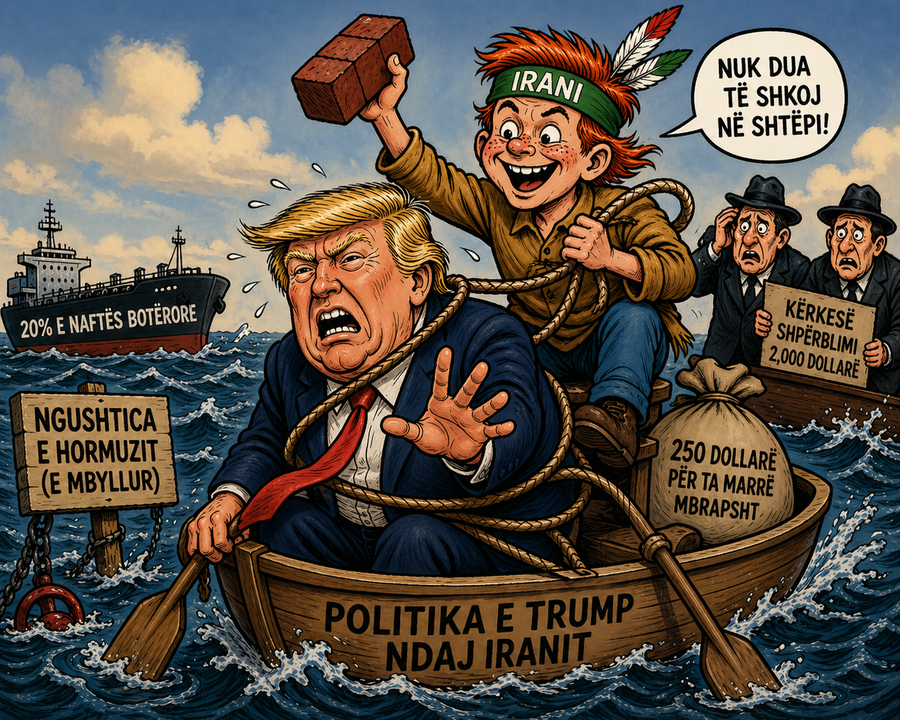
"I caught a thief, I want to let him go but he won't let me go"
" It seems like something good: but wait until I show you ."
Thus begins O. Henry's classic short story: "Red Chief's Bounty."
The tale, written in 1907, is the ultimate parable about the dangers of trying to capture and control a boy so cunning, so terrifying, that the kidnappers become captives.
The story is about two petty thieves who think they can make easy money by kidnapping a 10-year-old boy, the son of a wealthy landowner in a quiet Alabama town.
They grossly underestimate him. When they go to kidnap the red-haired, freckle-faced boy, he's throwing rocks at a kitten and hitting one of his kidnappers with a brick.
“ Red Chief, the terror of the fields, ” as the boy calls himself, wears the kidnappers out of their wits. He delights in torturing the men and refuses to return home. In the end, they are forced to give up their demand for a $2,000 ransom, and are even prepared to pay the boy’s father $250 just to take the child off their hands.
President Trump followed Bibi Netanyahu's optimistic argument for striking Iran. It seemed like a good idea, but ' wait until I tell you .'
After nearly two months of confrontation with the Iranian leadership and its allies, Trump seems inclined to back down. He repeatedly declares that he has defeated the clerics and “destroyed” their military power, yet Iran does not surrender.
Trump says he has a new regime that is easier to manage, but in fact it is the same regime, even tougher, run by strong and fanatical generals. Iran has not handed over its enriched uranium and negotiations remain uncertain. The Strait of Hormuz, which Trump insists is open, is in practice closed. The US is blocking the Iranian blockade.
“ Iran has proven far more resilient and capable than anticipated ,” writes Richard Haass, former foreign policy adviser to President George W. Bush, in his newsletter “Home & Away.” “ Almost all of the administration’s assumptions have proven wrong ,” he continues.
In addition to the weakening of Iran's conventional military capabilities, according to Haass, "almost every other indicator shows that the United States, the region, and the world are in a worse state."
Iran continues to challenge Trump symbolically, mocking him on social media as a “loser” and a figure dependent on Netanyahu. A viral Iranian rap song describes the conflict as “a trap you didn’t see.”
Meanwhile, American analysts and media note that the US must negotiate to return to a previous situation. The Strait of Hormuz remains a strategic point, through which over 20 percent of the world's oil passes.
Trump, who once called the Iraq intervention a huge mistake that destabilized the Middle East and cost the country dearly in money and lives, is now facing the consequences of a new involvement. He has reportedly ignored warnings about the military costs and strategic risks of a conflict with Iran.
In public communications, he continues to use hyperbolic and optimistic language, while his administration faces internal pressures, including rising energy prices and a lack of focus on the economy.
In this context, the analogy with O. Henry's story remains clear: a situation that seemed simple at first has turned into a complicated and unpredictable confrontation. / Adapted from "Pamphlet" by "NYT"


Lini një Përgjigje