


 Shkruar nga James Batchik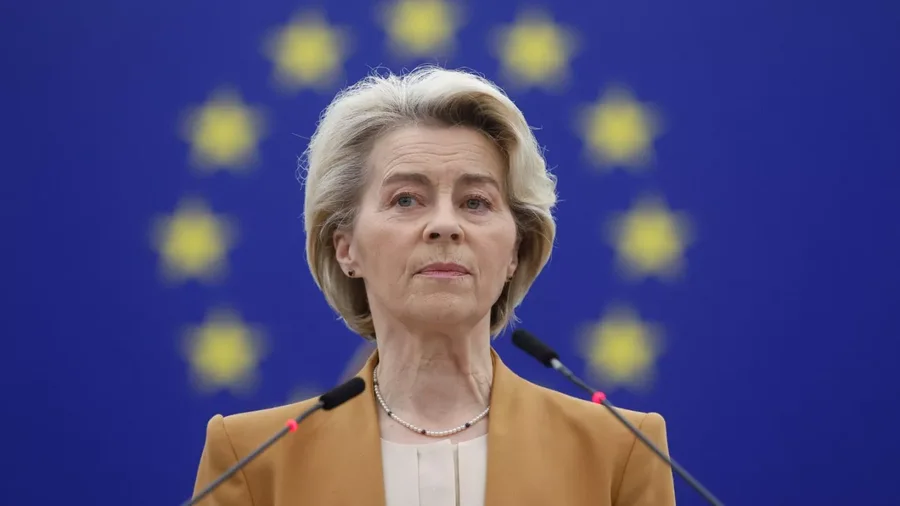
And as the European Commission tries to take a bigger role in traditional member state-led policies such as security and defence, Von Der Leyen will have to contend with more engaged member states who will demand concessions or exert their influence at the EU level.
The European Parliament voted on Thursday by a large margin in favor of the election of Ursula Von der Leyen for another 5-year term as president of the European Commission. Her confirmation in this post is good news for Europe and transatlantic relations.
But this time, she will face a different set of challenges than in her first term, and they will come from both inside the European Union and outside it. But what can be expected from her in the new mandate? Before the confirmation, Mrs Von Der Leyen promised a series of steps for the next term, in a combined effort to outline her vision but also to win the necessary votes.
In short they include building a more competitive Europe, which balances regulation and innovation and facilitates the transition to a less polluting economy; increasing the EU's ambitions in the field of defense; promoting social and economic policies such as affordable housing for all; supporting agricultural and environmental policies; the protection of democracy in Europe and the support of its global and geopolitical interests.
In practice, this means that her next term means a more central and active role for the Commission, and for Von Der Leyen herself. But there are also likely to be more obstacles from the European Council and Parliament. First let's dwell on her leadership style. In his first term, Von Der Leyen turned the European Commission into the most important arm within the EU, at a time when new crises were frequent. She was the EU's chief decision-maker and negotiator during the Covid-19 crisis, helped coordinate Europe's response to Russia's full-scale invasion of Ukraine, and dictated the EU's strategy for economic non-threatening and a tougher approach to China, acting as Europe's "bad cop" confronting Beijing's coercive and unfair trade practices.
Putting aside complaints of a leader suppressed by other EU bodies and national capitals, European leaders called on the Commission and Von Der Leyen to take concrete action on the challenges. Thus the role of EC was further increased by its successes.
In her first term, the main regulations for the digital and green transition were approved. The EU was a world leader in regulations on the use of Artificial Intelligence, internet content moderation and competition between platforms, while also boosting semiconductor production on the continent.
It also prioritized green policies to reduce greenhouse gas emissions, including the Carbon Cap Adjustment Mechanism and setting new emission reduction targets for cars, transport and factories.
The growing number of far-right groups is likely to add to the difficulties in the process of drafting and passing laws. In her second term, Von Der Leyen will seek to continue the work where she left off. Also, the Commission will aim to have a greater role in the traditional defense and economic security agendas, with the aim of strengthening Europe's defense capabilities against Russia and avoiding the threat from China.
Von Der Leyen's focus on a competitive agenda will drive innovation and greater support for industries furthering the green transition. In her speech after the vote, Ms Von Der Leyen promised a "European competition fund" and a "clean industry deal" within the first 100 days of the next term, along with greater investment in energy infrastructure and technology. .
And all this will come at a financial cost, and with more responsibility for the Commission. On the other hand, there will be limits to its ambitions, as states and parliaments of member countries will seek to exercise their power. Europe's political center is not what it was in 2019, and EU members will want to increase their influence.
Under these conditions, Mrs Von Der Leyen will be forced to face a growing number of populist leaders around the table at Council meetings. More far-right governments could emerge over the next 5 years, including in major countries like France, as Marine Le Pen's National Rally moves ever closer to power.
And as the European Commission tries to take a bigger role in traditional member state-led policies such as security and defence, Von Der Leyen will have to contend with more engaged member states who will demand concessions or exert their influence at the EU level.
Even the far-right and far-right groups in the European Parliament will aim to have their say. Unlike her first term, hard-right politicians are more interested in influencing EU policy than working against it.
The growing number and influence of far-right and traditional right-wing groups is likely to add to the difficulties in the legislative process, and laws may be passed through temporary coalitions rather than in the tradition of grand coalitions of parliaments in the past.
The greater influence of the right may hinder the ambition of adopting new regulations by the Commission. Von Der Leyen promised to continue the green transition, but the EU's green rules have already become a political target attacked by the right. The platforms of the center-right European People's Party (EPP), which includes Von Der Leyen and European conservatives and reformists, have expressed opposition to new tough regulations, especially those related to the green transition.
In the institutional aspect, the Commission was created to present new regulations and proposals. It is the only body within the EU that can do this. But this desire will be a moment of friction with the disgust that exists between the member states and the Parliament towards the new rules, which are too harsh for them.
But Von Der Leyen will also face challenges from beyond Europe. "We have entered an era of geostrategic rivalries" - it is emphasized in its proposals. To the east, Beijing will continue to try to divide Europe and sabotage the EU agenda. Meanwhile, supporting Ukraine against the Russian invasion will require sustained attention and funding.
In the West, Von Der Leyen cannot ignore the upcoming US elections. An ardent transatlanticist, she brought the EU closer to the US during her first term,
benefiting from a new administration in Washington that was friendly to Brussels.
Meanwhile, in the event of a second Trump term, she is likely to face an uphill battle to strengthen transatlantic ties. "The Europeans are treating us very badly!"- former president Donald Trump said on June 25 to Bloomberg, when asked about the European Union.
The confirmation in office of Von Der Leyen increases the likelihood that the EU will succeed in its goals. Rejecting her candidacy would have forced the European Council to restart negotiations to choose another, perhaps weaker, name, wasting more time with internal strife and politics, precisely at a time when predictability, not chaos, is vital. .
If Von Der Leyen's candidacy were to fall, it is not difficult to imagine the silence from Beijing, the mockery from Moscow, and even the harsh comments from Washington about the EU's dysfunction. According to Greek commissioner Margaritis Schinas (ally of Von Der Leyen) there was "no plan B" to her appointment. So it's good that plan A worked./ Adapted "Pamphlet" From "The Atlantic"
Note: James Batchik, associate director at the Center for Europe at the Atlantic Council think tank.




Lini një Përgjigje