


 Shkruar nga Pamfleti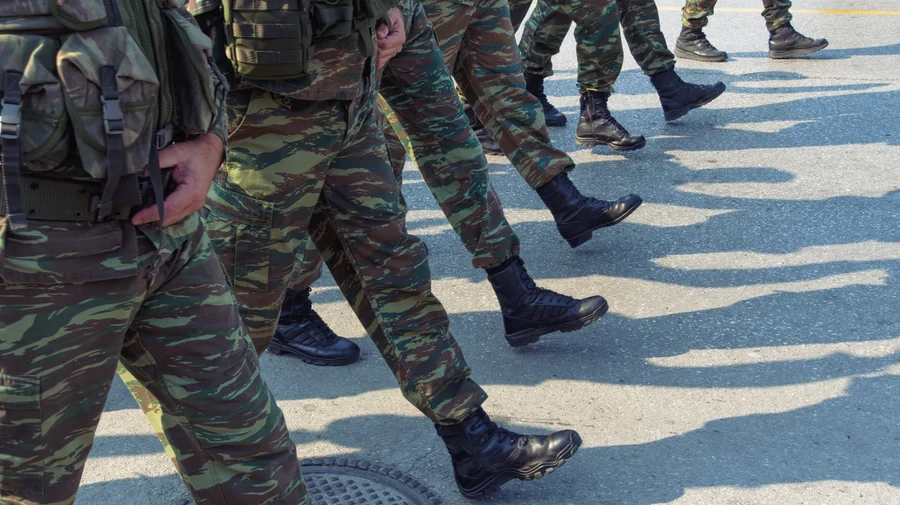
The implementation of the new military service model will begin from February 24 to 27, 2026. Defense Minister Nikos Dendias links the reform to the "Agenda 2030" plan and to adapting to geopolitical and technological developments...
The Ministry of National Defense of Greece presents the new model of military service with the classification of the First Military Service Corps 2026, which will take place from 24 to 27 February. Minister Nikos Dendias stated that the new service constitutes one of the main pillars of the “Agenda 2030” reform. Dendias justified the intervention with the need to adapt to geopolitical and technological developments and the changing nature of military operations, based on the experience of recent conflicts.
10 weeks of basic training in the Land Army only
The reform establishes as a central pillar a basic training that lasts more than 10 weeks and takes place exclusively in the Land Army. The ministry aims to form a reservist with concrete operational skills and specializations that can also be used in civilian life.
The program includes:
Increase in practical training time.
Increased shooting, including night shooting, pistol shooting, and grenade throwing training.
Increased marches, small group exercises, and overnight stays in the field.
Combination of marching with shooting and night operations.
The ministry also introduces training in first aid, fire protection, and environmental management.
A new element is training in Unmanned Aircraft Systems. Recruits undergo theory, simulator training with scenarios of increasing difficulty, and a final exam. Candidates who pass the final phase receive certification as UAS operators and a uniform badge.
Four ESSO stages and 13 training centers
The number of ESSO classifications decreases from 6 to 4, in February, May, August and November.
All recruits are initially classified in the Army. Only those with specific qualifications are transferred to the Air Force or Navy.
Recruits are distributed among 13 training centers. The service lasts 12 months. Exceptions are those assigned to Thrace, the East Aegean Islands, ELDYK and the Evzone Company of the Presidential Guard, who serve 9 months.
The training is divided into three phases:
The basic phase at the classification centers, which includes the classification week and the oath.
Specialization phase in Special Training Units or Lifelong Learning Centers.
The operational integration phase in units where recruits complete the remainder of their service.
After basic and special training, 70 percent of recruits are assigned to units in Thrace and the East Aegean.
Specializations reduced from 46 to 19
The Ministry abolishes specialties that do not meet the requirements of the modern operating environment and reduces them from 46 to 19 educational fields.
For the first ESSO, Lifelong Learning Centers offer specializations such as machine operator, lifeguard and equipment diver, weapons operator, drone operator, and cybersecurity program at the School of Computer Programmers.
Doctors, pharmacists, nurses, physiotherapists, microbiologists, IT officers, musicians and chemists are transferred directly to the unit.
The payment increases from 8.8 euros to 100 euros
The reform also changes the monthly compensation. Soldiers serving in Thrace and the Eastern Aegean islands will receive 100 euros per month, up from the 8.80 euros they received before. Those serving in the interior will receive 50 euros.
Children from large families will receive 150 euros from 35 euros. Parents of military personnel will receive 150 euros for one child, 200 euros for two, with an additional 50 euros for each additional child. Unmarried orphans of both military parents will receive 200 euros from the 100 euros they received until now.
The food budget increases
The Ministry increases the price of the daily portion from 4.50 euros to 6.40 euros and implements a new food regulation according to modern nutritional standards. The new diet calculates daily caloric needs and allows for personalized portions. The scheme will be implemented simultaneously in all training centers.
With these measures, the government of Kyriakos Mitsotakis is moving from a formal service model to one with intensive training, certified specialization and financial incentives for border areas. The reform will begin implementation in February 2026 and will be tested with the first ESSO of the year. /Adapted from Protothema /



Lini një Përgjigje