


 Shkruar nga Joseph Sarcina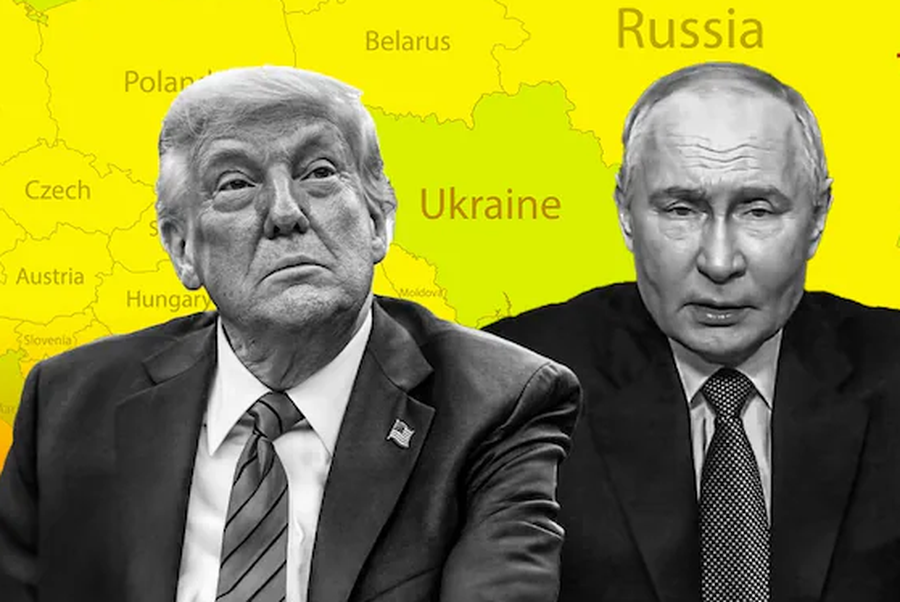
The policies of Russia, China, and the United States make it difficult to achieve a diplomatic solution to the conflict in Ukraine today.
We hear it repeated more and more often: another "Helsinki Conference" is needed to end the war in Ukraine and calm relations between Russia and the West.
The last to propose this was former Prime Minister Massimo D'Alema in an interview with Aldo Cazzullo, published in Corriere on Monday, November 3.
The Helsinki Conference was held in July 1975, at the height of the Cold War, and ended with a "Final Act" signed by 35 countries, starting with the United States and the Soviet Union.
Now, the idea is to open comprehensive negotiations that take into account the security concerns of each participant, just as happened 50 years ago.
Perhaps Vladimir Putin himself is predicting something similar when he claims that it is necessary to resolve the "root causes" of the conflict he launched on February 24, 2022.
For the Russians, this would mean, among other things, simply canceling Ukraine's chance to join NATO.
However, there is a problem. The political significance of the Helsinki Declaration (45 pages long) lies in the ten fundamental principles "that govern relations between states."
It is worth examining them, if only by their titles: respect for the sovereignty of each country; non-respect for the threat or use of force; inviolability of borders; protection of the territorial integrity of states; peaceful settlement of disputes; non-interference in the internal affairs of other nations; protection of human rights and fundamental freedoms; equality of rights and guarantee of self-determination of peoples; cooperation among states; and fulfillment in good faith of obligations under international law.
By invading Ukraine, Russia has violated all ten of these principles. The question is: would Putin really be willing to accept the "Helsinki Decalogue," because technically that would be a real conversion, for example, by returning the forcibly occupied territories to the government in Kiev? The dominant answer is "no."
Can the Kremlin leader guarantee that in the future he will respect, among other things, the self-determination of Ukrainians?
It's very hard to believe, having seen it in action over the past two decades, from the aggression against Georgia onwards. One can imagine the counterargument: as long as the Russian leader feels insecure, he will continue to act, that is, even use violence, to defend national interests.
But, again, the use of force to resolve disputes with other states is excluded from the “Helsinki Final Act” (points 2 and 5 of those listed above). After all, Moscow does not even seem willing to begin negotiations as challenging as those of 1975.
It is not enough. A new geopolitical master plan cannot fail to include China. On February 24, 2023, the first anniversary of the Russian invasion, Xi Jinping presented a “12-point mediation plan” that included, among other things, the restoration of Ukraine’s sovereignty and territorial integrity.
Only on August 7, 2023, did a Chinese delegation attend the “Peace Conference” in Jeddah, hosted by Saudi Crown Prince Bin Salman. After that, the Chinese disappeared from the diplomatic arena. Little by little, Xi Jinping became part of the problem, not the solution. Why? Diplomatic sources suggest two explanations. The first is purely political: in 2023, Beijing feared that Putin could use tactical nuclear weapons, posing a serious risk of a global explosion.
Then, the belief prevailed that this risk was not, in fact, real. And so Xi Jinping has continued to support Putin, reaping growing economic benefits. Of course, the main issue here is oil. China is the largest buyer of Russian crude oil, followed by India. It is said that, in recent months, at summits or bilateral meetings, various European delegations, including that of the Brussels Commission, have asked the Chinese to slow down hydrocarbon imports from Moscow. These requests have fallen on deaf ears. The Oscar for silence seems to go to Foreign Minister Wang Yi. Recently, the United States has imposed sanctions on Lukoil and Rosneft, which account for 55% of Russian oil exports. Several Chinese state-owned companies have slowed import flows. However, European government experts are under no illusions.
China imports only 20-30% of Russian crude oil transparently, respecting the maximum price set by a group of countries (including the US) at $60 per barrel. In other words, ships carrying Russian crude oil priced above $60 cannot dock in Western ports, or those of Japan and Australia. Nor can they rely on banks or insurance companies in those countries.
However, price caps are of little value: between 80 and 70% of Russian crude oil reaches China via the so-called "ghost fleets", large maritime smugglers, and thanks to triangulation with many countries that do business with Beijing. At the same time, the Chinese government has increased the level of supplies to Moscow, including for military use. For example, parts for drones. In conclusion, even a China like this does not seem to be compatible with a "Helsinki 2".
Finally, the United States. In 1975, the president was Republican Gerald Ford, who is remembered more for the fall of Saigon than for the Helsinki Act.
Today, Donald Trump has given the order to bomb Iran and now it seems that he is ready to attack Venezuela. Of course, the Americans explain how necessary it was to stop the nuclear plans of the ayatollahs and how important it is to eliminate drug traffickers. However, these are still "interference in internal affairs" and force is certainly preferable to diplomatic pressure to resolve crises.
These positions deal with issues very distant from Europe, but still contrary to the spirit of a new Helsinki. /Adapted from "Pamphlet" by "Corriere della Sera"



Lini një Përgjigje