


 Shkruar nga Pamfleti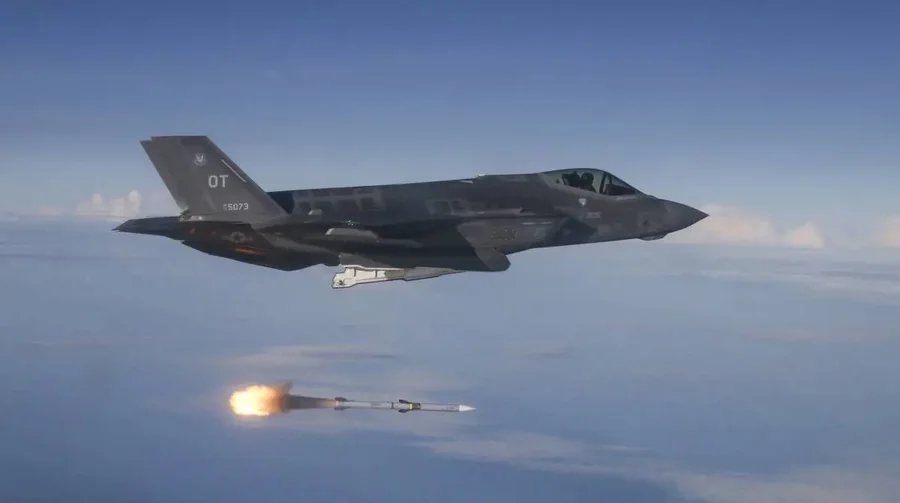
With an investment of $3.5 billion, the AMRAAM contract strengthens the air superiority capabilities of the United States and its allies by integrating advanced interception technologies and operational agility in a geopolitical context of increasing complexity and multilateral cooperation…
The Pentagon recently announced the award of contracts worth a total of $7.8 billion to two defense industry giants, Lockheed Martin and RTX Corporation, to produce thousands of missiles for the U.S. Air Force, Navy, and its international allies. This massive order represents a turning point in strengthening air and naval defense capabilities, with a focus on advanced weapons systems capable of providing strategic and operational superiority.
A historic investment in the AMRAAM air-to-air missile
At the heart of this order is the $3.5 billion contract awarded to RTX Corporation for the production of the Advanced Medium Range Air-to-Air Missile (AMRAAM), known as the largest in the history of the AMRAAM program. This weapon, known for its lightness, versatility and power, is designed to be used by a wide range of combat aircraft, offering excellent performance in interception and air superiority missions at various altitudes. In addition, its ground-launched capability for air defense functions increases tactical flexibility. In addition to missile production, the contract also includes telemetry systems and engineering support, essential for maintaining high standards of operational effectiveness.
Expanding the network of alliances through strategic procurement
From the analysis, we see that AMRAAMs will not be exclusively intended for the US military, but will also be distributed to a wide range of global partners. NATO recipient countries include the United Kingdom, Germany, Denmark, Hungary, Belgium, Spain, the Netherlands, Lithuania, Poland, Sweden, and Finland; in addition, countries such as Ukraine and Switzerland are also included in the Foreign Military Sales program. In the Indo-Pacific theater, Australia, Japan, and Taiwan will receive these systems, while in the Middle East, Israel and Kuwait are among the beneficiaries. This distribution reflects the United States’ desire to strengthen the collective defense capabilities of its allies in complex geopolitical environments.
Long-range missiles for air and sea superiority
In parallel, Lockheed Martin received a $4.3 billion order to produce two types of precision missiles: the Joint Air-to-Surface Missile (JASSM) and the Long-Range Anti-Ship Missile (LRASM). JASSM is a long-range cruise missile capable of a range of over 500 nautical miles, equipped with a GPS system resistant to electronic jamming and a penetrating warhead of approximately 450 kg, optimized for stealth attacks on highly strategic land targets. LRASM, designed to operate against naval targets, operates at subsonic speeds with semi-autonomous navigation and evasion capabilities, thus representing a next-generation offensive weapon for the US Navy. Both systems will also be used by allies such as Poland, the Netherlands, Finland and Japan, consolidating a common front in deterrence and power projection.
Sustainability and technological innovation in defense programs
In addition to missile production, the contracts include logistical and technical support services to ensure the full operation of existing assets, such as the one awarded to Vertex Aerospace for the maintenance of T-6 aircraft and the supply of F-35 spare parts by Lockheed Martin, essential for maintaining the efficiency of air fleets. Investments in research and development are also important, with awards earmarked for advanced studies to improve intelligence, surveillance and control systems, demonstrating the continued commitment to technological innovation that supports military superiority.
These elements, set within a framework of international cooperation, outline a comprehensive strategy aimed at strengthening the "readiness and responsiveness" of the US armed forces and their partners over the next decade. / Adapted from Il Giornale /








Lini një Përgjigje