


 Shkruar nga Pamfleti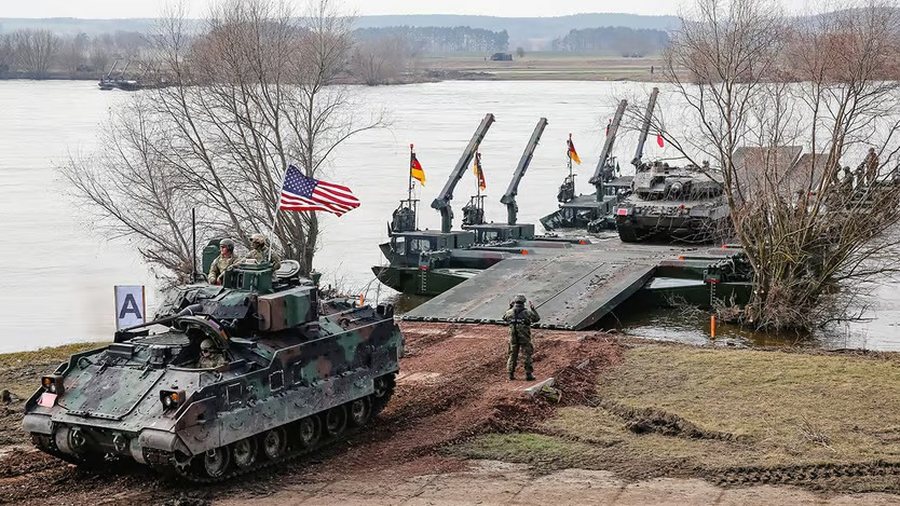
The largest NATO exercise since the end of the Cold War, Steadfast Defender 24, began on January 24 and will last until the end of May. Involving around 90,000 members from the armed forces of 31 NATO allies plus Sweden, the exercise aims to demonstrate how NATO can rapidly deploy forces from North America and across Europe to repel an attack on allies from the opponent, ie Russia.
Since last year's summit in Vilnius, the alliance has worked to ensure that 300,000 troops are kept on high alert, as well as to set up a structure to respond to any attack whenever it occurs.

In addition to having many more members than during the Cold War, NATO also has a much longer border to defend. A key finding of the exercise will be what more needs to be done to enable the smooth movement of much larger forces across national borders in the event of a real crisis or pre-crisis.
Since the Cold War, moving forces across Europe has been entangled in a web of national regulations and customs requirements, while necessary physical infrastructure, such as rail systems and bridges strong enough to withstand the weight of tank carriers, has been neglected.
Improving military mobility in Europe by addressing these obstacles has supposedly been a top priority for both NATO and the European Union since Russia's annexation of Crimea in 2014.
Four years later, military mobility was added to the "joint statement" that the EU and NATO issued for the first time in 2016 on how the two organizations could work together and complement each other. The EU went on to create an action plan for military mobility, called "Military Schengen", and a Dutch-led project (Pesco) was created to implement it.
So far Pesco has been a disappointment. Ben Hodges, who was commander of US forces in Europe until 2017 and now advises NATO on logistics, says the pesco has broken "because they withdraw the money".
The European Commission had proposed 6.5 billion euros ($7.1 billion) to fund 95 projects to support military mobility as part of the 2021-2027 EU budget. However, after negotiations with member countries, this was reduced to 1.69 billion euros.
Following Russia's full-scale invasion of Ukraine in 2022, the EU injected greater urgency by announcing a new plan covering four main pillars: so-called “multimodal corridors”; regulatory reform; resilience and preparedness (particularly focused on security threats to transport systems); and "committed partnerships", which essentially means close cooperation between the EU and NATO, at the end of which America, Canada, Norway and Britain have all joined PESCO. In January, the EU announced that €1.69 billion had been spent and was now allocating another €807 million to 38 additional projects aimed at improving the transport of troops and equipment.
Since then, the Netherlands along with Germany and Poland have announced a new plan to develop a military corridor for the movement of forces from Europe's North Sea ports to NATO's eastern flank.
It will address transportation bottlenecks, such as low or flimsy bridges (tanks weigh much more than they used to) and the bureaucracy that requires permission to move munitions across borders. It will also give priority when necessary to military rail requirements over civilian traffic. General Hodges says the alliance, for example, should be able to move forces from Rotterdam to the Polish border in no more than 90 hours. For deterrence to be serious, he says, you have to show you can move forces from A to B faster than the Russians.
But he warns that in addition to reforming the legal and regulatory framework, you need to have enough rail cars to transport heavy military equipment. Ukraine has shown how vital trains are for transporting tanks, other combat vehicles and ammunition to the front line. But in discussions with German rail network operator Deutsche Bahn, General Hodges revealed that there may be less than 10% of the locomotives that would be needed in a crisis ready.
NATO's concerns also include a lack of military equipment and "insufficient host country support" for incoming forces.
A single armored brigade with at least 50 tanks must have 15 km2 of space to meet all its requirements. General Hodges says NATO needs to do much more forward storage of parts and ammunition. Both assembly points and logistics centers will also need to be protected from attack. Referring to the experience of the Ukrainian forces, a senior NATO official says: “We have a requirement for much more air and missile defense. We are ready to give allies the biggest signal of demand for the next decade.”/ Taken from The Economist







Lini një Përgjigje