


 Shkruar nga Mario Monti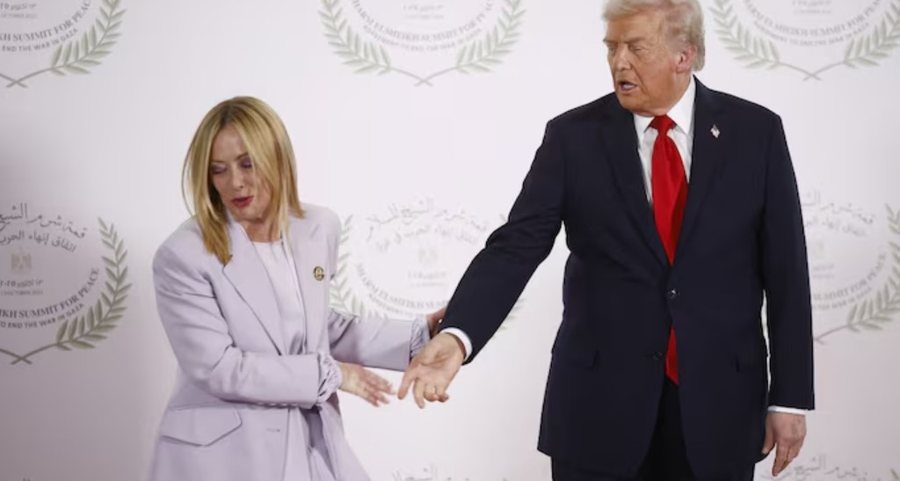
In recent months, concerns have grown in America and around the world regarding President Trump's governing style...
Why is Giorgia Meloni still so close to Donald Trump today? A year ago, three strong reasons could explain this. First, the visionary ideological and political affinity between the two leading figures of conservative nationalism, one in America, the other in Italy and Europe.
Second, political expediency: being the only European head of government capable of speaking fluently with Trump, clearly gaining his trust, was a source of prestige and strength, exploitable by Prime Minister Meloni in the Italian political arena and perhaps by Italy in the European and global context.
Third, a strategic mission: as the first conflicts between the United States and Europe emerged, our Prime Minister set herself the laudable goal of acting as a bridge between the two sides of the Atlantic and preserving the unity of the West.
However, over time, it became clear that President Trump's hostility toward Europe, and especially the European Union, was driven not so much by specific disagreements as by a geopolitical doctrine deeply rooted in the MAGA movement.
Moreover, the most severe blows to transatlantic relations and Western cohesion were dealt by President Trump himself, who was more inclined to respect the authoritarian leaders of autocratic great powers like Russia or China than the gray rulers of liberal democracies.
Finally, in recent months, concerns have grown, in America and around the world, about President Trump's governing style, perhaps also linked to certain personality traits. Without questioning his intentions and looking only at the facts, it is now clear that Trump no longer considers the rule of law a constraint, either domestically or internationally. Indeed, he himself declared on January 9 to the New York Times: "I am not bound by international law. My morality and my judgment are the only things that can stop me."
The fact that tens of millions of Americans support their charismatic president in exercising absolute power, regardless of their Constitution and the international treaties ratified by the United States, cannot be used as a mitigating factor ( "he was elected ") for the systematic destruction of the rule of law, in America and around the world, to pave the way for the arrogance of the strongest.
In the United States, polls also show a significant decline in Trump's approval rating, which now averages 40%. However, they, the Americans, must feel like the sole beneficiaries of the president's policies ("America First", "Make America Great Again" ). Even more, Europeans, those who are fundamentally hurt, are beginning to revolt against Trump's positions and measures, even in countries that have traditionally, for many valid historical reasons that we know, been very much in harmony with the United States.
According to the most recent "Grand Continent" poll, 90% of Italians, French and Germans see authoritarian or even dictatorial tendencies in Trump. In the same countries, almost 70% of those interviewed consider their foreign policy a plan for recolonization and plunder.
In light of these data, it is now difficult to see political expediency in unwavering loyalty. In short, of the three compelling reasons that a year ago could explain Giorgia Meloni's desire to be very close to Donald Trump - ideological-political affinity, political expediency and a mission for Western unity - the second and third have disappeared.
If this analysis is correct, the special closeness that persists must be fundamentally linked to ideological affinity and political vision. This may also do our prime minister credit: even when political expediency disappears, ideological convictions remain. However, this would be a very worrying conclusion for Italy.
As early as last April, on the eve of Giorgia Meloni's first visit to the White House, we noted in these columns that if, in order to gain favor, Trump had taken a submissive stance, without distancing himself in any way from the first visible signs of the authoritarian regime that was emerging, overthrowing the barriers represented by the rule of law, he would have run a risk.
Some features of Trump's authoritarianism resemble characteristics that Italy, fortunately, has not seen since the fascist regime. Failure to distance itself, in words and deeds, from these aspects of Trump, increasingly evident as the months pass, would put Italy in a difficult position regarding the present and the future, which are even more important than interpreting the past. A closeness, with uncritical silence, to Trump's authoritarianism today, even towards Europe, would raise alarms that not even a strong condemnation of fascism could calm.
Such a stance could also raise well-founded concerns regarding other initiatives by the government and the majority.
Take the reform of the judiciary, for example. I, for one, am undecided about the referendum; I see both light and shadow. But if our prime minister continues to appear as the most committed European leader to Trump, despite his constant attacks on Europe and his efforts to destroy the rule of law at home and around the world, I suspect that she too has a deep-seated authoritarian bent. It would be better, therefore, I would conclude, not to give her the tools that could facilitate the implementation of authoritarianism./ Adapted from “Pamphlet” by “Corriere della Sera”


Lini një Përgjigje