


 Shkruar nga Pamfleti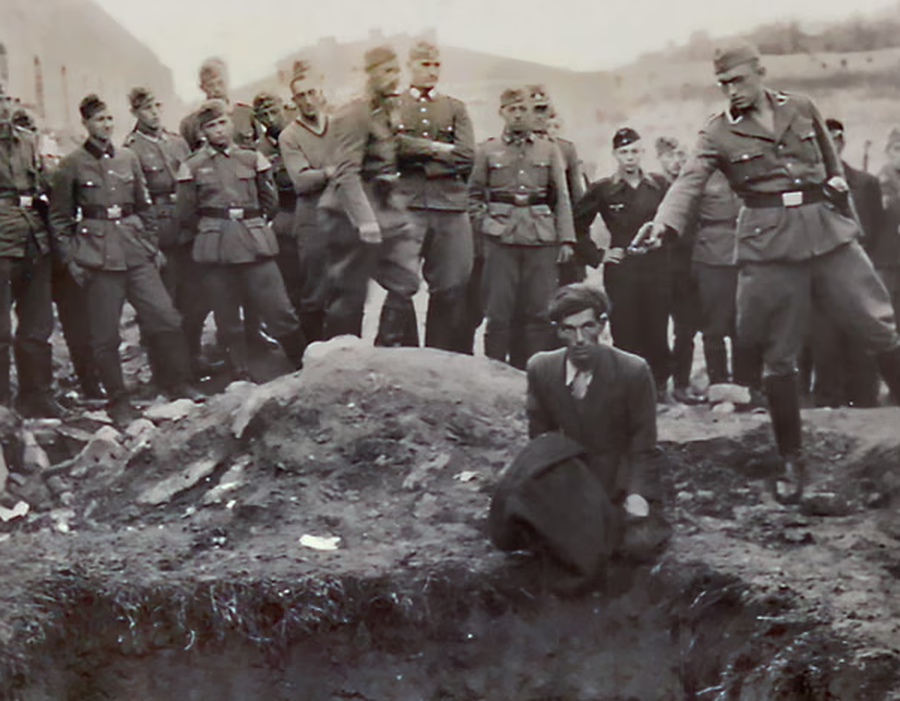
One of the most chilling images of the Holocaust: a bespectacled Nazi soldier points a pistol at the head of a resigned man in a suit kneeling in front of a pit full of corpses. German troops surround the scene.
The photograph taken in present-day Ukraine was long known, incorrectly, as the "Last Jew in Vinnitsa" and remained shrouded in mystery for decades.
US-based German historian Jürgen Matthäus has been painstakingly piecing together the pieces of the puzzle for years and, with the help of artificial intelligence, is convinced he has identified the killer, writes "The Guardian".
Discovery made through archives and artificial intelligence
According to his study published in the scientific journal Zeitschrift für Geschichtswissenschaft, the massacre took place on July 28, 1941, in the town of Berdychiv, about 150 kilometers southwest of Kiev. There, the Nazi commando Einsatzgruppe C had begun operations to exterminate Jews and “partisans” a few days before Adolf Hitler’s visit to the front.
Thanks to a combination of traditional methods of historical research, archives, family testimonies and image analysis by experts from the investigative group Bellingcat, Matthäus managed to identify the armed Nazi in the photo as Jakobus Onnen, a German language and gymnastics teacher born in 1906 near the border with the Netherlands.
How artificial intelligence helped
A reader, influenced by the first publication of Matthäus's research, got in touch to suggest that, according to family letters and documents, his wife's relative could be the man in the photograph. Although many letters from the Eastern Front were destroyed in the 1990s, the family still kept photos of Onnen. These were used in a detailed comparison with the infamous image, using artificial intelligence technology for facial recognition.
AI experts emphasized that for historical images it is not possible to achieve an absolute match as in modern forensic analysis, but the similarity was quite high and, combined with other documentary evidence, was enough to make the identification public.
Who was Jacobus Onnen?
Onnen came from an educated family and in his youth had an interest in travel and language studies. He joined the Nazi Party before Hitler came to power in 1933 and, like many of his contemporaries, was involved in extermination units during the invasion of the Soviet Union. He remained a private, never promoted to higher ranks, and was killed at the front in August 1943.
"Participating in such massacres did not provide you with a career or rewards. It was something considered normal in those killing units," Matthäus explains.
The historian regrets that Onnen's original letters from the front were destroyed, as they could have provided more information about his motives and beliefs. However, a relative who read them at the time described them as "banal", indicating a lack of reflection on the crimes.
A symbolic photo of the Holocaust in the East
The photograph of the Berdychiv massacre, according to Matthäus, is one of the most direct testimonies of the crimes of the Holocaust. He emphasizes that the image is as important as the iconic view of the gates of the Auschwitz camp, as it shows the face-to-face moment between the victim and the killer.
In Berdychiv, where about 20,000 Jews lived before the Nazi occupation, only 15 were left alive in 1944, according to Der Spiegel reports. Such photographs, often taken by German soldiers themselves as “trophies,” show the open brutality of the massacres and dispel the myth that German society was unaware of the genocide.
Work to identify the victim
Matthäus has already begun another phase of the search: identifying the kneeling victim in the photo. He is collaborating with Ukrainian researcher Andrii Mahaletskyi and is using Soviet archives to discover his name. Here too, artificial intelligence could help if comparable images from destroyed Jewish communities in the area are found.



Ne Shqiperi jane shume foto kur partizanet e NC kane pushkatuar njerez do ishte mire qe historianet te na i gjejne emerat e skuadres se pushkatimit dhe motivet e tyre personale se perse kane mare pjese ne togat e pushkatimit. Gjermanet po e bejne ta bejme dhe ne.