


 Shkruar nga Austin Sarat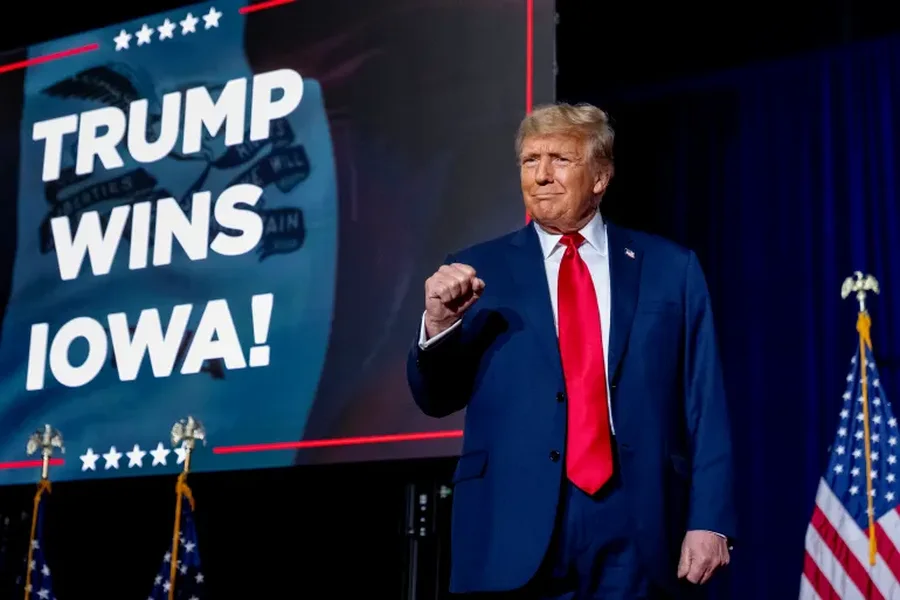
So loyal were Trump's supporters in Iowa that 71 percent of them told pollsters they would consider him fit to serve as president even if he were convicted of a crime.
The results in last night's Republican caucuses in Iowa were not surprising. For months, polls have indicated that former President Trump would score a landslide victory when voters make up their minds.
His margin of victory over Florida Gov. Ron DeSantis, the runner-up, was, as The New York Times predicted, "more than double the largest margin of victory for a Republican in a previous competitive caucus."
Trump voters displayed a kind of loyalty that progressives and "Anti-Trumpists" still cannot fathom. Underlying this loyalty is a strong bond with Donald Trump himself and an appreciation of his record as president.
So loyal were Trump's supporters in Iowa that 71 percent of them told pollsters last night that they would consider him fit to serve as president even if he were convicted of a crime. He faces 91 charges in four criminal cases.
Loyalty to Trump in Iowa was also fueled by a deep pessimism about the state of the country and its future prospects. Today, only 18 percent of Americans say they are "satisfied with the way things are going in the U.S."
While members of the Iowa Republican caucus are not representative of the entire American electorate, it is important to pay attention to both their loyalty to Trump and their pessimism.
Let's put Trump's victory in context.
We remember that in 2016, Trump lost the parliamentary groups. He was defeated by Texas Senator Ted Cruz, who received 27 percent of the vote to Trump's 24 percent. Florida Sen. Marco Rubio came in third, with 23 percent.
The simple fact that, in eight years, Trump increased his share of the vote to 51 percent is impressive in itself. It is another clear indication of the Trumpification of the Republican Party.
In 2016, Trump performed best among lower-income groups and in caucuses held in states with fewer evangelical voters. This year, his populist profile consolidated his support among these voters, although he also won among college-educated Republicans. Trump also did very well with evangelicals.
In 2016, Cruz reached out to evangelicals and did very well among 64 percent of them who turned out in caucuses. He took 33 percent of Iowa's evangelical vote, with Trump coming in just ahead of Rubio among that group, with 21 percent.
And, in a preview of what would unfold in 2020, Trump claimed that Cruz's victory in Iowa was the result of fraud. After the caucuses, the real estate mogul tweeted, "The State of Iowa should disqualify Ted Cruz from the most recent election on the basis that he cheated. It was a total fraud!"
I think it's safe to say there won't be any fraud charges against the former president in Iowa this year.
As last night's results prove, over the past eight years, Iowa has become Trump's country. In fact, The New York Times credits him with transforming the state “from a swing state to a GOP stronghold.” He carried the state by more than eight percentage points in 2020 — a 14-point swing since Obama won Iowa in 2012.
"No other state," notes the Times, "has shifted so strongly toward Republicans over the same period."
So strong is Trump's victory in Iowa that this year, he made very few campaign appearances. DeSantis, by comparison, practically camped in Iowa visiting all 99 counties.
Of course, when Trump campaigned in Iowa, he "stole" the show. In typical Trumpian fashion, he "traveled to Iowa with an entourage to bash DeSantis. It consisted of members of Congress from Florida who have endorsed Trump over their state's governorship.
Trump secured last night's victory despite breaking with another tradition by refusing to participate in the Republican debates that preceded the Iowa caucuses.
A big reason he was able to win was the dramatic improvement in support he received from Iowa's evangelical voters. Polls found 51 percent of evangelicals backed Trump compared to 29 percent for DeSantis and 13 percent for former United Nations ambassador Nikki Haley.
New York Times columnist Brett Stephens was right when he wrote in 2016 that “Trump rode a wave of pessimism in the White House — pessimism that his critics overlooked because he was talking about an America they either didn't see or they only saw it as a caricature. But as with this year," Stephens continues, "when liberal elites insist things are going well while the vast majority of Americans say no, Trump's disaffected outlook has affected the mood of the country."
Many of this year's Iowa voters say they are looking for a complete and total reversal.
Trump's victory in Iowa should be a wake-up call. His opponents inside and outside the Republican Party will have to up their game quickly if they want to stop him from returning to the Oval Office. / Adapted "Pamphlet" from "The Hill"






Lini një Përgjigje