


 Shkruar nga Pamfleti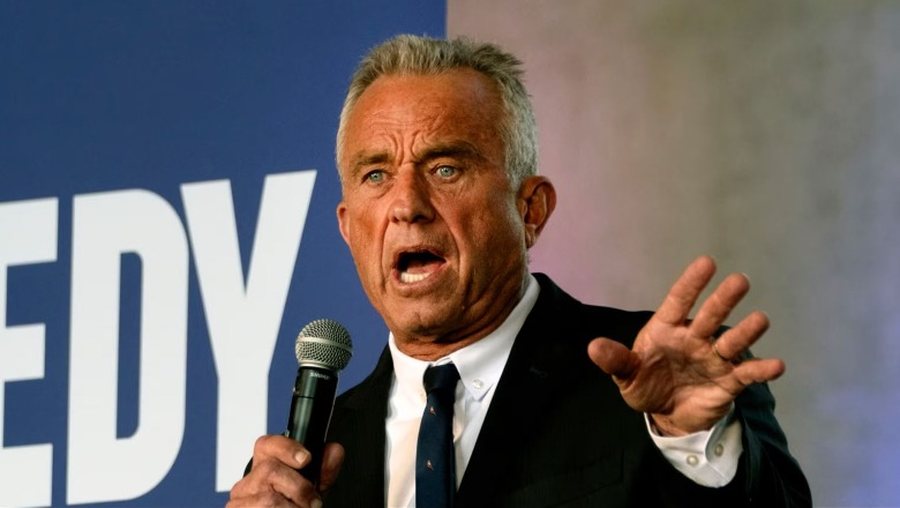
An independent candidate with no political experience but a household name has entered the race as an independent with little chance of winning the White House and has secured some support from Americans who are unhappy with the candidates expected to appoint the two major parties.
Robert F. Kennedy Jr., 70, is the son of former New York senator and former United States attorney general and grandson of former President John F. Kennedy. He is an environmental advocate and perhaps best known for his vaccine conspiracy theories.
Analysts say Mr. Kennedy is unlikely to win the presidency. But in a race that could be decided by a few thousand votes in a number of swing states, as has been the case in the last two presidential elections, Mr. Kennedy may be able to pull in enough votes to prevent the victory of one of the candidates who could lead the race.
"The context is this: The two major party candidates, Donald Trump and President Joe Biden, don't really have much support," Chris Jackson, vice president at polling agency Ipsos, told VOA.
"The support for Joe Biden is no more than 40 percent and as for Donald Trump, according to the levels of support we are seeing, the numbers tend to be in the 30 percent range. RFK Jr. it's basically the name that those who don't like either of them can support, to voice their displeasure with the two candidates," says Mr. Jackson.
Meaningful support
According to a poll published this week by The Wall Street Journal, Mr. Kennedy appears to have significant support from voters in a number of key states that are likely to determine the next president.
In Nevada, 15 percent of voters said they would vote for Mr. Kennedy, as did 13 percent of voters in Arizona, 12 percent in Michigan and 10 percent in North Carolina and Wisconsin. Mr. Kennedy was least supported by voters in Georgia and Pennsylvania, with 8 percent and 7 percent respectively.
The difficulty now is to determine which candidate Mr. Kennedy is getting the most votes. The Wall Street Journal poll seems to suggest he is pulling the votes of both candidates, but slightly more of Mr Trump.
In the poll, voters were asked to choose from a list of candidates that did not include Mr. Kennedy and then from a list that included his name. In 5 of the 7 key states where the poll was conducted, Mr. Trump lost a higher percentage of voters who chose Mr. Kennedy than Mr. Biden lost. But in most cases, the difference was about 1 percent, within the polls' margin of error.
However, some early polls suggested Mr. Kennedy was getting more votes for Mr. Biden than Mr. Trump, and many other popular polls continue to suggest that is the most likely scenario.
More data from other surveys expected
Drew McCoy, president of Decision Desk HQ, which processes data on US presidential elections, says it's becoming increasingly clear that Mr Kennedy, who was seen by many as an insignificant candidate when he announced last year that he would run for the White House, could play a significant role in the outcome of the election.
"The polling agencies are realizing that Mr. Kennedy's inclusion in the poll will be more necessary than it might have seemed three or four months ago. So I think we're going to see more data," Mr. McCoy told VOA.
That doesn't mean Mr. Kennedy is likely to win the presidency, or even any particular state, he added.
"What people are expected to look at carefully is his impact in some of these close-contested, key states. His ability to attract votes and how his support will be compared to other candidates, it will be really interesting to see."
Little known candidate
Mr. Kennedy's poll numbers may change as voters get to know him better and become more familiar with his political stances.
"Mr. Kennedy himself has not clearly defined what his positions are. "He's basically someone with a big name in an election race where a lot of people don't like the candidates of the two major parties," Kyle Kondik, from the Center for Politics at the University of Virginia, told VOA.
Mr. Kondik pointed out that historically, candidates who are not from the main parties tend to have weaker results than the polls suggest. As voters consider the outcome of the election, support for a third candidate tends to wane.
"Some of that support will fade as people focus on candidates who can actually win the election," he said.
A very familiar past
Born into one of the most prominent political families in the United States, Mr. Kennedy was 14 when his father was assassinated while running for the Democratic Party nomination in 1968, a race he was likely to win. 5 years later, Mr. Kennedy's uncle was assassinated.
Mr. Kennedy's youth was marked by drug abuse. After being expelled twice from school for drug abuse as a teenager, he managed to graduate from Harvard University, the London School of Economics and the University of Virginia Law School.
He worked briefly as an assistant Manhattan district attorney in the early 1980s, but resigned in 1983 after testing positive for a New York State drug test. In the same year he was arrested on charges of possession of heroin.
In the years after his arrest, Mr. Kennedy forged a new identity for himself, becoming a well-known lawyer and environmental activist associated with the Riverkeeper organization dedicated to cleaning up New York's polluted Hudson River.
In the decades that followed, he achieved considerable success as an environmental lawyer and advocate, winning several high-profile court cases against large corporations.
Contradictions on vaccines
In the early 2000s, Mr. Kennedy's name became increasingly associated with a growing movement of Americans who believe that many common vaccines given to young children cause a range of health and other problems, including autism.
His anti-vaccine stance became more pronounced during the COVID-19 pandemic, when he repeatedly became a source of inaccurate information and a frequent critic of public health authorities.
In recent years, Mr. Kennedy has floated a number of other conspiracy theories, often talking about what he calls shadowy groups of entrepreneurs and billionaires who he says run United States politics out of the public eye.
Since the age of 40, Mr. Kennedy suffers from a disease that leads to a disorder of the larynx and causes voice tremors./ VOA



Lini një Përgjigje