


 Shkruar nga Andrea Muratore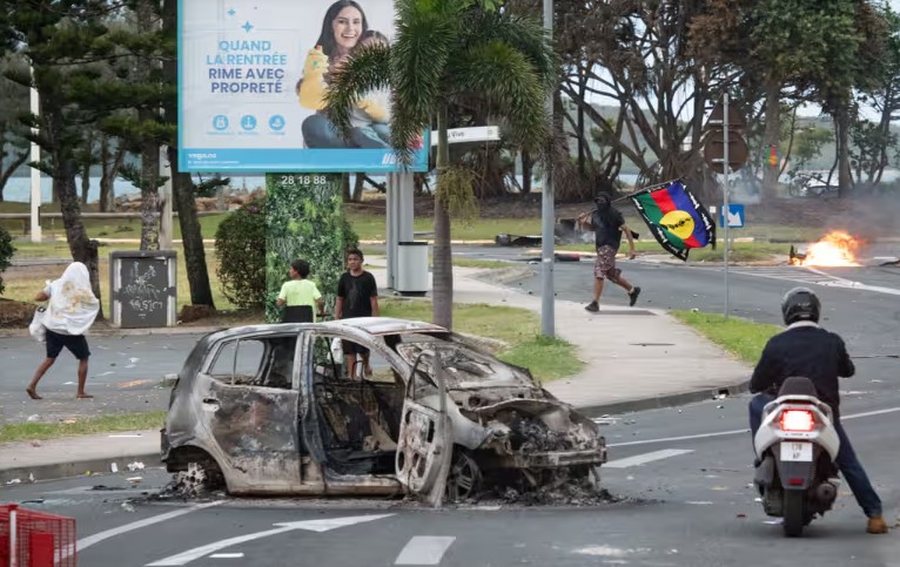
At stake is the geopolitical cause of the centralization of the suburbs. Today it has become a key to understanding global geopolitics...
Is France perceiving a political encirclement of Azerbaijan and Turkey in New Caledonia? Paris and its secret services have been warning for weeks of a foreign "hand" in fomenting the protests that are rocking its colony in the middle of the Pacific, and with a strategic position for large nickel resources and projection oceanic of the Hexagon.
The Azeri (and Turkish) hand behind the protests on the outskirts of global France
Azeri flags displayed in Noumea at the protest of the Kanaki ethnic group caused a stir, after the modification of the right to vote by the National Assembly in Paris, which revived the feeling of independence of New Caledonia, already tested in three referendums (2018 , 2020, 2021), which confirmed the strong ties with Paris.
So at play is the geopolitical cause of the centralization of the suburbs. Today it has become a key to understanding global geopolitics. Added to that is the issue of hybrid conflict, from information wars to propaganda wars, which dictate many global political and diplomatic scenarios.
French Interior Minister Gerard Darmanin made it abundantly clear: France believes Baku may have instigated the protests in response to Paris siding with Armenia over the disputed Nagorno-Karabakh region, which was attacked last fall. from Baku, as Paris supported a negotiated settlement and an end to the arbitrariness of Ilham Aliyev's dictatorship over it.
From the Caucasus to New Caledonia, "hybrid wars" without borders
These scenarios are part of the wider all-round conflict between Turkey and France over various spheres of influence:
Baku is accused as it is seen as the long arm of Turkey, an ally of France in NATO, but essentially a rival to it.
So we have a race, stretching from the Caucasus to the Niger, and where the arrival of Turkish militias instead of French soldiers is being taken for granted. Then we go to the Horn of Africa, where Ankara's influence is growing. And there is no doubt that the rivalry culminates in the Balkans, where Turkish penetration clashes with the Franco-German-led European one.
The latter aim to attract towards Brussels the insecure states that are not members of the European Union, namely Albania, Bosnia and Herzegovina and Serbia. So much so that the French television Europe 1 openly feared Turkish support for the destabilizing movements of Azerbaijan.
From this point of view, the political conflict can be resolved in different ways. The "Eurasianet" portal reminds us how Azerbaijan's attention on New Caledonia's maneuvers is anything but secret: "Azerbaijan's anger over the Franco-Armenian special relations started as early as 2023, during the reoccupation of Karabakh by Baku.
Azerbaijani President Ilham Aliyev tried to exclude France from the Karabakh peace process. He also tried to influence France in other ways: denouncing what he described as French neo-colonialism, encouraging the creation of the "Baku Initiative Group against French Colonialism".
In February, the group organized a conference in Turkey entitled "Decolonization: The Awakening of Renaissance", which was attended by politicians from the French colonies. Therefore, from the point of view of Baku and Ankara, each role is equal to a double political bluff aimed at influencing Paris, in projecting diplomatic and informational power. This is also remembering the clear acceptance of political objectives such as the modern hybrid war, which can take place even between allies, in the middle of the day, and with divisive statements and maneuvers.
Centralization of the suburbs
The strategic data to be observed are related to the issue of the centralization of the suburbs, and the possibility of an all-round destabilization of contested regions even by regional or local actors at a great distance from their territory, with the necessary potential for intelligence , influence and economic power.
Among the rival capitals of the West, especially Moscow and Beijing, there will be those who will have taken notes at this stage, and where every suburb can become the center of a destabilizing confrontation.
This applies to the maneuvers of the Euro-Atlantic bloc towards its opponents (the issue of human rights in the Chinese province of Xinjiang, the outskirts of the suburbs, used as a political weapon)
But the opposite is also true. In the most radical cases, it makes no difference whether the West or the East destabilizes a periphery. The goal is always the same: to set fire to a building to send a warning to the entire neighborhood, sometimes with the hope and expectation that the flames will engulf the entire block.
Other times, a fire is set in the yard to force the tenants to leave the house, taking advantage of their distraction to carry out surprise acts in parts left unattended. Or to distract attention from other areas.
In this case, beyond the metaphor, it means forcing France to deal with the troubled situation in New Caledonia and reducing its attention on Armenia (an area of interest for Baku) or on its neighbor Turkey. But also to send a message about the possibility of further geopolitical adventurism in the confrontational areas: Paris will find rivals capable of striking it in the wings. So in the suburbs. Everything in the light and the sun. But denying the facts of the intervention. / Adapted "Pamphlet" from "Il Giornale"



Lini një Përgjigje