


 Shkruar nga Federico Fubini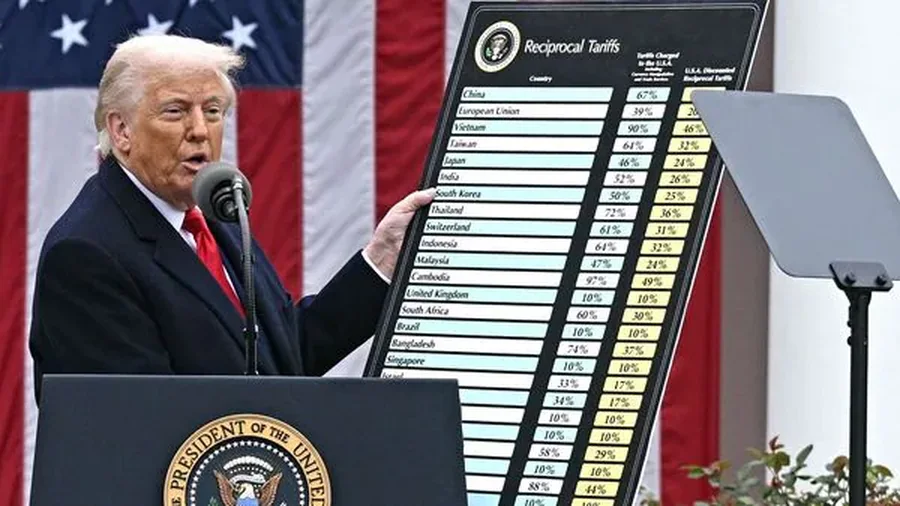
Year-ends should usually be occasions for a stocktaking, not a relaunch. This year-end, however, applies to both, because, in the tension of war, the latest threats with which the White House is “honoring” us have gone unnoticed in Europe. They are no small thing. On Tuesday, Trade Representative Jamieson Greer issued a note warning that the United States will use “every tool at its disposal” if the European Union and its governments do not stop “lawsuits, taxes, fines and discriminatory and harassing directives against American service providers.”
The threats, as we will see, are clear and fully affect Italy as well. All signs converge in one direction: the fact that Donald Trump was given the victory in the issue of tariffs on goods has not calmed him; on the contrary, it fuels his aggressiveness. Where is the balance in all this? It is temporary, but it exists: if the passivity and uncertainty of the European Union is the reality that is taking on the task of showing Trump the failure of his trade policy; with it, cracks in his entire economic policy and, in perspective, in his system of power come to light. Trump seems so strong that we do not see his weakness well. But it is precisely from this weakness that Europe must start again in 2026.
Discontent in the US
A chart released last Friday by the University of Michigan, which measures the mood of American consumers every month, shows that in December they are feeling worse than they did immediately after the collapse of Lehman Brothers or during almost all postwar recessions. In one year of Trump's presidency, households' assessment of their economic situation has fallen by 33%, while their assessment of the outlook has fallen slightly less.
Of course, the reality is not so dramatic. America is not in any worse shape than it was during the Great Recession 15 years ago or the periods of high unemployment in previous decades. Paul Krugman argues that a widespread sense of exclusion from the more concrete aspects of the “American dream” (housing, healthcare), a lack of economic security, and apparent injustices in opportunity make Americans more pessimistic than simply the growth or employment data indicate.
However, Trump is directly affected by this dissatisfaction. All segments of the electorate, regardless of age, gender, race or education, overwhelmingly disapprove of his performance, especially on economic issues (inflation, taxes, jobs). The gap between positive and negative assessments of the president, after almost a year, clearly leans towards disapproval, more than during the same period for Joe Biden and, for most of the time, even more than Trump himself during his first term.
Greer's attack
In this climate, the American president has found the culprit: Europe. The Trade Representative, Greer, has launched an attack that sounds like the first step of a new campaign. He says that the European Union and its governments are persecuting American service companies, while, according to him, the American administration allows European companies to operate without obstacles in the United States. Greer also names nine companies by name, among them the French Mistral and Publicis, as well as the Germans SAP and Siemens (but he could have also mentioned the Italian Bending Spoons).
In conclusion, Greer warns: “If the European Union and its member states continue to restrict, hinder, and discourage the competitiveness of American service providers through discriminatory means, the United States will have no choice but to begin using every instrument at its disposal to counter these unreasonable measures.” He adds that US law allows for the imposition of taxes or restrictions on foreign services if retaliatory measures are necessary.
It is the threat of a new phase of the trade war. What is it about? Section 891 of the 1986 US Internal Revenue Code gives the president the authority to double the tax on citizens and businesses of a foreign country “if that country subjects US citizens or businesses to a discriminatory or extraterritorial tax”. Not only that. There is already a precedent of special tariffs of 25% on a number of French manufactured products during Trump’s first term, in response to the Paris tax on digital services approved in 2020. Another example, again against France, is the 100% tariff as a countermeasure announced in the spring for transalpine subsidies to the cinema industry. Moreover, in Washington there is already open talk of hitting with personal sanctions, as well as against Russian oligarchs, European officials and politicians who would apply Brussels’ digital rules to American companies.
Von der Leyen's words
Five months after Trump and Ursula von der Leyen’s controversial handshake on the Turnberry golf course in Scotland, we are now facing “tariffs 2, retaliation.” Rarely have Ursula’s words stood the test of time as poorly as those uttered in late July, when she declared: “We have a great deal that will bring stability and security to our businesses.” Say that today to companies threatened with new tariffs or doubling taxes by presidential decree.
And it will not be just a French problem. Once again, Trump is targeting many countries. At the center are taxes on digital services, applied by 17 European countries, including Italy, France, Spain, the United Kingdom, Poland and Germany. In Italy, it is a 3% tax on the national turnover of digital companies with revenues over 750 million euros worldwide, which affects Meta-Facebook, Google-Alphabet, Elon Musk's X or OpenAI, bringing about 600 million euros a year to public finances.
Taxes for big tech companies
The idea that this tax is “discriminatory” is, frankly, ridiculous. These American multinationals have been avoiding taxes worth hundreds of billions of euros in Europe for years, thanks to a sophisticated system that includes Ireland and Trump’s fiscal reform in 2017. If there is discrimination, it is in their favor, since they pay much less tax than European companies operating in the same markets. The problem is not that the White House does not understand this, but that it does not want to understand it: between Trump and the tech giants there is an oligarchic pact based on money and electoral power.
Five months ago, between trade war and dishonor, Europe chose dishonor. And before the year is out, we risk a new trade war. How should we react?
New negotiation
It is more reasonable to look at how the White House's tariff policy has worked so far. According to Trump, it was aimed at improving the trade balance, creating jobs in industry, and increasing fiscal revenue. In all three of these areas, with varying degrees of intensity, Trump is failing.
Not only is the mood of Americans in a bad place, but the US trade deficit in goods has reached almost a trillion dollars in the first nine months of 2025, about 120 billion more than in Biden’s last year. Instead of improving, it has worsened. Meanwhile, employment in industry has begun to decline. As Penelope Naas of the German Marshall Fund explains, Trump’s tariffs make industrial production in the US more expensive and less competitive. “For every 10,000 jobs we create in the steel industry thanks to tariffs,” she says, “we lose 175,000–200,000 jobs in other industrial sectors that depend on steel.”/ Corriere Della Sera





Lini një Përgjigje