


 Shkruar nga Pamfleti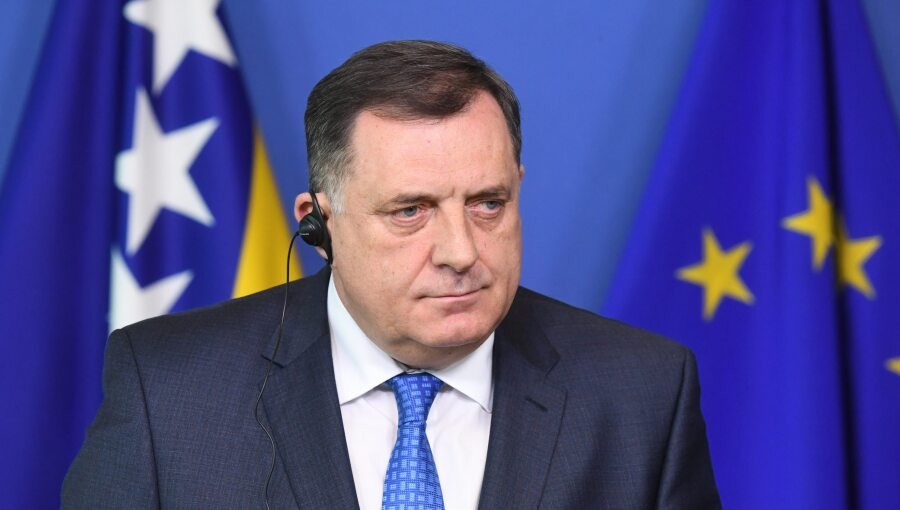
The president of the Bosnian Serb entity, Milorad Dodik, was sentenced on August 1 to one year in prison and banned from holding political office for 6 years after being found guilty of refusing to implement decisions made by Bosnia's top international envoy, the High Representative.
The Court of Bosnia and Herzegovina upheld an earlier ruling in February, confirming that Dodik had broken the law by signing a decree that contradicted a decision by High Representative Christian Schmidt. The move was seen as a deliberate challenge to Bosnia's constitutional order and the authority of the post-war oversight mechanism.
The decision, confirmed by a three-member judicial panel, marks an escalation in a long-running standoff between Dodik and Bosnia's central institutions. It also deepens the country's political crisis nearly three decades after the 1995 Dayton Peace Accords ended a bloody civil war.
Dodik, addressing the media after the verdict, called the sentence "purely political", accusing Schmidt of targeting him for refusing to recognise his authority. "This is an attack on Republika Srpska", he said, adding "after all, Christian Schmidt said that anyone who does not respect him will end up in prison".
The Office of the High Representative (OHR) was created to oversee the implementation of the Dayton Agreement, with broad powers to impose laws and dismiss officials. Schmidt, a German diplomat appointed in 2021, has not been confirmed by the UN Security Council, a point of contention repeatedly raised by Dodik and his allies.
Dodik has long opposed the OHR's role, arguing that the post-war structure has shifted in favor of centralization, undermining the autonomy of Republika Srpska (RS), the Serb-majority entity within Bosnia.
In response to the February ruling, the RS National Assembly passed laws further limiting the authority of state judicial and law enforcement agencies on its territory. The Court of Bosnia and Herzegovina later issued a central arrest warrant for Dodik in March, citing suspicions of an attack on the country's constitutional order.
Serbian leaders reacted against the decision in February. President Aleksandar Vučić has now called an emergency meeting of Serbia's National Security Council. Vučić, who has consistently supported Dodik, previously described the charges as politically motivated and warned that further international pressure on RS could provoke regional instability.
“The appeal decision against Milorad Dodik is not just a political attack on the President of Republika Srpska, it is an attack on the Dayton Agreement and the institutional integrity of Republika Srpska,” said Milan Knezevic, a Serb political leader from Montenegro, in comments to the local daily Politika.
Critics of the decision argue that it risks fueling tensions in an already fragile country where ethnic divisions remain entrenched. Others warn that the continued challenge from Banja Luka, the de facto capital of RS, could push Bosnia closer to disintegration.
Dodik, once hailed by Western diplomats as a moderate voice during the post-war reconstruction, has transformed into one of the region's most vocal nationalist leaders. His increasingly close ties to Moscow and calls for greater autonomy or even secession have fueled fears that Bosnia could slide back into conflict.
Supporters of the High Representative and Bosnia's central institutions claim that Dodik's actions threaten the rule of law and the country's constitutional framework. They insist that the OHR remains a necessary stabilizing force in a country still haunted by its wartime legacy.
However, Dodik insists that his challenge is in line with the original Dayton Agreement, which he says guaranteed RS a high degree of autonomy.
The decision is expected to heighten the already growing mistrust between Bosnia's ethnic communities, Bosniaks, Croats and Serbs, and raise further questions about the country's future as a united state under international supervision.





Lini një Përgjigje