


 Shkruar nga Pamfleti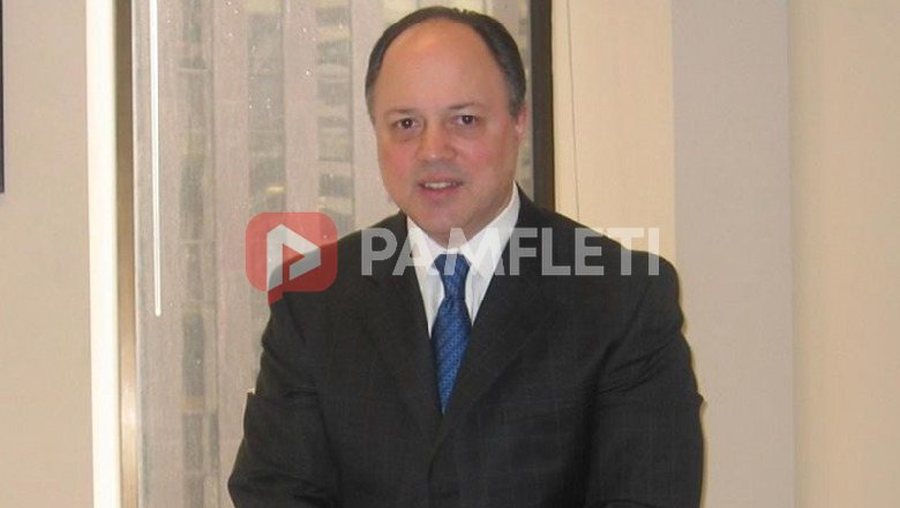
In the letter provided by "Pamphlet", Kokalari enumerates all the achievements of the former prime minister, while listing the arguments or data he has...
The Albanian-American activist, Geri Kokalari, has sent a letter to the leader of SPAK, Altin Dumani, where he shows the deeds of Sali Berisha.
Kokalari once cooperated with Berisha, but then they parted ways and Kokalari has never stopped criticizing, and has even shown details of some affairs he is aware of, such as the privatization of ARMO, Albpetrol, pyramid firms or Gërdec.
In the letter provided by " Pamphlet ", Kokalari enumerates all the achievements of the former prime minister, as well as the arguments or data he has. Kokalari starts his paper with the pyramid firms of 1997.
" We know that Berisha moved to a new luxury building in one of the best neighborhoods of Tirana, after he was forced to leave the Presidency. At the time, his explanation for the new house was the claim that his daughter (Jamarber Malltez's wife) had paid for the property from her salary from working in Kosovo, but that's a story that should be easy to tell. was verified. The American government knows more about Berisha's involvement with the pyramids, and I would be happy to point them in the right direction if you pursue this matter ," he said.
Then Kokalari tells about the affair with ARMO, where Berisha brought Rezart Taç into the game. According to him, it was all a genuine corrupt scheme.
" I believe that Berisha shares responsibility for this fraud and deserves to be questioned aggressively to determine how he may have facilitated Taçi's bid. There are a number of parties that should be called to testify about this affair, including Frank Wisner and Jude Kearny, who was Patton Boggs' attorney at the time and assisted in the tender process that placed Armo in the hands of the Crown," it says . the activist.
Kokalari has also stopped at Gërdeci. He had contacts at that time with Kosta Trebicka and helped him write an article in "The New York Times". Kokari tells how Berisha and his son are immersed in Gërdeci, while also mentioning the death of Trebicka.
" There is also the issue of the death of Kosta Trebicka. In 2007, Kosta contacted me because he was furious that his contract for repackaging AEY's ammunition was removed and reassigned to Delijorgji. He believed that this was done because Delijorgji had a business relationship with Shkëlzen Berisha. Costa was not shy about expressing his desire for justice and he was publicly vocal about what he perceived as improprieties around the AEY deal. Thus, in the process, he stepped on the toes of powerful people who might have been able to benefit from this arrangement. Afterwards, Kosta died under suspicious circumstances on a remote road in the south of Albania ", he writes in the letter obtained by " Pamphlet ".
THE LETTER OF GERI KOKALAR
Mr. Dumani,
I welcome your commitment to the investigation of the privatization of the Partizani sports complex. It is a crucial step towards addressing potential misconduct in this matter. I would like to draw your attention to additional matters that, if investigated, may reveal further improprieties involving Sali Berisha and his family.
1. Perhaps the most infamous crimes involving Sali Berisha are the pyramid schemes that flourished in the mid-1990s and collapsed in 1997, leaving death and destruction in their wake. Hundreds of thousands of Albanians suffered financial damage from the schemes, and Albania's progress as a democracy was set back decades. To my knowledge, Berisha has never been asked to determine why, after being repeatedly warned by financial experts, he allowed those Ponzi schemes to continue? And why did he publicly support Vehbi Alimuçaj and tell Albanians that their money was safe in his Vefa pyramid scheme? One reason could be sheer stupidity, and based on my interaction with Berisha, I got the impression that his upbringing according to Enver Hoxha's Stalinist doctrine left him with a very distorted, somewhat naive view of the world. But ignorance is not an excuse, so it must be determined to what extent, if any, Berisha benefited from the pyramids. We know that Berisha moved to a new luxury building in one of the best neighborhoods of Tirana, after being forced to leave the Presidency. At the time, his explanation for the new house was the claim that his daughter (Jamarber Malltez's wife) had paid for the property from her salary while working in Kosovo, but that's a story that should be easy to tell. was verified. The US government knows more about Berisha's involvement with the pyramids and I would be happy to point you in the right direction if you pursue this matter. For example, at the height of the crisis, the Governor of the Bank of Albania was taken out of Albania and brought to Washington to be briefed.
2. P rivatization of ARMO, a state asset, was a great theft perpetrated on the Albanian people. At the center of this crime was Rezart Taci, a close associate of Sali Berisha who is now a fugitive from justice. As a brief refresher, the ARMO privatization tender became the midwife of Patton Boggs, a Washington law and lobbying firm that was hired by the Berisha government. As you know, the winning bidder for ARMO was Refinery Associates of Texas (RAT). A simple internet search at the time would have revealed that RAT was an unknown company that acted as an oil product broker and had neither the experience nor the capacity to acquire and operate a foreign oil company. During the time of the privatization, I brought this to Frank Wisner's attention by email. Wisner, a former US ambassador, was Patton Boggs' point person in Albania. To my knowledge, my warnings were ignored. Instead, in the last hour, Rezart Taci emerged from the shadows as the real winner of the tender, and Berisha displayed willful blindness to the blatant subjugation that Taci used to win the bid. A critical requirement of the ARMO acquisition contract was Taci's guarantee to invest $250 million to modernize its operations. As we now know, Taci never had $250 million and RAT never established a presence in Albania to invest and manage ARMO, so the crimes were committed on multiple levels. First, it is unimaginable for me to believe that Taci won the ARMO tender without giving a quid pro quo to Berisha. So, if proven, this would be a significant act of corruption at the highest level of government. However, there were other crimes committed during the tender process, including the use of a shell company to hide the fact that Taci was the real bidder and the fraudulent representation that Taci would invest $250 million to be used for capital expenditures . The Berisha government, using Patton Boggs as counsel, should have completed the proper test, which I believe would easily expose this fraud. Because Taci failed to fulfill its financial obligation, ARMO quickly deteriorated and went bankrupt. Thus, we have what I believe was the fraudulent transfer of a state asset to a close associate of Sali Berisha, followed by the subsequent damage to the asset. I believe Berisha shares responsibility for this fraud and deserves to be aggressively questioned to determine how he may have facilitated Tac's bid. There are a number of parties who should be called to testify about this affair, including Frank Wisner and Jude Kearny, who was Patton Boggs' attorney at the time and assisted in the tender process that placed Armo in Tac's hands.
In 2014, Patton Boggs effectively went into bankruptcy as a result of a $15 million fine it was forced to pay due to a lawsuit filed against the firm by Chevron, the multinational oil giant. In that case, Chevron alleged that Patton Boggs participated in an extortion campaign against Chevron in Ecuador. Patton Boggs disputed the insinuation that she would compromise her reputation by engaging in unethical behavior in a deal with a group of Ecuadorians. However, Randy Mastro, the lawyer representing Chevron, argued to the judge that Patton Boggs was willing to risk its reputation because the firm expected to receive a large contingency fee as compensation for the $18 billion deal in Ecuador. Patton Boggs lost the case and due to the large fine imposed by the presiding judge, the firm was then forced to merge with another law firm to survive the financial blow. Did Patton Boggs receive a contingency fee for her work on the A RMO deal? If so, this may explain why important information about Tacit and RAT was ignored. Coincidentally, I was a plaintiff in a lawsuit in New York in which Randy Mastro, one of the best corporate litigators in the US, represented my group, and I highly recommend the services of his law firm to assist you reach the end of this story.
3. Albpetrolit was another large state asset that Berisha tried to privatize. Despite the various frauds committed with the privatization of ARMO, which Berisha was well aware of when the privatization of Albpetrol was announced, a phantom company was declared the winner again, this time as Rruga e Mëndafshit Vetro. As with ARMO, I did a simple internet search to come to my conclusion that Vetro Silk Road lacked the experience and financial resources to complete the Albpetrol acquisition. I notified Frank Wisner of my findings, but it appears my warnings were again ignored. And as with ARMO, at the 11th hour, Rezart Taci emerged from the shadows as the real person behind Vetro Silk Road, which merely served as a straw company to keep Taci's name out of the tender process until the end. In a democratic country governed by the rule of law, under normal circumstances, Taci would have been disqualified from bidding for Albpetrol because of the underhand tactics he used to win the ARMO tender. But not in Albania. However, a critical provision of Albpetrol's tender required the winning bidder to post a $100 million guarantee from a US bank. Fortunately, the deal was cut at the last minute when I discovered the fact that the $100 million guarantee given by Taci, allegedly from American Chartered Bank, was a complete fraud. This was confirmed to me in an email from John Purtill, American Chartered's legal counsel, and from my communications with the FDIC, the regulatory agency that oversees and insures US banks. I understand that the false warranty may have been forged in the articles of American Chartered Bank, but you should be able to discover the facts through subpoenas and discovery. The documents related to the bank guarantee should have been included in Albpetrol's tender file and you should immediately freeze all Albanian government files related to this transaction. If the correspondence related to the bank guarantee is now missing in the file, you can add obstruction of justice to the pile of crimes for which you can accuse Berisha. I know the FDIC investigated this matter because Michael Delgado, an FDIC investigator from Chicago (where American Chartered Bank was located), came to New York to interview me. So the FDIC developed a file, and through State Department and Justice Department channels, you should be able to get the relevant documents. However, there is a caveat: a common thread between the ARMO and Albpetrol deals was Patton Boggs and Frank Wisner was their man on the ground in Albania, and he kept his relationship with Berisha and Tac very public. As part of the investigation into this matter, compensation for Patton Boggs, including any contingency fee arrangements, should also be reviewed. Coincidentally, David Wisner, the charge d'affaires of the American Embassy, is the son of Frank Wisner. I don't mean to imply that he had any involvement or knowledge of the ARMO or Albpetrol privatizations, but if you have to ask the US government for help on these issues, David Wisner should recuse himself from the matter. Taci, who is already a fugitive from justice, should be extradited and tried for the fraud he has committed in relation to the privatizations of ARMO and Albpetrol and to testify about the involvement of Berisha in these agreements.
4. AEY Arms Deal/"War Dogs" - I partnered with Kosta Trebicka to expose the AEY scandal on the front page of The New York Times. I also arranged for Costa to testify before Congress and the Department of Justice, and as such, he served as a witness for the US government. When the story broke in the Times, I clearly remember Saliu barking like a mad dog that the paper was "toilet paper" when the scandal was revealed. As you remember, the deal involved AEY, a Miami-based company headed by Efraim Diveroli, who in a phone conversation recorded by Kosta Trebicka (easily found on YouTube), complained about the corruption of the Berisha government. During the phone call, Diveroli said: "He went up to the prime minister and his son. I can't fight this mafia. It got too big. The animals just got very out of control." We also know that Alex Podrizki, who worked for AEY and was responsible for managing the repackaging project in Albania, claimed that he and Diveroli were brought to a meeting in Tirana with Mihal Delijorgjin to discussed the price of ammunition and the reassignment of the repacking contract from Trebicka to Delijorgji. Podrizki claimed that Shkëlzen Berisha was present at that meeting. Shkëlzeni then sued the publisher and author of "Dogs of War" for defamation, but he lost the case. This raises some serious questions, such as, if Shkëlzen was at the meeting, what was he doing there? Furthermore, Shkëlzen's lawsuit and appeal, which he also lost, could have cost hundreds of thousands of dollars in legal fees. Where did Shkëlzeni get the money to pay his lawyers? At that time the AEY deal was made in Albania, Berisha was the prime minister and Fatmir Mediu the minister of defense and Pinari the head of Meico, do you believe that a 300 million dollar contract for the Albanian government for supplied to the US Department of Armed Defense could have proceeded without the direct approval of Sali Berisha?
We now know that AEY committed fraud against the US Department of Defense because Diveroli and several other Americans were sentenced by the US Department of Justice to prison terms. But we also know that the AEY deal could not have been concluded without the full cooperation of very high officials of the Albanian government such as Sali Berisha and Fatmir Mediu. We also know that AEY's payments to Meico were laundered through Evdin, a Cyprus-based company controlled by Henri Thomet, a notorious arms dealer who had been blacklisted by the US Department of Defense. I know this because the contracts and bank records were given to me by Costa and I presented them to the US government and the New York Times. You can use the power of your office to determine if any of those funds were returned to Albanian government officials by Thomet.
To be clear, although there are common threads between Gërdec and AEY, such as Mihal Delijorgji and Fatmir Mediu, they are separate and distinctly different crimes. One was the Gërdec explosion, which, due to the negligence of the Berisha government, led to the tragic death of 26 people. I am concerned that there are important witnesses who, to my knowledge, have not been called to testify for Gërdec. They include several former Gerdec employees and Patrick Henry and Rodney Taylor, who ran Southern Ammunition, the company that supplied equipment to the Gerdec facility. And let's not forget General Luan Hoxha, who avoided interrogation because he was easily allowed to leave Albania to seek asylum in the USA. The other distinctly different crime was the illegal AEY arms deal with Meico and the US Department of Defense. There has never been an investigation into the Albanian government officials who aided and abetted AEY and who in Albania may have benefited from this fraud perpetrated against the US government.
There is also the issue of Kosta Trebicka's death . In 2007, Kosta contacted me because he was furious that his contract for repackaging AEY's ammunition was removed and reassigned to Delijorgji. He believed that this was done because Delijorgji had a business relationship with Shkëlzen Berisha. Costa was not shy about expressing his desire for justice and he was publicly vocal about what he perceived as improprieties around the AEY deal. Thus, in the process, he stepped on the toes of powerful people who might have been able to benefit from this arrangement. Afterwards, Kosta died under suspicious circumstances on a remote road in the south of Albania. Of course there were suspects who had motives to harm Kosta. But those who were in charge of investigating Kosta's death were known to be close to Sali Berisha, so it was quickly and easily concluded that it was an "accidental" death. Maybe it was, but many Albanians still believe it was a cover-up. The people of Albania and the Trebicka family deserve closure. Costa's remains should be exhumed and examined by an impartial and qualified forensic pathologist with extensive experience in homicide investigations.
I urge you to consider these matters diligently, ensuring a thorough investigation of each matter, and I will be happy to provide information that may facilitate your prosecution of related cases. The findings could shed light on any wrongdoing by Berisha and contribute to transparency and accountability in Albania.
Thank you for your attention to these serious concerns.
Sincerely,
Gary Q. Kokalari
/ Pamphlet


Lini një Përgjigje