


 Shkruar nga Fadil Lepaja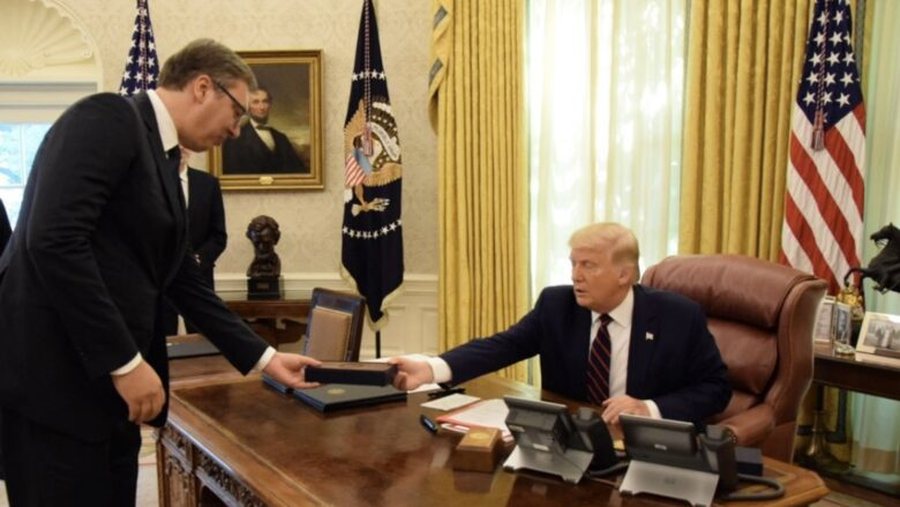
Although Serbia's cunning policy of sitting in two chairs has come at the most difficult moments since the beginning of the war in Ukraine, Serbian President Vučić is still not giving up on his efforts to copy the former moderate communist leader, Tito, and a policy of not joining "blocs"...
Will the Serbian government itself buy the Russian shares in NIS, nationalize the oil, or will a foreign company buy them? This is expected to be decided by the government itself within a period of 45 days, during which time the US administration expects Serbia to exclude Russian interests from NIS (Oil Industry of Serbia), where the Russians (Gazpromneft) hold 56% of the shares.
This process of removing Russian interests from NIS must be acceptable to the US administration. This Serbian decision-making is conditioned both by the Russian willingness to sell its share of the shares, but also by the unknowns that the Trump administration brings to Serbia. This implies the hope for a radical change in US policy towards Russia, but also the fear that despite political changes, the interests will remain the same, so the struggle between Anglo-American oil and gas companies and Russian oil oligarchs to control the infrastructure and markets leading to Europe will continue.
Russia itself may refuse to sell its share, foreign companies may hesitate to buy the Russian share package, but the US administration may also consider it unacceptable for these shares to go into the hands of another company that follows the same lines of interest as Russian oil companies.
Given that NIS controls 80% of the fuel market in Serbia, and the state's reserves have been declared to be sufficient for only two months, if the steps requested by the US administration are not taken, this could put Serbia in an extremely difficult position, ending with expanded sanctions, political pressure for change, and political sanctions to force it to fall into line.
But, even though Serbia's cunning policy of sitting in two chairs has come at the most difficult moments since the beginning of the war in Ukraine, Serbian President Vučić is still not giving up on his efforts to copy the former moderate communist leader, Tito, and a policy of not joining "blocs".
Thus, the Serbian president's latest offer for Serbia to be the venue for the first Trump-Putin meeting seems to be important, in addition to its political importance, to create a balance between the interests of the West and Russia in the Balkans, where economic and infrastructural interests are the main ones, but also political ones to shape a construction that would pursue the balance so necessary for Serbia, which tried to adapt the Berlin Process to these interests, promoting the Open Balkans, or preferring any form of political union that would replace the former Yugoslavia, where the East and the West were divided and united, while Serbia benefited and was strengthened immensely from this mediation.
What Serbia will do in these circumstances, when it is also facing a revolt and demand for accountability from Serbian students, is difficult to know in advance, as a fundamental characteristic of Serbian policy in relation to the West and Russia is flexibility and lack of decision-making.
The loss of NIS is likely to, if not destroy it, then greatly diminish Russian influence in the Balkans. The Serbian decision would mean driving Russia out of the Balkans and Vučić would face for the first time and irrevocably the wrath of the Russian oil oligarchs, who currently run the Russian state for their own interests.
Therefore, Serbia will not make a decision without being forced or without opening the way for it to be a factor in US-Russia relations. If Trump shows interest in a deal with the Russians and Serbia is the host country, and Vučić is the mediator, then the sanctions will be eased, or why not, even canceled.
The 45-day deadline gives him time to assess whether Trump will need his mediation services or not. This will also indicate the direction of his administration, in relation to Russia, Serbia and consequently the Balkans./ Pamphlet


Lini një Përgjigje