


 Shkruar nga Pamfleti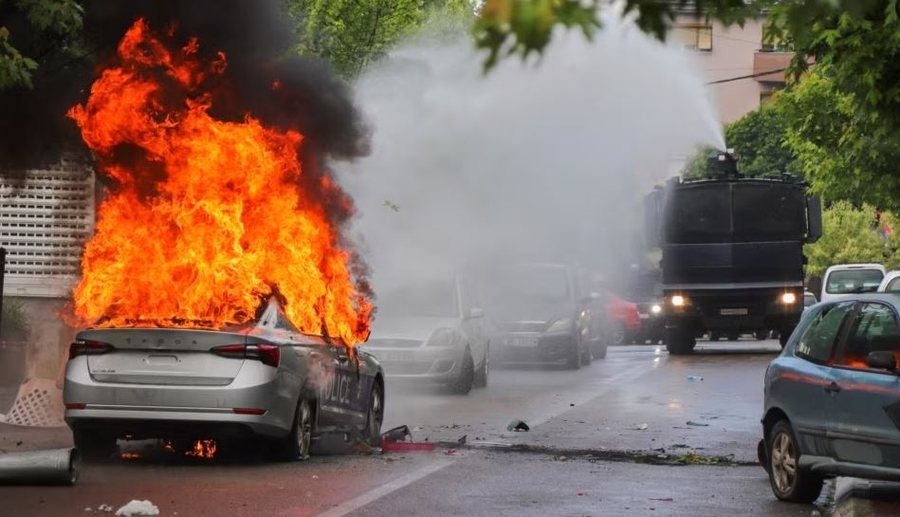
The concerns of the officials of the United States of America (US) and the European Union (EU) that the violent incidents in Kosovo could turn into a "regional confrontation" should be carefully considered.
This is how Mentor Vrajolli, an expert on security issues in Kosovo, and Ognjen Gogič, a Serbian political scientist from Belgrade, assess.
However, they have different views on whether the developments in the north of Kosovo can turn into a regional conflict.
Representatives of some opposition political parties in Kosovo express the opinion that the actions, for which Western emissaries Gabriel Escobar and Miroslav Lajçak have expressed concern, should be avoided, at least by the Government of Kosovo.
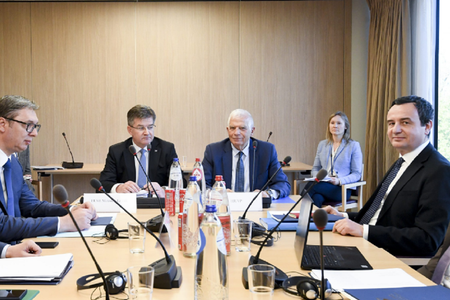
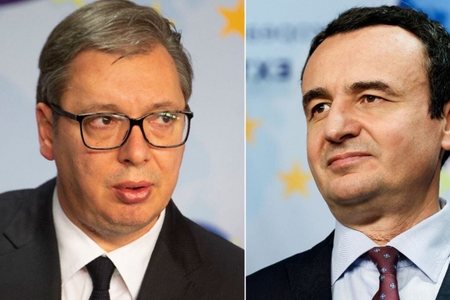
To find a solution to the current crisis, the EU has called an emergency meeting on Thursday. The Prime Minister of Kosovo, Albin Kurti, and the President of Serbia, Aleksandar Vucic, have accepted the invitation, but it remains unclear whether there will be a tripartite meeting in Brussels.
Kurti has said that he will talk about the escalation of the situation in the north, while Vuçiqi has stated that he will not meet with the Kosovar Prime Minister, but only with the head of European diplomacy, Josep Borrell.
During a debate held by the Atlantic Council in Washington, on June 20, the envoy of the United States of America for the Western Balkans, Gabriel Escobar, expressed his concern that the tensions between Kosovo and Serbia have the "potential to turn into a regional conflict". .
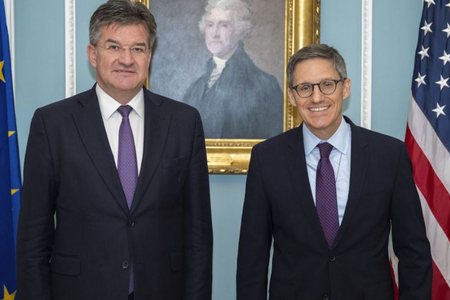
In the same debate, the special envoy of the European Union for the Kosovo-Serbia dialogue, Miroslav Lajçak, emphasized that "if we do not manage to escalate [the situation], then we are expecting to have victims".
That same day, Kurti stated that the escalation of the situation in the north of Kosovo "is a direct consequence of Belgrade's interference in the internal affairs of Kosovo".
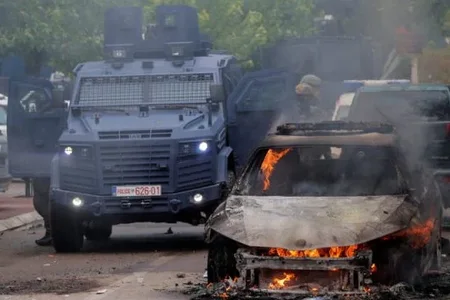
In the north, inhabited by a majority of Serbs, tensions have increased since the end of May. The Serbs are opposing the entry into the municipal buildings of the new Albanian mayors of Zveçan, Leposaviq and Zubin Potok.
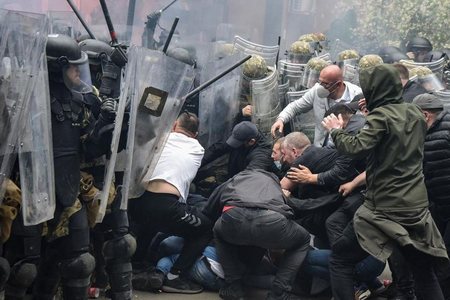
On May 29, the protests escalated into violence, when Serbs in Zveçan clashed with soldiers from the NATO peacekeeping mission in Kosovo, KFOR. Dozens were injured on both sides.
Such protests, albeit with lower intensity, are still continuing.
The violence has prompted NATO to commit an additional 700 troops to Kosovo, in addition to the 4,000 troops already in the country.
Vrajolli: The danger from the domino effect is real
The White House in Washington has announced that the US President, Joe Biden, has decided to continue the national emergency regarding the Western Balkans, which was declared by executive order on June 26, 2001, at least until on June 26, 2024.
The White House announced that "the actions of persons who threaten peace and international stabilization efforts in the Western Balkans" and the current situation in the region, "present an unusual and extraordinary threat to national security and foreign policy."
Mentor Vrajolli, executive director of the Kosovo Center for Security Studies, tells Radio Free Europe that before and after the start of the Russian invasion of Ukraine, in February 2022, Serbia has had its elements involved in the countries of the region, which have the potential for destabilization.
Meanwhile, the recent actions of the Government of Kosovo in the north of the country have created preconditions for these elements to act towards destabilization there.
"The risk that a conflict will have a domino effect in other countries of the region is great, it is real. For this reason I think that, as far as [the parties] can show the good will to take the initial step to escalate the situation. But, I think that the international community should be determined this time. The return of the conflict is always possible if steps are taken only to de-escalate the situation and not to improve the situation on the ground", says Vrajolli.
Gogi֛ç: Dramatic situation, but not for a regional crisis
Political scientist Ognjen Gogič from Belgrade estimates that Ecobar and Lajcak's statements in the Atlantic Council debate show that they do not have enough instruments for managing the crisis and influencing the parties.
As he says for Radio Free Europe, their statements are "calls for help" in Washington.
"As for the narrative of regional conflict, there are no indications of this. What can happen is that there can be conflict only in the north of Kosovo. Even the involvement of Serbia with the army is a little believable. However, it cannot be said that all this can be transferred to Montenegro or Bosnia and Herzegovina. The situation on the ground is really dramatic, but it is not a regional crisis", says Gogič.
He adds that based on the developments since May 26 of this year, but also last year's riots in the north of Kosovo, violent incidents there are expected. However, he does not believe that it is possible to reach a situation where Serbia would intervene militarily, because this would mean its confrontation with NATO.
As Gogiç says, if this were to happen, "the conflict would be localized, because KFOR is in Kosovo, which has been restrained so far, but can apply adequate violence" in case this will be necessary.
"Kosova should reflect" and avoid "adventures"
The statements of American and European officials expressing concern for a possible regional conflict, with a starting point in the north of Kosovo, are quite serious, according to the representatives of the opposition parties of Kosovo.
The deputy of the Democratic Party of Kosovo, Hisen Berisha, member of the parliamentary committee for security and defense issues, tells Radio Free Europe that in the context of geostrategic developments and the Russian occupation of Ukraine, Russia needs a center of crisis or conflict in the Balkans Western.
According to him, if the actions of the Government of Kosovo are claimed to be the reason for the instigation of such a conflict, then it should be careful and coordinated with the western partners.
"Every action of ours, which leads to a conflict in the region, is then in the service of Russian geostrategic interest and is against the geostrategic interest of NATO and our ally, the USA. Therefore, I think that the Government of Kosovo should reflect and coordinate its positions and actions with international partners", says Berisha.
The former Minister of Defense of Kosovo, Anton Quni, from the Democratic League of Kosovo, currently a member of the parliamentary committee for security and defense issues, says that the incidents in the north of Kosovo can be facts that support the warnings of the American and European emissaries.
However, he does not expect any conventional military intervention of Serbia inside the territory of Kosovo, due to the presence of KFOR. He does not exclude the introduction of certain elements from there, to destabilize the north, up to clashes with the local police and members of KFORI. All these, according to him, challenge the decisions of the Government of Kosovo regarding the management of the situation in the north, but also the international partners.
"Therefore, it is always suggested that these actions [of the Government of Kosovo] be undertaken in good cooperation and coordination with our partners. It is, indeed, an adventure if we make any effort and do not have the support of our partners, in particular the United States of America," he says.
Conflict can be avoided "until the next episode"
The EU and the USA have presented Prime Minister Kurti with three demands regarding tensions: the calming of the situation in the north of Kosovo, the holding of new elections in the four municipalities in the north and the return to dialogue for the normalization of relations.
Kurti, meanwhile, has presented a five-point plan, which also foresees the holding of elections. However, he said that in order to hold free elections in the north, the rule of law is needed.
The EU and the US have asked Serbia to lower its state of military alertness and help reduce tensions among Serbian protesters in the north. Recently, the unconditional release of three Kosovo policemen has been requested, for whom the Serbian authorities claim that they were arrested deep in the territory of Serbia, while the official Prishtina claims that they were kidnapped in the territory of Kosovo.
However, the question remains whether the parties will find a way out of the crisis.
Rashiti: Radical change in the geopolitical positions of the USA towards Kosovo and Serbia
Kurti: Western emissaries are coming to us with demands from the other side
Mentor Vrajolli considers that the Kosovo side, currently, is more rigid in its demands. According to him, the rule of law in the north of Kosovo, which the Government of Kosovo aims for, is a form of solving problems. But, as he says, "the rule of law should not be manifested as a show of power."
However, avoiding a direct conflict with Serbia, according to Vrajolli, does not depend entirely on Kosovo.
"The potential - whether there will be a conflict or not - I think it mainly depends on how much pressure is exerted on Belgrade so that there is no conflict. I think that for the northern part, it is not for Kosovo to decide whether or not there will be a conflict. In the northern part, in some form, Belgrade is located, through its structures. This is because these current structures, which are in the north, have the potential to cause conflict, and they are mainly on the payroll of official Belgrade", emphasizes Vrajolli.
Political scientist Gogiç estimates that based on the practices of previous crises in the north of Kosovo, the conflict was avoided at the last moment. This, he says, is possible again.
According to him, Kurti has already sent signals that he will withdraw the special police forces proportionally with the removal of criminal elements from the north of Kosovo, as well as warned of the possibility of holding elections there.
Kurti's five-point plan for reducing tensions in the north
The rule of law in the four municipalities in the north, which means the identification, prosecution and fair trial of all members of the criminal groups that have attacked the Police, NATO troops and journalists
Violent groups should immediately withdraw from the territory of Kosovo and any criminal act against the institutions of Kosovo should be prohibited
Kosovo Police, members of NATO and EULEX to carry out joint security assessments, to guarantee a safe and risk-free environment for everyone.
The Government of Kosovo should coordinate with all actors and announce early elections in the four municipalities in the north
Kosovo and Serbia to return to dialogue mediated by Brussels, and a high-level meeting to be held this week
Meanwhile, he expresses the opinion that even President Vucic, who was begged by the Hungarian Prime Minister, Viktor Orban, to release the three Kosovar policemen, can do so.
But the exit from the current crisis, as he says, does not mean that the problems have been solved.
"This does not imply long-term stability. This meant that only this episode has ended and now we are waiting for the next one. I believe that we will get to de-escalation in the next period, but not to the solution", emphasizes Gogiç.
The EU has imposed some punitive measures against Kosovo due to the failure to take steps to reduce tensions, stressing that there may be other measures./ rel


Lini një Përgjigje