


 Shkruar nga Pamfleti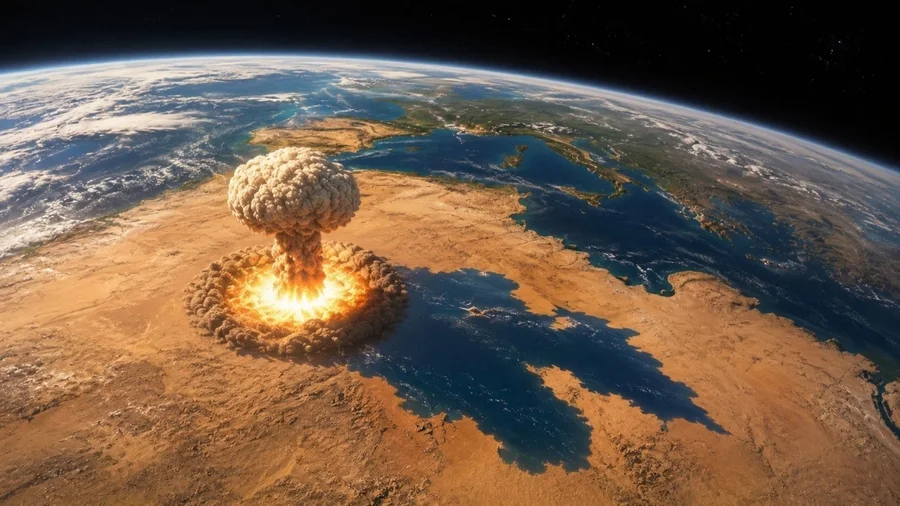
Engineers and governments studied for decades the idea of flooding the Qattara Lowland in the Egyptian desert and turning it into a giant energy source.
In the heart of the Sahara lies one of the most unusual engineering projects of the 20th century. The Qattara Basin, in northwest Egypt, lies 133 meters below sea level and is located just 55 kilometers from the Mediterranean. This geographical position has led engineers, geographers and governments to imagine for decades the creation of an artificial sea in the middle of the desert.
The most extreme proposal came from German engineer Friedrich Bassler, who between 1964 and 1973 suggested opening a canal from the Mediterranean to the Qattara Lowland. To speed up the excavation, he proposed using 213 nuclear bombs, each about 100 times more powerful than the Hiroshima bomb.
The purpose of the project was not military, but energy. According to the plan, the Mediterranean water would naturally flow towards the lowlands due to the difference in altitude. The extremely hot and dry climate would cause constant evaporation, creating space for the constant influx of new seawater.
This continuous flow would pass through turbines and generate electricity. The project envisaged a capacity of up to 5,800 megawatts, more than the Aswan High Dam. In practice, the desert would be transformed into a natural power plant, powered by gravity, the sea and evaporation.
However, the main problem was the construction method. Although today the idea of using nuclear bombs to open a canal seems extreme, during the 1960s such projects were seriously considered. Both the US and the Soviet Union experimented with so-called “peaceful nuclear explosions” for infrastructure projects.
In the end, Egypt rejected the plan. The risk of radioactive contamination, possible seismic consequences, and the presence of explosive remnants from World War II in the area made the project too risky and costly.
However, the idea did not disappear completely. In recent years, the Qattara Lowland has returned to discussion as a potential area for clean energy, this time through modern technologies such as solar power, wind turbines and desalination plants.
Researchers also recall that the Sahara has not always been a desert. Thousands of years ago, the region had lakes, rivers and rich fauna, including elephants and hippos. In this sense, the project aimed to artificially recreate a landscape that was once naturally shaped by climate and water. / Washington Post and gazzetta.gr







Lini një Përgjigje