


 Shkruar nga Pamfleti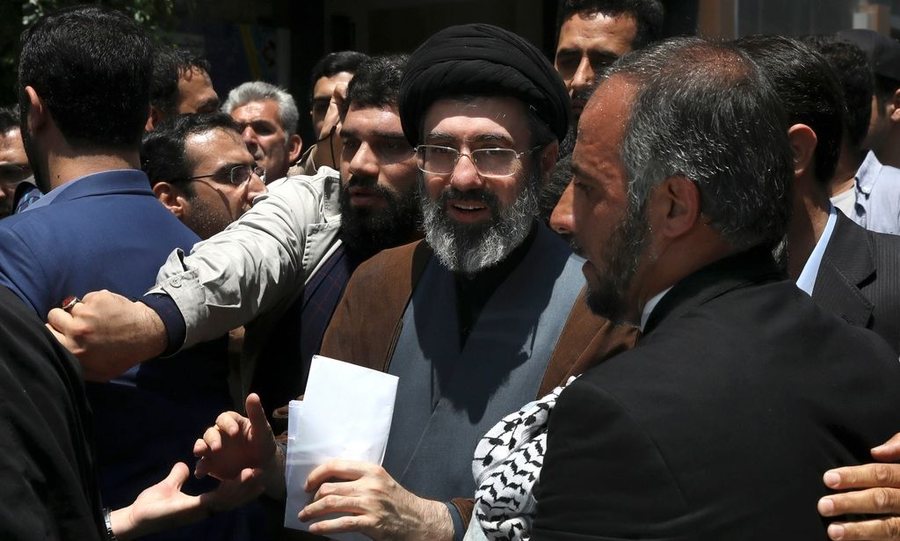
Targeted assassinations continue in Iran. Following the death of Security Council Secretary Ali Larijani, another Israeli attack last night also targeted the Minister of Information and National Security Esmail Khatib. Khatlib was a religious politician who had studied Islamic jurisprudence in the conservative circles of Qom and who had also been a student of Ali Khamenei, the recently assassinated Supreme Leader. He had held the post of Intelligence Chief since 2021, when Ebrahim Rais was still president, and was later confirmed by his successor, Masoud Pezeshkian. He ran one of the country's main spy centers, often in coordination with the Pasdaran services. Several Western countries had placed him on sanctions lists for his role in managing the suppression of domestic protests.
The number of key figures of the regime still alive is dwindling. Currently, there are:
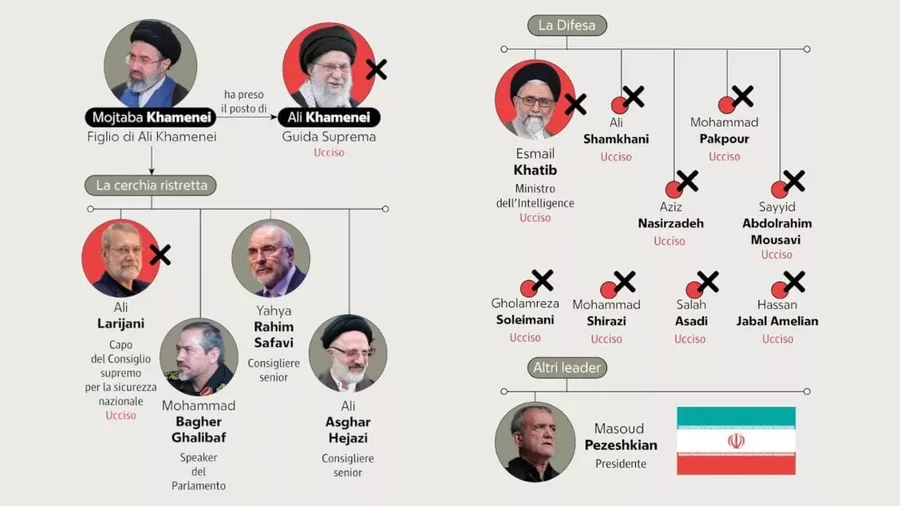
Iran's new supreme leader, Mojtaba Khamenei
Khamenei's second son, wounded on the first day of the war, was chosen to replace his father on March 8. He is a conservative with a "muscular" approach, opposed to easing tensions with the United States. He has excellent relations with the Pasdaran, who sought his appointment. According to a Bloomberg investigation, he is said to be the head of a real estate empire worth millions of dollars. The funds were amassed mainly from Iranian oil sales, which passed through British, Swiss, Liechtenstein and UAE banks, as well as companies registered in Saint Kitts and Nevis and the Isle of Man. He had been under sanctions since 2019. Various rumors say that he was injured in the raid that killed his father. He is said to be currently in a safe house, possibly in Russia, receiving medical treatment.
Iranian President Masoud Pezeshkian
Elected in July 2024, he is a reformist who won the election with 53 percent of the vote. A heart surgeon of Azeri and Kurdish origin, he is popular among minorities. He is a centrist who has tried to unite the moderate spirits of both camps, reformists and conservatives. A figure with ties to the theocracy, he has been open to dialogue with the West from the beginning. After describing Khamenei's death as an attack on the Muslim world, he tried to apologize to Gulf countries for the attacks, but his efforts to ease tensions failed.
Chief Justice, Gholam-Hossein Mohseni-Ejei
He is one of the leading exponents of the hardline. A cleric, he has been part of the judiciary for decades, to which he was appointed by Khamenei himself. Educated in the holy city of Qom, where he completed his Islamic studies, he is a hojatoleslam, one rank below ayatollah. In 2010, he was sanctioned by the United States for "serious human rights violations" in connection with the suppression of protests following the disputed re-election of President Mahmoud Ahmadinejad in 2009, when he held the post of Minister of Intelligence.
Guard Council Member Alireza Arafi
The head of Iran's seminaries, in addition to being an ayatollah, he is also the second vice-chairman of the Assembly of Experts, the body responsible for appointing and overseeing the Supreme Leader. An opponent of Shah Reza Pahlavi, he served 16 years in prison. He is cautious, but after Khamenei's death he nevertheless declared: "The nation will continue on the path of revolution."
Speaker of Parliament, Mohammad Bagher Ghalibaf
A former police officer, former mayor of Tehran and former head of the Revolutionary Guard, he oversees budgets and laws to finance the war response. He is considered a key figure in the political and military spheres.
Pasdaran leader Ahmad Vahidi
A former interior minister and defense minister, he was chosen to replace Mohammad Pkapour, who was killed in US raids. A former head of the Quds Force, he is believed to have organized the 1994 attack on the AMIA (Jewish Association) in Buenos Aires, which left 85 dead.
Eliminating enemies one by one is an ancient Israeli practice, dating back to 1972, after the assassination of 12 of its Olympic athletes in Munich. The campaign of revenge lasted for years. It was revived in the early 2000s, during the Second Intifada, and again in 2024, when Hassan Nasrallah, the leader of Hezbollah, was assassinated. Some Israeli analysts believe that the tactic could weaken Iran to the point of forcing the government to negotiate, not only on peace, but also on its nuclear and ballistic missile ambitions. But others believe that the Iranian power structure is too complex and multifaceted. And even if the targeted killings continue, Israel will not be able to bring the government to its knees./ La Repubblica



Lini një Përgjigje