


 Shkruar nga Federico Rampini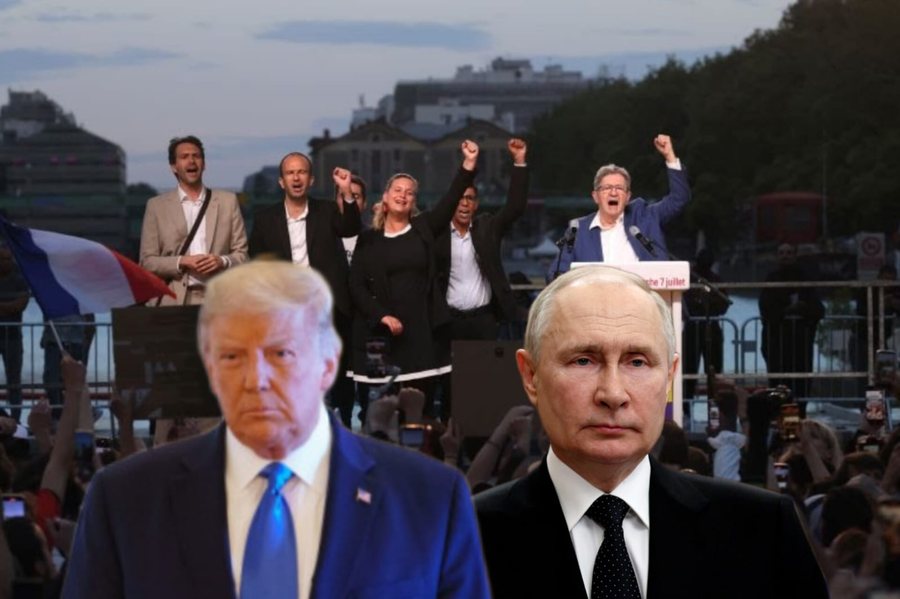
A similar scenario has always been thought of in the United States to block Trump's re-election. It is about insisting on the nightmare of January 6, 2021 to emphasize the subversive, anti-democratic aspects of Trump's character.
The defeat of the Rassemblement National party in France contains signals that go beyond French borders. There is a geopolitical impact that concerns Russia, another may concern America.
For Vladimir Putin it is a loss. For American Democrats who want to prevent Donald Trump from returning to the White House, there is reason for hope after so many headaches caused by Joe Biden.
Elections are almost never played on international issues, the French ones being no exception, so external consequences are only side effects. Marine Le Pen confirmed a few days before the second round that a government of her party would end up supporting Ukraine (a position similar to that of Trump). It would have been a rupture perhaps more symbolic than real, because the Constitution of the Fifth Republic entrusts foreign policy and defense to the president, not the prime minister.
However, a government also has indirect ways of influencing foreign affairs and defence, for example through budget choices. With Sunday's result, France will not have a Russophile government in the Palais Matignon. What could have been a Sunday of celebration for Putin let him down.
Now it remains to be seen what kind of government France will have, because there are also differences between the winners regarding the war in Ukraine. The leader of the radical left (France Insoumise) Mélenchon accepted arms supplies to Ukraine, but sharply criticized Macron's idea of further Franco-European involvement on that front. Mélenchon said sending French troops to Ukraine, even in an advisory and training capacity, would be a "slide" into direct war against Russia. There is also a Russophile current on the left, just as there are members who sympathize with Hamas (Mélenchon has been accused of anti-Semitism several times).
Macron's own future will affect the continuity of French foreign policy. The president comes out of this election partly strengthened, as his risky bet on an early dissolution of the Houses turned out to be smarter than expected. But now the next test awaits, the composition of a government majority. In the most catastrophic scenario, the inability to form a government would force Macron to resign prematurely. Since almost everyone has underestimated Macron's ability in recent weeks, the most pessimistic predictions should be treated with great caution.
The fact remains that this president faces a completely new situation. There were three precedents in which presidents of the Fifth Republic lost their parliamentary majority: François Mitterrand twice (starting in 1986) and Jacques Chirac once (1997). In all those cases, however, there was a clear government majority and therefore there were so-called "cohabitations": between a president of one political color and a government from the opposing side. This time, however, Macron must manage to form a majority made up of some of his supporters, some of the moderate right (former Gaullists who opposed the alliance with Le Pen), some of the pro-European left and moderate (Glucksmann and Hollande but not Mélenchon). It is actually an unprecedented situation. Of course there will be from the extreme right and maybe even the extreme left to boycott this experiment.
For America, the impact of the French vote is very modest. Like any nation, the United States has introverted election campaigns dominated by domestic issues. Political cycles are not synchronized with supranational trends. It is enough to remember that when in 1981 François Mitterrand dragged out his version of the Popular Front, i.e. the social-communist coalition of the Gauche Unie, the political era of neoliberal conservative Ronald Reagan had just begun in America, which then lasted for a decade.
Based on this premise, there is no shortage of left-wing American commentators who want to take relief and encouragement from the French vote. Their argument is this: the negative, fear-based campaign worked. Themes of anti-fascism, campaigns of "resistance" against the dangers of the right, led the French to a record turnout.
A similar scenario has always been thought of in the United States to block Trump's re-election. It is about insisting on the nightmare of January 6, 2021 to emphasize the subversive, anti-democratic aspects of Trump's character. It's about giving maximum visibility to every sentence of the Republican candidate that betrays authoritarian impulses. Eventually, the American electorate will "wake up" to the danger, as the French did. This line of thinking has been present in the United States for four years, and the result in Paris can only be comforting.
There is some reason for skepticism about whether the "anti-fascist" appeal will work in both America and Europe. I list reasons to be careful in dealing with parallels. The United States, like the entire Anglosphere (United Kingdom, Canada, Australia, New Zealand), has never experienced a serious fascist threat; unlike continental Europe, their antibodies have always been effective. The very “coup” dimension of January 6, 2021 has been unilaterally exaggerated: in that case there was no plan to overthrow the institutions (if Trump had, he would have to do much more than hold a rally); the regularity of Biden's election was sanctioned by many Republicans loyal to the establishment, starting with Vice President Mike Pence and Senate leader Mitch McConnell.
Finally, in America, anti-fascism has been shamefully manipulated, including in the word itself, by "antifa" groups that are the local version of social centers: violent, anti-democratic, subversive in their own right. American culture's awakening to its totalitarianism has gone much further in America than its attacks on France. In short, the differences between the two sides of the Atlantic, between Norfolk and La Rochelle, are obvious. The fact remains that the suspension of the National Rally provided a pleasant diversion for the US Democratic Party, after a week of siege on Biden to withdraw from the race. / Adapted "Pamphlet" from "Corriere Della Sera"








Lini një Përgjigje