


 Shkruar nga Pamfleti
Mojtaba Khamenei succeeds his father after Ali Khamenei's death in US-Israeli airstrikes
When millions of Iranians took to the streets in 1979 to end the Shah's rule, their revolution seemed to have finally ended the practice of passing power from father to son. But recent developments suggest otherwise.
Mojtaba Khamenei, the second son of former Supreme Leader Ali Khamenei, has ascended to the position his father held for nearly four decades until his death in US and Israeli airstrikes. He now presides over a weakened system after the 88-member Assembly of Experts did what many Iranians hoped would never happen: transform the Islamic Republic into a dynastic system.
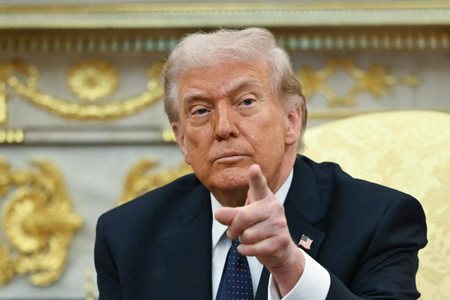
US President Donald Trump said last week that appointing Khamenei as his father's successor would be "unacceptable" to him.
The US-Israeli attack that killed his father also claimed the lives of several other relatives. According to Iranian state media, the attack killed Ayatollah Ali Khamenei's daughter, a nephew, a daughter-in-law and a son-in-law. A few days later, the late leader's wife, Mojtaba's mother, also died from her injuries, state media reported.
Born in 1969, Mojtaba Khamenei received a religious education like his brothers, although he did not reach the rank of mujtahid, a high level of Islamic jurisprudence that many regime supporters consider necessary for the role of supreme leader. He is married to Zahra Haddad Adel, the daughter of former parliament speaker and close Khamenei family ally Gholam Haddad Adel, CNN reports.
For many years, Mojtaba maintained a low public profile. However, behind the scenes he was a central figure in the vast power apparatus set up by his father. He forged close ties with the Islamic Revolutionary Guard Corps (IRGC) and the economic networks that supported the system.
For Iran watchers, his influence was evident even without holding a formal high office. In recent years, while working in his father’s office, he increasingly positioned himself as a potential successor. In 2021, photos circulated on social media showed supporters handing out posters on the streets of Tehran openly promoting him as the next leader.
Many analysts believe that he played an important role in supporting the election of Mahmoud Ahmadinejad as president in the 2005 elections. According to these assessments, he mobilized Revolutionary Guard networks to strengthen the candidacy of Ahmadinejad, then mayor of Tehran, who was facing his more prominent rival Akbar Hashemi Rafsanjani, a political opponent of Khamenei.
In 2009, when millions of Iranians took to the streets to protest Ahmadinejad's re-election, which they saw as rigged, it became clear that Mojtaba was not just the son of the supreme leader, but also a political actor in his own right. The uprising was violently suppressed, marking the beginning of the weakening of any genuine reformist movement within the country.
Protesters in the streets chanted: "Mojtaba, die so you don't take the leadership."
In 2019, the United States imposed sanctions on him. The US Treasury Department accused him of working closely with the commander of the Revolutionary Guard to advance, in its words, his father's "destabilizing regional ambitions and repressive domestic objectives."
Hopes for a more democratic future for Iran may have faded, as Mojtaba’s elevation to the top of the state sends a clear signal about the direction conservative leaders intend for the regime. It suggests that the Revolutionary Guard and its affiliated factions have emerged from the first phase of the current struggle more determined to continue the legacy and policies of Ali Khamenei.
Mojtaba Khamenei does not have extensive administrative experience, having not led any major organizations or institutions. He has made few public statements on the social, economic, cultural, and political challenges facing the country, even before the devastation caused by the war. His political views have been largely shaped in the shadow of his father.
According to Maha Yahya, director of the Beirut-based Carnegie Middle East Center, his selection signals “the continuity of the regime.” In a statement to CNN before his confirmation, she said the appointment could also be seen as a message from the Iranian leadership that military pressure from the US and Israel “will not force us to change our stance.” /Pamphlet/


Lini një Përgjigje